
A weekend with Dometic’s DG3 gyro stabilizer
Many people spend halloween trick or treating or at parties. Not me, I travelled, along with several other marine journalists, to the Florida Keys to spend a weekend aboard two boats equipped with Dometic’s DG3 gyroscopic stabilizer. The time onboard provided ample opportunity to experience the impact the DG3 makes on the rolling action of the vessel. Plus, Dometic provided one relatively common hull, a 37-foot center console, and a far less typical hull, a 35-foot, aluminum, power catamaran. With two full days on the water, I got the full experience of what the DG3 can do and how it goes about doing it. Read on for a full report and my thoughts on the DG3 compared to Seakeeper’s gyros.
The competitive landscape
I don’t think it’s possible to talk about the DG3 without comparing it to Seakeeper’s gyros. I wrote up the DG3 based on what I learned at this year’s Miami Boat Show where Dometic announced the gyro. That article breaks down a number of the differences between the DG3 and a Seakeeper 3, the comparably sized unit from Seakeeper. Comparing these gyros, there are a tremendous number of similarities. Fundamentally, both units spin a large flywheel in a near vacuum. That flywheel is mounted in a roughly spherical enclosure that rotates or precesses on a gimbal. Rolling of the boat causes the gyro to precess fore and aft. The gyro’s precession imparts stabilizing force on the hull. Both the DG3 and all of Seakeeper’s gyros use heat exchangers to cool the bearings and motors via seawater. The biggest differences between the two gyros include:
- The DG3 uses an electric actuator rather than a hydraulic brake. The electric actuator allows Dometic to actively move — or precess — the sphere of the gyro rather than simply retard or brake the movement. Dometic employs active precession whereas Seakeeper uses passive precession
- Reduced maintenance through no hydraulics or sacrificial anodes
- Dometic’s flywheel spins at a significantly lower speed — 4,700 RPMs vs 8,450 RPMs
- Both the DG3 and the Seakeeper 3 are DC powered. However, the DG3 accepts 12, 24, or 48 volt DC inputs whereas the Seakeeper 3 is 12 volt DC only
- The DG3 uses a dedicated 48-volt battery to spin up the gyro. In turn, when spinning down the flywheel, the motor is used to recover spin-up energy
- Once the gyro is spun up, the gyro draws power from the boat’s house system and partially recharges the spin-up battery
Let’s take a look at the DG3 and Seakeeper’s gyros side-by-side. I’ve included the Seakeeper 4 in the comparison due to its comparable size and close in cost to the DG3.
| Dometic DG3 | Seakeeper 3 | Seakeeper 4 | |
| Price (MSRP) | $43,999 | $39,300 | $46,200 |
| Angular Momentum at Max RPM | 3,000 N-M-S | 3,000 N-M-S | 4,000 N-M-S |
| Vessel size rating | 35-41 feet | 35-41 feet | 38-44 feet |
| Spool up time to Stabilization | 9.5 minutes | 29 minutes | 34 minutes |
| Spool up time to rated RPM | 16.5 minutes | 50 minutes | 60 minutes |
| Spool up power | Not provided – comes from spin up battery | 900 watts / 12v @ 75 amps max | 1,050 watts / 12v @ 88 amps max |
| Operating power | 260-750 watts / 22-63 amps @ 12v | 400-900 watts / 33-75 amps @ 12v | 550-1,050 watts / 46-88 amps @ 12v |
| Seawater supply requirements | 2 GPM minimum / 6 GPM maximum | 2 GPM minimum / 6 GPM maximum | 2.5 GPM minimum / 4 GPM maximum |
| Noise output | < 72 dB @ 1 meter | < 72 dB @ 1 meter | < 72 dB @ 1 meter |
| Operating temperature | 32F-140F / 0-60C | 32F-140F / 0-60C | 32F-140F / 0-60C |
| Weight | 580 lbs (263.04 kg) | 550 lbs (249 kg) | 746 lbs (338 kg) |
| Size | 27.1 L x 27.2 W x 23 H (inches) 0.688 L x 0.690 W x 0.584 H (meters) * Not including 48v spin-up/spin-down battery | 26.8 L x 27.0 W x 23.1 H (inches) 0.680 L x 0.688 W x 0.587 H (meters) | 25.56 L x 28.05 W x 20.98 H (inches) 0.675 L x 0.713 H x 0.533 H (meters) |
| Warranty | 3-year or 3,000 hours | 2 years or 2,000 hours | 2 years or 2,000 hours |
As the table above shows, on paper these are very similar units. In the comparison chart, there are three things that jump out at me. First, the DG3 is both faster to spool and uses less power once spooled up. Second, on a dollars per newton meters per second of stabilizing force, the Seakeeper 4 is a bargain. At $43,999 and 3,000 Newton meters per second, the DG3 costs $14.66 per Newton meter per second. The Seakeeper 3 comes in at $13.10 per N-M-S and the 4 is just $11.55 per N-M-S. I don’t know that anyone has ever compared gyros based on the cost per Newton meter per second, but it’s the easiest way for me to break it down.
My take on the differences
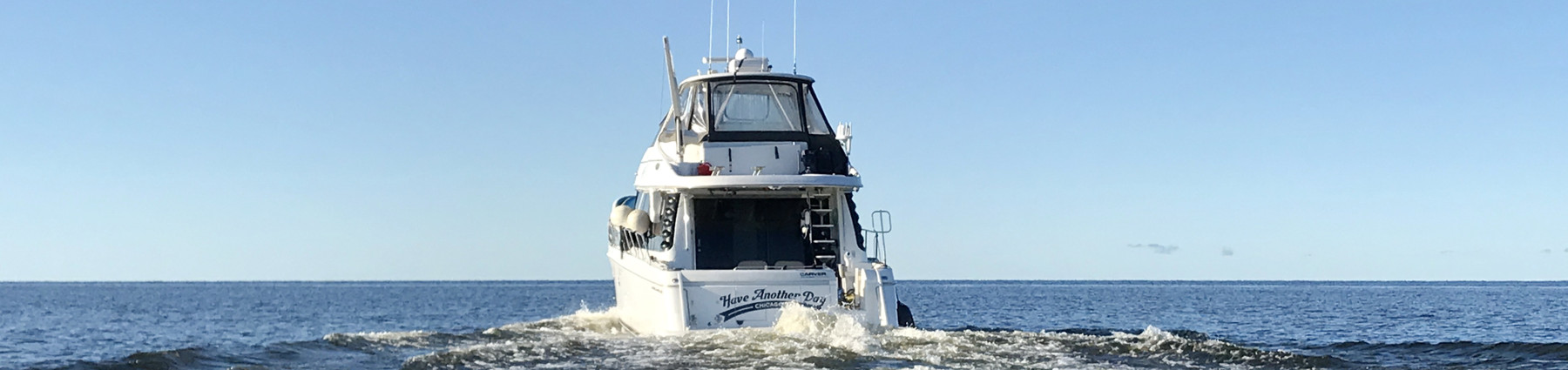
I have a lot of experience with Seakeeper’s gyros. Back in 2015, before I entered the marine industry, I purchased and had a Seakeeper 9 installed on Have Another Day, my Carver Voyager 570. I owned that boat for 7 years with the Gyro installed and cruised for 10s of thousands of miles with it. Subsequently, I had a Seakeeper 1 installed on the previous Panbo(at), a 22-foot Cobia 220CC. So, although I don’t have extensive first hand experience with the Seakeeper models that directly compare to the DG3, I am familiar with the product line overall. That familiarity helps me compare my Seakeeper experiences with those I had aboard Dometic’s boats in the Keys.
Active precession
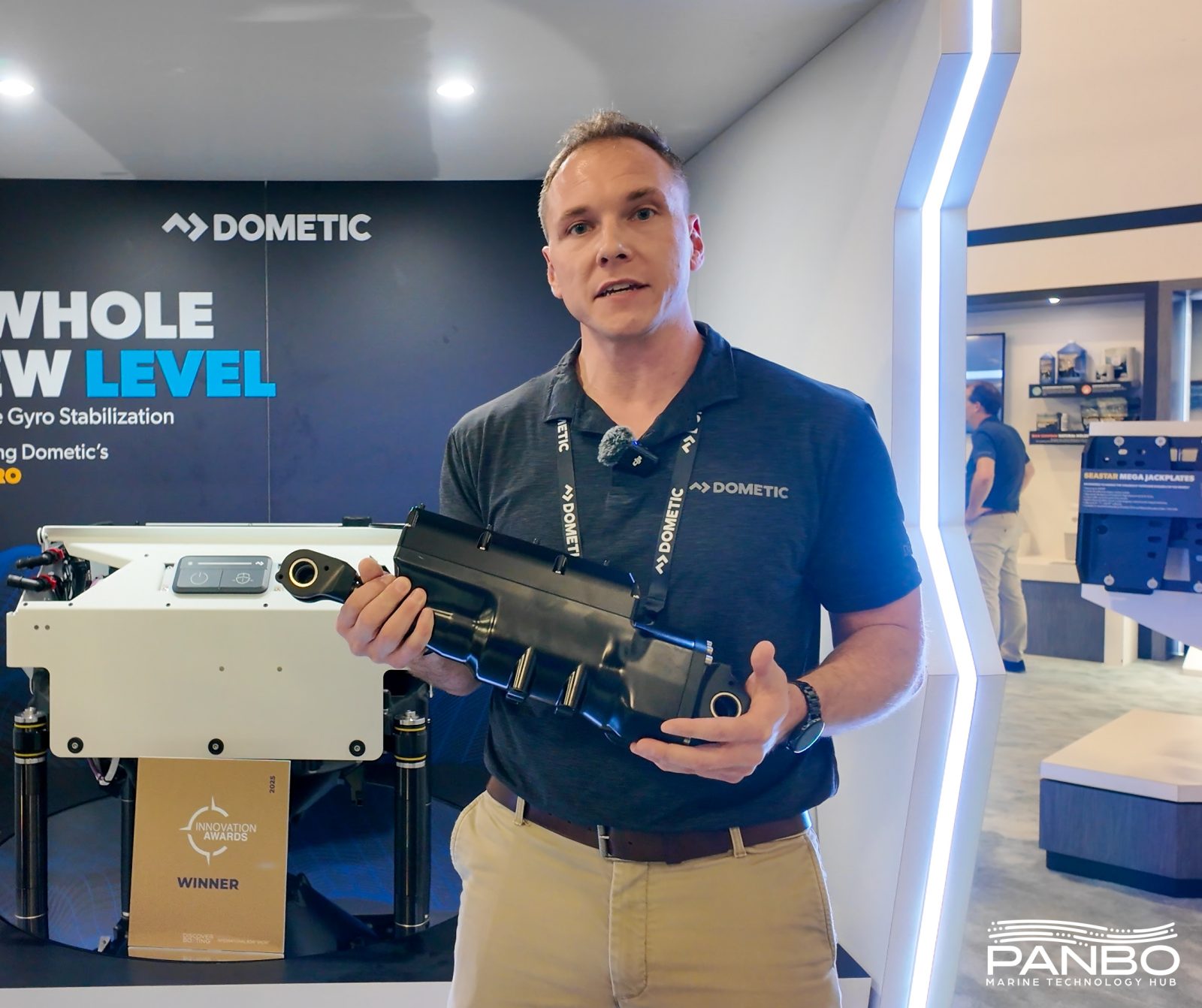
As mentioned earlier, Dometic uses an electric actuator rather than a hydraulic brake to control the precession of the gyro. The actuator gives Dometic the ability to actively control the movement of the sphere, not just slow it. To demonstrate this, during demonstrations, Dometic uses the actuator to force the sphere precession forward and aft. That precession rocks the boat from side to side. It’s sort of the opposite of Seakeeper’s demonstration where they manually rock a boat back and forth with the gyro locked and then unlock it, stopping all rocking.
Demonstrations aside, Dometic says one main advantage of active precession is the ability to respond to more sea states. The main example given is relatively calm water in which the movements of the boat might not be large enough to provide the force required to start the sphere precessing. In my time on the water with Seakeeper gyros, I have never found the small movements of the boat problematic or even really noticeable. I’m sure some motion goes uncorrected by passive precession, but I haven’t noticed it.
Dometic also points out they can use their ability to move the sphere to ensure there is some precession left for the next wave. I’ll try to describe this, while also acknowledging that we’re getting deep into the secret sauce of both companies, their control algorithms. Dipping into the control algorithms means that neither company will tell me exactly what they do. Those algorithms are proprietary and account for a lot of the efficacy of their products.
Gyros are most effective between positive and negative 70-degrees of precession. Once a gyro gets to 90 degrees, it stops generating stabilizing force. So, both companies use their electronic control unit to control precession and preserve some stabilizing force. I know from experience that Seakeeper uses their brakes to stop the gyro before it has precessed to a hard stop. Dometic uses the electric actuator to perform the same function. But, they also hint that they can move the sphere back towards 0 degrees, to create more precession. I don’t know exactly when that might occur, but I imagine there are times in the boat’s natural movement when the sphere could be slowly rolled.
Spin-up time
Dometic is rightfully very proud of their greatly reduced spin-up time. I have a roughly ten to fifteen minute run from where I store Panboat to open water. At 9.5 minutes to spool up, the gyro would be up to speed by the time I reached open water. Seakeeper’s roughly 30 minute spin up time requires a little more planning. In the time I’ve run Seakeeper equipped boats, I remember several occasions where I misjudged conditions and paid the price. Thinking it would be calm, I didn’t spool up the gyro, by the time I realized conditions didn’t match expectations, I had quite a bit of time to wait before the gyro would unlock and stabilize. Dometic’s spin-up speed advantage strikes me as meaningful.
Spin-down time
In conversations with Dometic, they regularly herald their reduced spin-down of 16.5 minutes compared to half a dozen or more hours for Seakeeper. Having owned two Seakeepers, I fail to see the advantage. Frankly, I’ve never cared one whit about how long it takes the gyro to spin down. Neither Seakeeper nor Dometic need external power to manage cooling while the gyro spins down. So, outside of barely perceptible sound made by the spinning flywheel, there’s no difference at all to the boat owner if the gyro is still spinning. On the other hand, Dometic converts the energy stored in the spinning flywheel into electricity to recharge the spin-up battery. I see that as highly useful and will discuss that in a moment.
Spin-up / spin-down battery
Dometic includes a 48-volt, lithium iron phosphate (LiFePO4) battery with each DG3 to provide energy to the DG3 to spin up the flywheel and to provide a destination for the energy captured from the flywheel during spin-down. This battery isn’t used during operation of the gyro after the gyro has spun up, but it is charged to a preset level from the house batteries. The battery isn’t fully charged so there is storage capacity to capture the spin-down energy. House power can come from 12, 24, or 48 volt nominal systems providing flexibility and removing the need for any external voltage conversion.
Installing the Seakeeper 1 on Panbo(at) was complicated by the boat’s single Yamaha 150 horsepower engine and its limited electrical output. Admittedly, that 22-foot boat was a foot under Seakeeper’s recommended minimum size, but just a foot. On that boat, running the Gyro once spun up wasn’t a problem, the engine’s output kept up with the gyro’s energy demands. But, spinning up the gyro puts a dent in the battery since the startup demands are larger than the engine can produce. I’ve heard suggestions of spooling up on shore power, but the rack storage facility I use doesn’t have many shore power outlets and that isn’t always practical. So, the idea of spinning up from a dedicated battery and collecting a large percentage of the spin-up energy at spin down strikes me as a significant step forward.
Reduced maintenance
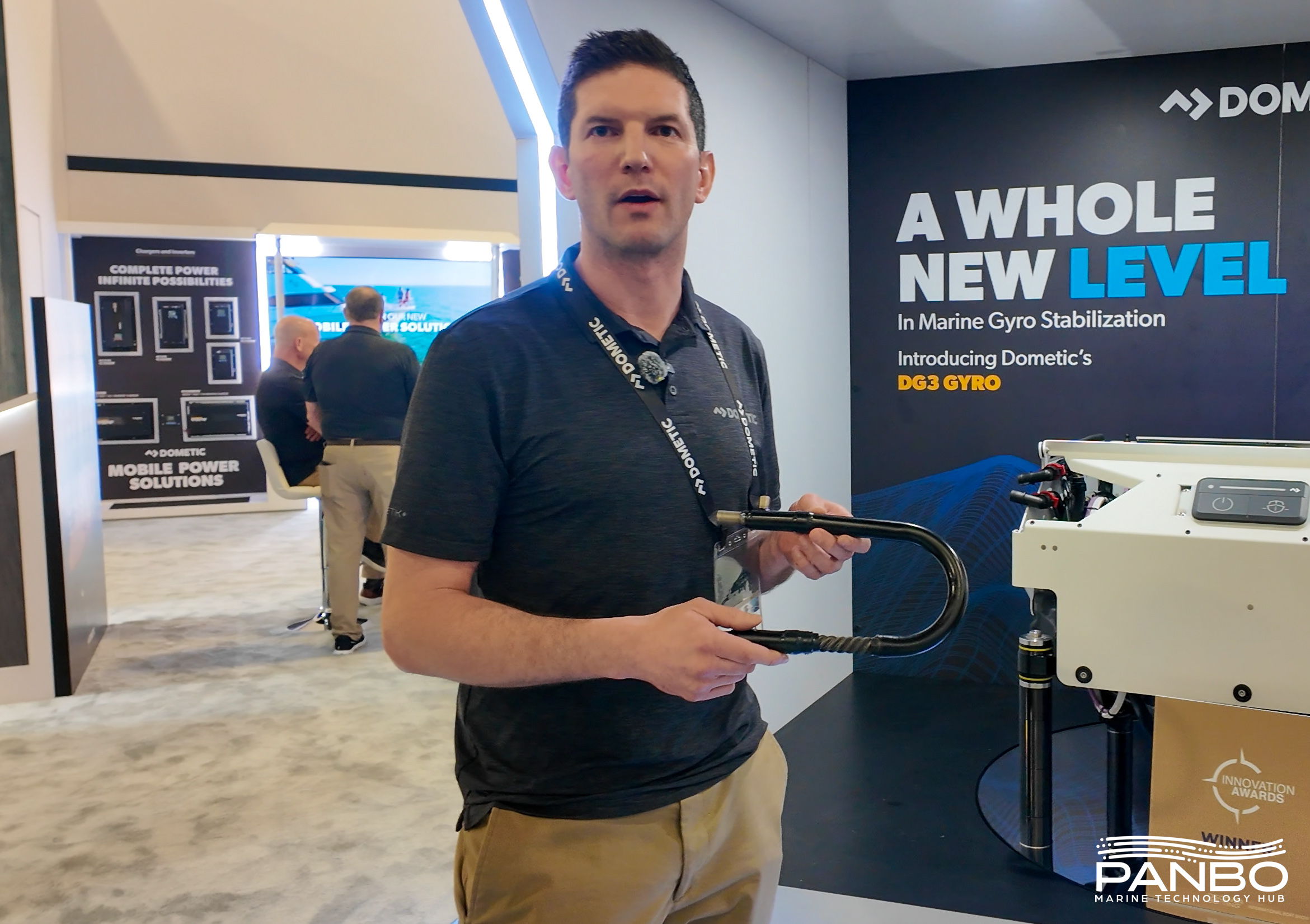
Although I’m still working to understand all the potential benefits of active precession, it doesn’t take long to understand the potential benefits of an electric actuator in lieu of hydraulic brakes. Put simply, the benefit to my mind is maintenance. The selection of an electric actuator could raise questions about durability and reliability. But, Dometic is using the same actuator design — and I believe many of the same components — as they use for their all electric steering systems. The Dometic all electric system I installed on the Cobia 220CC has stood up to nearly 1,000 hours of use without skipping a beat.
By using an electric actuator and titanium heat exchange, Dometic has eliminated both the need for brake service and anode replacements. By eliminating both, they’ve addressed the two biggest routine maintenance tasks associated with a gyro.
Time on the water
Day 1 – Dry Tortugas
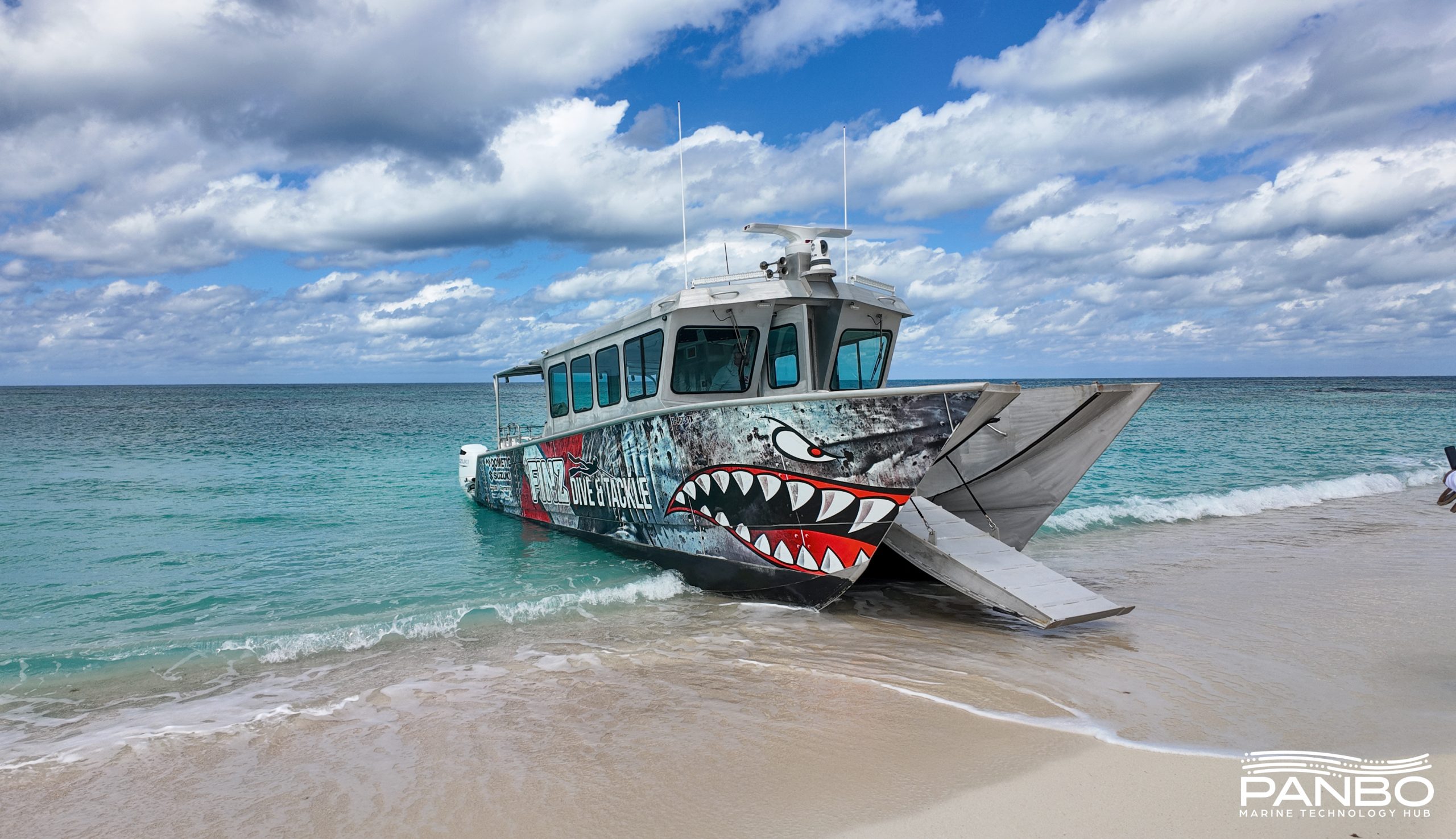
Dometic put together quite a weekend to experience the DG3. The small group of journalists split into two groups. The first day my group headed out to the Dry Tortugas national park aboard Finz Dive Center’s Park Shark, a custom built, 35-foot, aluminum power catamaran captained by Robert Trosset III. On Day two, Robert’s brother Chris captained the boat. Their father, Robert Trosset II is a legend among fishing guides with 239 IGFA world records to his name. Equipped with four Suzuki 300 horsepower outboards, a DG3 stabilizer, 12-volt air conditioning, multiple fridges, and comfortable seats in an enclosed cabin, we had a lovely ride out to the park in a mix of 1-2 foot chop followed by some larger seas.
Once at the park, we explored the fort for a bit before heading out to grab a mooring ball at the wreck of the Windjammer. Time spent on the mooring provided a good demonstration of the DG3’s ability to stabilize the Park Shark. With the gyro locked, we routinely saw rolls of 8-9 degrees with occasional rolls beyond that. With the gyro unlocked and stabilizing, the maximum I saw was 1.6 degrees. During stabilization with the gyro unlocked, there is a noticeable amount of noise from the actuator’s movements. It’s similar to what I’ve heard coming from the steering actuator at low speed. I wouldn’t call it bothersome, but it’s more noise than I’ve ever heard from a Seakeeper gyro and its hydraulic brake system.
There’s an obvious question at this point: how does the DG3’s performance compare to a Seakeeper? Unfortunately, my answer is highly subjective and probably not overly detailed. I’d say the DG3 performs well as does an appropriately sized Seakeeper. In fact, based on the conditions I experienced, if blindfolded I’d say the only way to distinguish between the performance of the two gyros would be the sound of the actuator on the DG3.
In my time with Seakeepers, I’ve found the biggest test for the gyro typically comes from low speed running in large swells. The attendant long duration movements can both run the gyro out of precession travel and reduce the RPMs of the flywheel as rotational momentum is turned into angular momentum. I only experienced those a few times on Have Another Day with the Seakeeper 9. Have Another Day, a large motor yacht with a higher center of gravity came in towards the top of the length and displacement ratings of the 9.
In contrast, the Seakeeper 1 on Panbo(at) is rated for significantly more length and displacement than the Cobia 220 presents. Park Shark comes in towards the top of the DG3’s ratings. So, especially paired with the fact the boat is a catamaran, I expect that larger sea conditions at lower speeds might make the gyro work pretty hard. Unfortunately, our time running the boat didn’t include the conditions I’m describing.
Day 2 – Fishing
Day 2 in the keys saw my group fishing on Dometic’s 37-foot Sea Hunter center console. The more traditional Seahunter hull likely challenges the DG3 less than the Park Shark. Captain Chris Trosset first brought the boat out of the Ocean’s Edge Resort’s marina towards the flats to catch bait. While catching bait, Dometic’s Joey Greenwell talked us through some of the unique aspects of the DG3’s design.

With bait collected, we made our way about ten miles offshore and did some fishing. The fishing was hit and miss so we found ourselves moving around a few times. The DG3 provided a stable platform from which to fish. Watching the gyro’s performance, it seemed clear there was ample stabilizing ability for the 1-3 foot sea states and the 37-foot boat. Similar to my earlier observations, I don’t think that based on the boat’s performance I could tell the difference between a Seakeeper stabilized boat and one stabilized by the DG3. That’s a good thing, Seakeeper sets an awfully high bar and I think Dometic is right there with them.
Also similar to on the Park Shark, the sound of the precession actuator was pretty noticeable on the boat. The gyro is in a heavily modified leaning post that isn’t doing a lot to dampen noise. Additionally, the gyro on this boat was an early engineering sample, but I think there is an opportunity for Dometic to quiet that aspect.
Several times during the day, the boat lost house power. The issue shutting down the house power isn’t particularly important. Our boat is part of Dometic’s test fleet and I am keenly aware of what a tough life test boats live and the likelihood that the last change may have some unintended consequences.
The power interruptions brought all of our electronics down and took the DG3 offline. That made for an interesting and effective comparison between time on the water with the stabilizer stabilizing and time without it. Suffice it to say, the time without the DG3 proved it was working nicely. But, those resets also demonstrated a quirk of the DG3. If the gyro loses power while operating, it must spin all the way down and then spin back up. If I understand correctly — and that’s not a given — that requirement is based on calibrating position sensors for gyro precession. Regardless of the reason, I hope Dometic will take a look at that behavior and see if it can be avoided. With both AC and DC powered gyros, I have definitely experienced power interruptions and would hate to have to bring the gyro all the way down.
Final thoughts
Dometic’s DG3 is the biggest competitor Seakeeper has encountered in the market to date. My time on the water demonstrated that the DG3 is a worthy competitor with some nice advances. However, I’m also a little cautious in proclaiming a victor. I like a lot of the power management work Dometic has done with greater efficiency and collecting energy from the flywheel during spin down. But, I’m also aware that Seakeeper has spent more than 15 years refining and perfecting their control algorithms. So, without having the opportunity to head out and explore every corner case, it’s tough to proclaim a winner. I expect we will start seeing DG3s show up on more new boats. Those boats will provide real world data to better understand all the facets of the DG3’s operations. In the meantime, I’m excited to see how Seakeeper responds.


Recent Panbo Comments