

Never miss a word on the water with Garmin Signal VHF marine radios
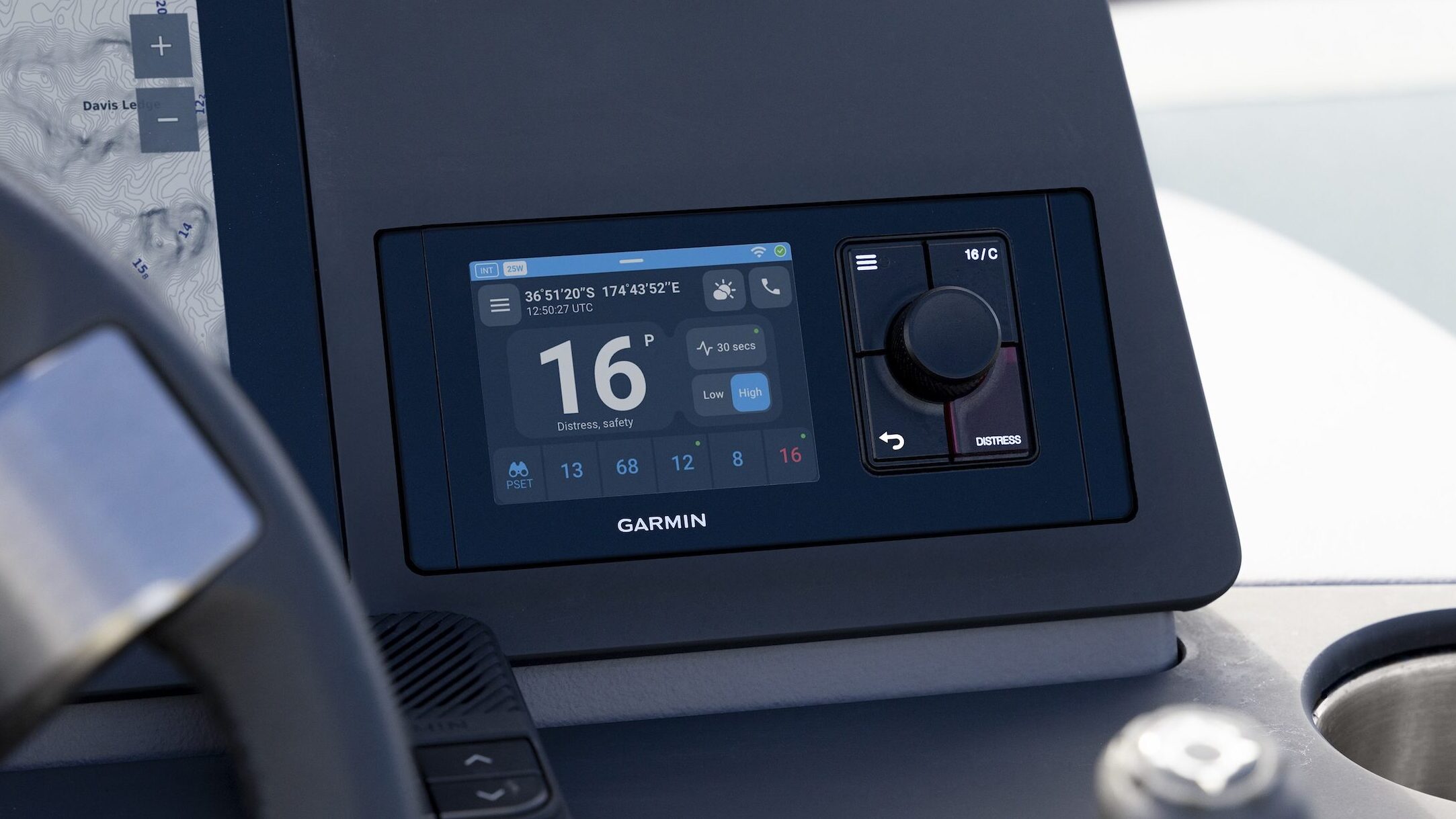
Modern compact VHF radios bring built-in AIS, advanced noise cancellation and cutting-edge 3.5-inch color touchscreens
OLATHE, Kan. – Garmin, the world’s largest marine electronics manufacturer, today announced the Garmin Signal VHF 400 and VHF 220 all-in-one marine radios designed to help boaters stay connected and aware of their surroundings on the water. Boasting a revolutionary sleek design, the Garmin Signal VHF radios take up minimal space at the helm and feature an industry-first 3.5-inch color touchscreen with edge-to-edge glass. The premium Garmin Signal VHF 400 enhances situational awareness by offering an integrated Class B AIS (Automatic Identification System) transponder, which transmits vessel name, position, course and speed to nearby AIS-equipped vessels.
“When performance and reliability are of utmost importance, the new Garmin Signal VHF radios provide mariners with peace of mind on the water. With a compact, yet modern design, the all-in-one radios offer advanced software features to enable reliable offshore communication when boaters need it most.” –Susan Lyman, Garmin Vice President of Global Consumer Sales & Marketing
World class performance
Leveraging Garmin’s most forward-thinking radio technology into one of the world’s smallest all-in-one marine radios, the Garmin Signal VHF series provides reliability on the water:
- Communicate clearly: Remove unnecessary radio noise with automated squelch and adaptive noise cancellation, which automatically works to tune out background noise, for superior VHF audio clarity when transmitting or receiving voice communication.
- VHF playback: Automatically record up to three minutes of audio transmission from any active channel. The radio can record three different channels simultaneously. Advanced watch modes also allow captains to listen to six channels at the same time for VHF activity.
- Boat-to-boat calling: Transmit a distress signal to nearby vessels with the distress button which uses Class D DSC (Digital Selective Calling) to automatically send crucial information that can help emergency responders. Effortlessly make a DSC call to nearby vessels from the AIS plotter screen.
- Fist mic: Hear audio over engine, wave and wind noise with the included fist mic that features a loud built-in speaker (95 dBA at 0.5 meters), adaptive background noise cancellation and can be mounted in an optimal position, even away from the head unit.
- Simple installation: With the Garmin Signal VHF 400, transmitand receive VHF/DSC/AIS communication from a single VHF antenna. Includes integrated GPS antenna/receiver, built-in advanced diagnostics tools and support for 12 and 24 V electrical systems.
Radio control away from the helm
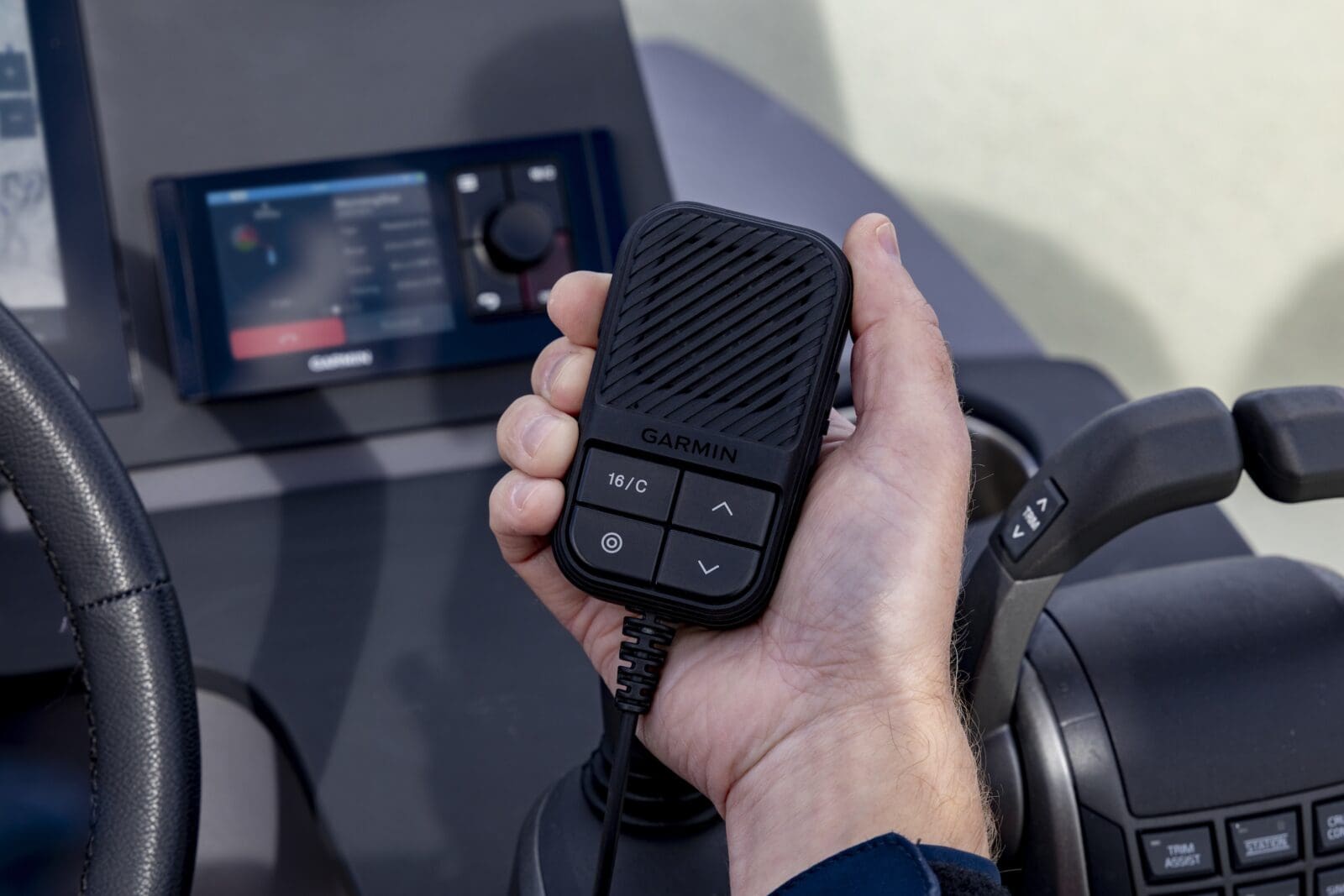
Control a Garmin Signal VHF 400 or VHF 220 with the new Garmin Signal RM 100 remote station. The premium fixed-mount head unit allows mariners to connect via the Garmin Marine Network and control radio functions from a secondary helm or flybridge. The intercom feature enables communication between remote station and networked head units. Boasting a modern, edge-to-edge glass design and 3.5-inch color display, this remote station includes a fist mic to match the look of Garmin Signal VHF marine radios and compliments the helm on any vessel.
Superior system integration and connectivity
The Garmin Signal VHF radios integrate seamlessly with Garmin chartplotters via the NMEA 2000 network, Garmin Marine Network 1.0 and Garmin BlueNet. They also support connection to a compatible loudhailer for onboard announcements, an external speaker connection for VHF audio at a second location and NMEA 2000 for AIS, DSC, GPS and external heading sensor data.
Captains can configure the radio, program the MMSI (Maritime Mobile Service Identity) number and get over-the-air software updates with the ActiveCaptain smartphone app with built-in Wi-Fi connectivity.
The Garmin Signal VHF 220 marine radio has a suggested retail price of $999.99, while the Garmin Signal RM 100 has a suggested retail price of $699.99. Both devices will be available for purchase on Garmin.com beginning June 1, 2026. The Garmin Signal VHF 400 has a suggested retail price of $1,499.99 and will be available on a later date. To learn more, visit garmin.com/marine.
Panbo publishes select press releases as a service to readers and the marine electronics industry. The release contents do not reflect the opinion of the editors and are not fact checked by the editors


It would be great if all radio manufacturers included AIS into their builds so that more and more vessels would be identifiable and be able to discern speed and heading and size of vessel. In writing this out I realize that if that were to occur the screens might get way too cluttered, much like a marina with many vessels all transmitting AIS info forming a giant cluster of tangled green triangles. I don’t really know what the answer is. Perhaps somehow having some sort of geofencing where AIS is active. I don’t need AIS inside a marina’s boundaries but I sure appreciate it when underway in the ICW or Norfolk harbor. Just my $0.02 worth of shower thoughts.
I am a touch confused. This looks like a standard VHF/AIS combo unit. They’ve been around a while, and are a solid answer for AIS (especially if you already want to upgrade your VHF). I read the blurb, and don’t see what makes this notably better (sure, a color display, but fundamentally the same as say a B&G V60B — which appears to be a few hundred less expensive).
Harry,
This is Garmin’s press release announcing Signal. I’d encourage you to take a look at my piece detailing some of the bloodline between Signal and Vesper’s Cortex (https://panbo.com/garmin-announces-signal-vhf-radios-vespers-dna-lives-on/). If you’re really curious, take a look through some of our coverage of Cortex when it was launched. The differences between Cortex — and by extension now Signal — and other combination VHF Voice and AIS units is in the radio technology employed and the level of integration. I don’t believe that any of the other combination units are actually one radio. Every one that I’m aware of — and definitely the B&G V60B — are effectively two radios in one case. Cortex and now Signal use a single, software defined, radio to handle all VHF communications, both voice and AIS. That simplifies the antenna needs while also increasing the capability of the radio. The SDR in these radios is capable of receiving on all frequencies at once. That enhances the scanning capabilities to a point I haven’t seen from any other radio.
For individual applications, the additional capabilities may or may not be worthwhile, but Signal at a few hundred dollars more than a V60B looks like a bargain to me. The color display, NMEA 2000 to WiFi bridging, audio playback, advanced scanning, and other capabilities bridge that gap for me.
-Ben S.