

Safiery Solid State battery – testing begins
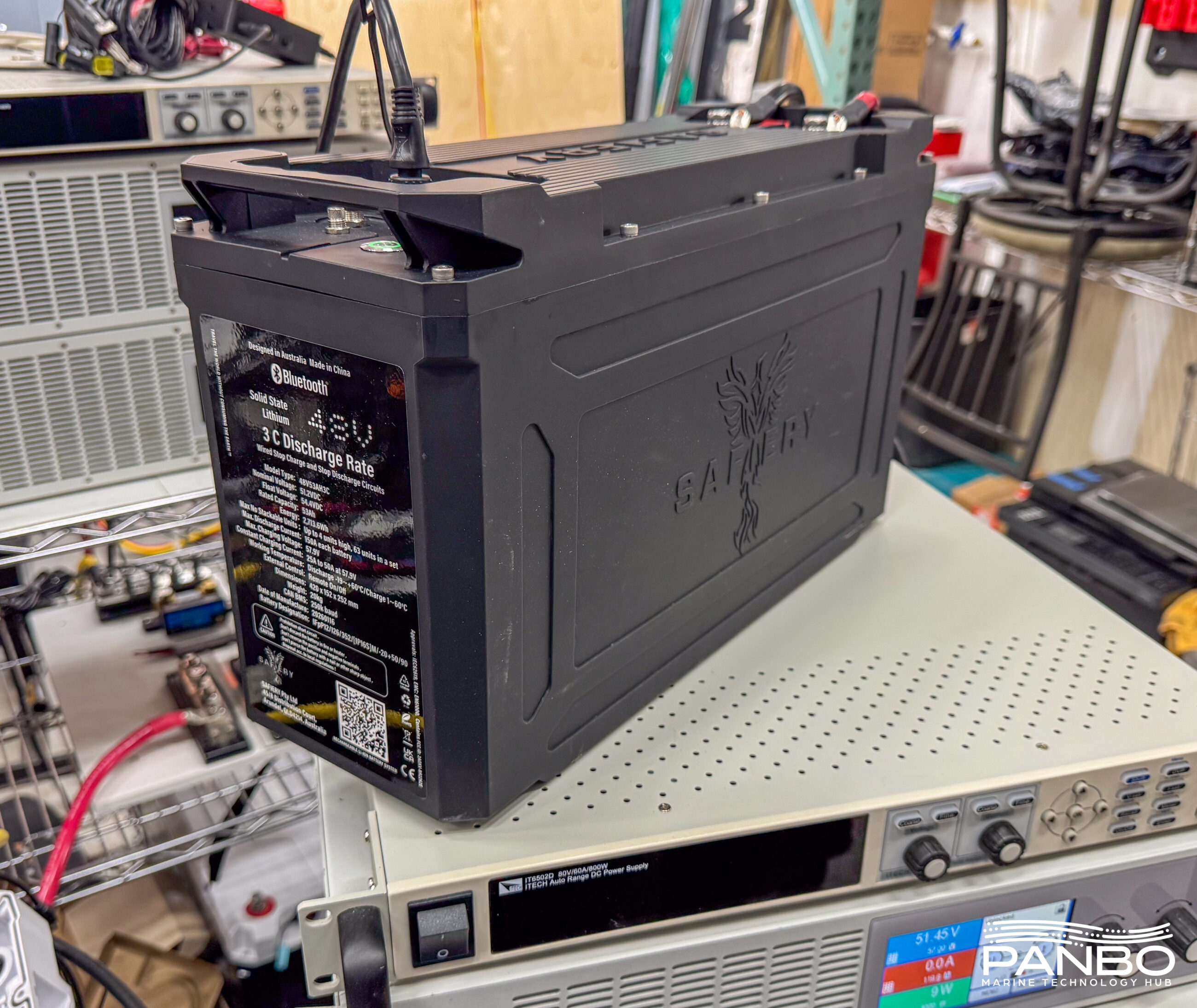
Over the last few months, I’ve been hearing some rumbling about Safiery’s new solid state batteries and the sublime specs they offer. So, it was a bit of good fortune when I ran into Bruce Loxton, the man behind Safiery’s impressive mix of products, at the Palm Beach International Boat Show. A short conversation with Bruce left me excited about what the batteries offer and his promise to send me a battery got my wheels spinning. How would I test this battery and just what is it capable of delivering?
Fast forward about two months and I have a 48-volt, 53 amp-hour, 2.79 kilowatt-hour solid state battery in my hot little hands. Hot might be appropriate when you look at some of the data coming out of the battery during my testing. This battery is capable of some pretty sublime rates of power delivery and acceptance. Large amounts of energy in motion builds heat and my early testing demonstrates that.
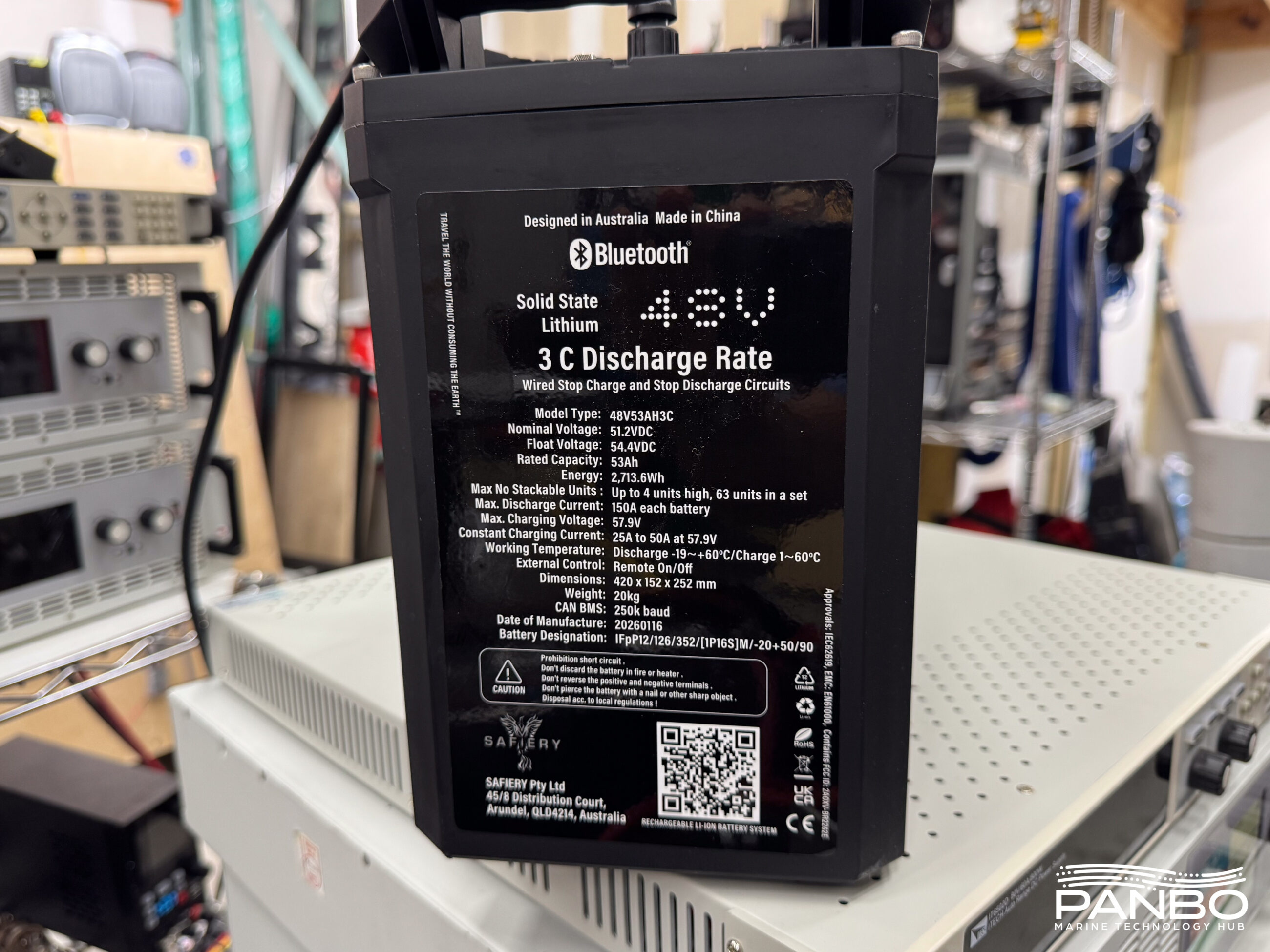
If you test batteries, Safiery’s specs feel like an invitation to do silly things to the battery. Right there at the top, in big bold letters, Safiery advertises a 3C discharge rate or 150 amps for this battery. Although the battery is rated for 53 amp hours, nearly all of the specs correspond to a rounded off 50 amp-hour capacity. For example, the 3C discharge rate of 150 is correct if the capacity is 50 amp-hours. Additionally, the 50 amp maximum charge rate is 1C at 50 amp hours.
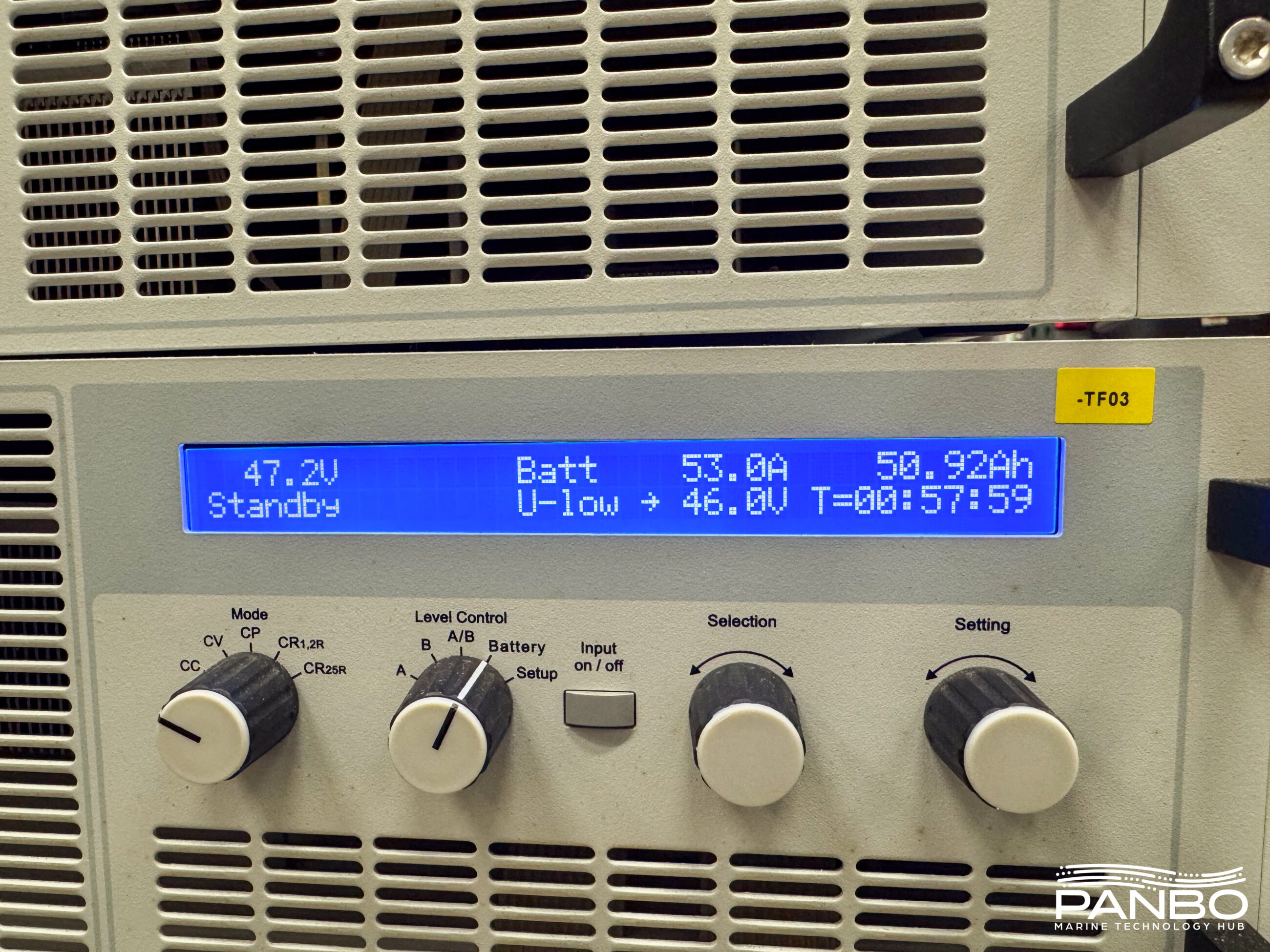
I have done a few capacity tests so far. As is the norm for me, I’ve ended those early tests at higher voltages. I like to understand how the battery operates and verify that all the low voltage protections are working performing a deeper discharge. So, this test ended at 46v or 2.875 volts-per-cell. That’s higher than the generally recognized termination point of 2.625 or even 2.5 volts-per-cell. At any rate, my first test ending at 46 volts yielded a capacity of 50.92 amp-hours.
I highly doubt there is an additional 2 plus amp hours of energy between 46 and 42 volts. Typically, with the sharp knee at the end of discharge, there is little energy to be found past the knee. The blue line in the chart above depicts voltage dropping during the discharge test in question. Around 3:06pm, voltage drops rapidly and accelerates until the session terminates because of low voltage.
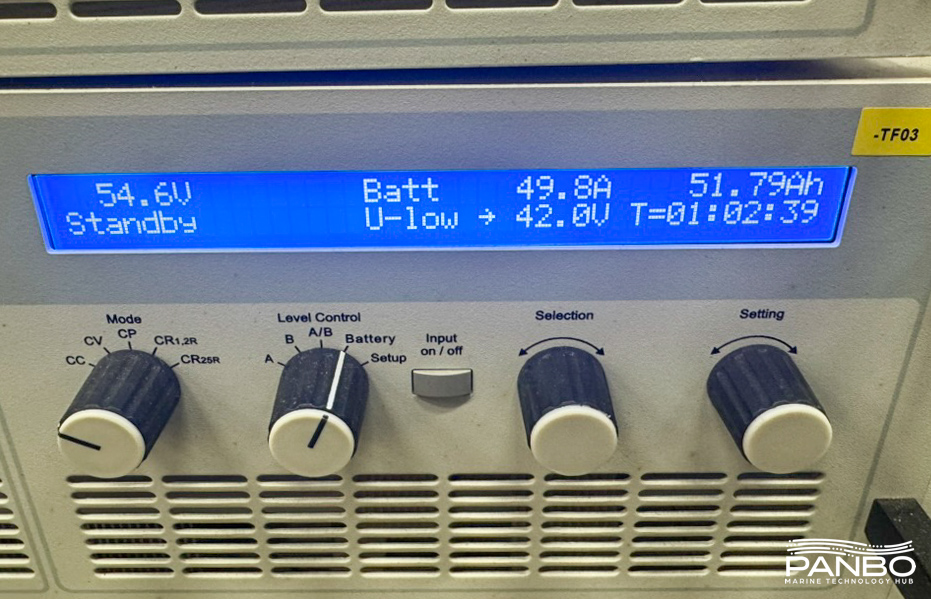
My next capacity test, conducted at 50 amps, yielded a slightly higher 51.79 amp hours. That’s still a hair below the rating on the battery. I have more testing to do, but these early test results cause me to wonder if perhaps the battery is built with 50 amp-hour cells and the 53 amp-hour rating represents a best case scenario number. However, to be fair, I am only speculating. Time and a tear-down of the battery should yield more information.
Battery specs detail a maximum cell temperature of 65°C during both charging and discharging. A 1C round trip pushed the battery to 56°C. I have performed a few 3C discharges and found that the cells get very warm. Currently, I’m waiting for the battery to cool enough to do a full discharge and charge test. Previous tests have shown that charging at 1C can’t complete after a 3C discharge without allowing the cells to cool.
The full range
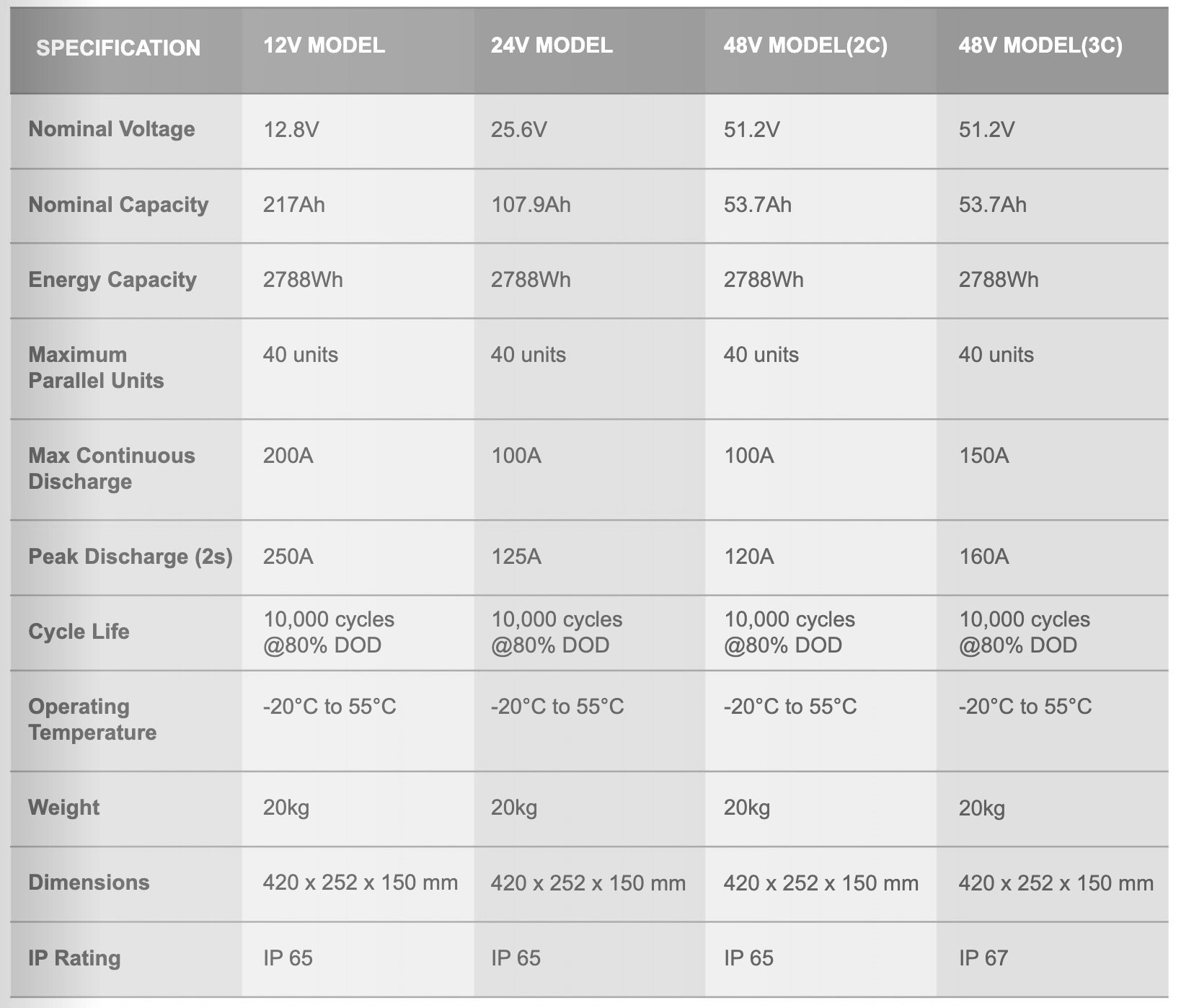
Safiery offers a total of five solid state batteries. All are rated at 2,788 watt hours, and are available in 12, 24, and 48 volts. I haven’t found anything in the specs that clearly states the actual construction of the cells. But, I suspect these are semi-solid state, meaning there is a small amount of liquid or gel in the electrolyte. There are three 48-volt models — although the chart above shows 2 — with discharge rates of 50, 100, and 150 amps or 1, 2, and 3C. The 12 and 24-volt models both carry 1C discharge ratings. Pricing, in U.S. Dollars is as follows: 12v, 217ah – $1,522.73, 24v, 108ah – $1,522.09, 48v, 53ah, 1C – $1,437.93, 48v, 53ah, 2C – $1,641.82, and finally the 48-volt 3C battery sells for $1,710.55 U.S. dollars.
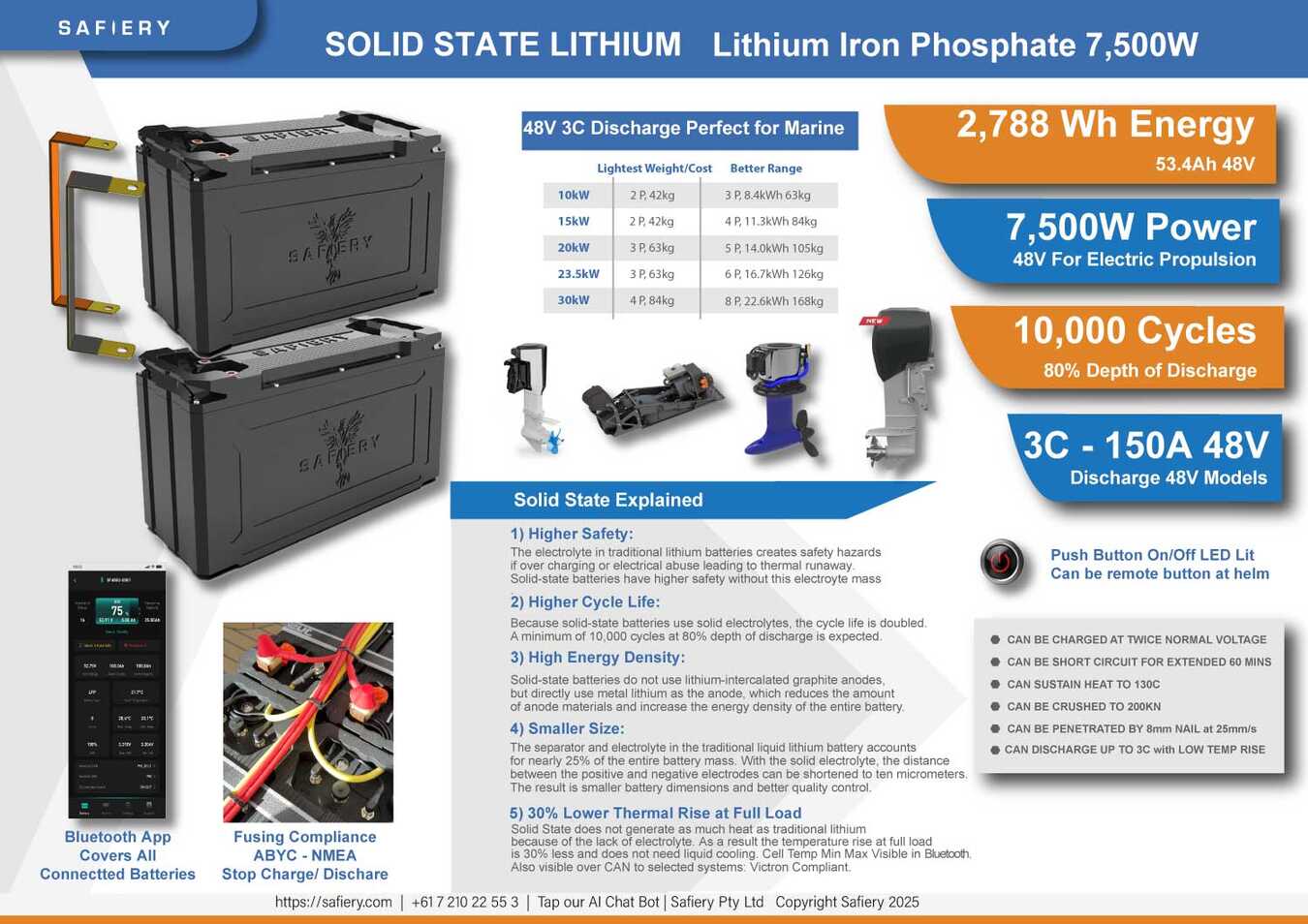
I have plenty to discover about these batteries still. However, based on what I understand and have read so far, Safiery’s batteries differ from the other marine focused player, Solid State Marine. Safiery’s batteries utilize a semi-solid state variety of lithium-iron-phosphate cells. My understanding of Solid State Marine is that their batteries utilize a semi or quasi solid state varient of nickel manganese cobalt oxide (NMC) cells. Solid State Marine’s cells produce higher voltages than LFP. The result is that the 12v version of a Solid State Marine battery sits at potentially troublesome voltages. The Safiery batteries don’t have that challenge.
More testing to come
I plan to continue to work these batteries hard and push the limits of just what they can deliver. The claimed advances in safety alone may be enough to justify the cost premium compared to existing LFP options. Plus, if your power requirements demand the huge power output these batteries can generate, these may enable fewer batteries and a more efficient system.
I’m also looking forward to tearing into the batteries and seeing how it’s all put together. But, in the meantime, Safiery has published a video highlighting some of components and construction methods employed. I’ll be back soon with my own tear-down and much more in-depth testing.



As an Aussie company I have had a few years with safiery . I’ve done a few boats now with these very batteries and others of theirs as well as their Scotty system. I give credit in alot of places. We have had teething issues with all of the products …and more often than not limped over the finish line each time. Early series of the solid states didn’t have Bluetooth which annoyed me. But the victron coms was pretty good .
The Scotty system……oof.
But it’s exciting to see it out on the world stage 🙂
Moose,
I have heard some of the rumblings about Safiery, some of them have been pretty loud. I don’t have first hand experience beyond this battery so that’s all I can base my opinion on. Sometimes, it takes an aggressive company to get the first examples of technology in the marketplace. Safiery has proven themselves aggressive and sometimes that comes with some troubles. Time will tell on these batteries, but I’ll do my best to put them through their paces.
-Ben S.
totally agree. and i kive credit to Bruce, he is a bit of a mad scientist, and when ever ive been at boat shows or RV shows with him my head has walked away sore from his knowledge. and considering how hard it can be for australian tech companies in a world stage. i commend them for producing some pretty nifty stuff. teething troubles exist…. .its………..just that we exist also in a space where when things go bad,…. its can be quite a bother. be it at sea or australian outback. No doubt you have seen the delos couple going deep into them. and perhaps the cartwright saga. i would love to see them all rounded out. i do have a tad concern about the size/cost/capacity of them versus where we are at with regular marine lithium. but thanks for getting it on the bech!
What does “oof” mean?
Basically a massive face palm mate. Expressing massive dismay, disappointment, etc.
I am very interested in the outcome of your testing. I have used some of Safiery’s other products and have met with issues. I hope this is better. For the average consumer, trying to get Safiery to respond to technical questions and or issues has been almost impossible. As one writer put it, they have a mad scientist that is great, but the back end support is terrible and the lack of documentation disappointing. This deals primarily with their sensor products and NMEA switching. I hope this proves better. Please prove me wrong, but the same name is on the product in either case.
i agree Alan, its been a bit of a hair pulling experience sometimes, i haven’t been brave enough to try the digital switching.
Hello Ben. I hope you are able to test two or more of these in parallel. I am discovering the “Diode Blocked Discharge” problem, where on battery assumes the entire bus load, is pretty wide spread.
Lewis,
Indeed, any battery that uses some sort of full charge protection scheme that disconnects charge MOSFETs introduces impedance imbalance. That imbalance results in some batteries carrying more than their share of the load while others carry less than their share. I haven’t observed any such behavior in these batteries but will explore more. As of now, I only have one test battery, I can talk to Safiery about getting another.
-Ben S.
Charge FET Off is certainly exacerbated by Full Charge Protection (FCP) but you can get in to this state via other routes. So, in my opinion, it is not so much FCP as it is the failure by the BMS programmers to test and clear the condition (DBD, that is). My current recommendation to those doing Lithium upgrades is, if you are going parallel, only use batteries with inter-battery communication that can clear DBD. Supposedly the JK series BMS with the parallel communication module option works. Maybe Epoch with comms though I have not tested this.
@Lewis Graham: There are 20+ definitions of “DBD” at http://www.acronymnfinder.com. I couldn’t find one that fit the context.
So, for the uninitiated, please define “DBD”.
It is a situation where one (or more) parallel batteries are not supplying power to the bus even though a load is present. It occurs because the non-supplying batteries have their Charge FETs (“switches”) turned off. This prevents them from supplying the bus until the bus voltage drops about 0.7 volts lower than their internal battery voltage. This occurs because, when the Charge FETs are off, the BMS routes outgoing current through a diode in the Charge FET (the “body” diode) rather than through its normal conduction channel. This imposes a “diode voltage drop” of about 0.7 volts on the discharge path. Hence the term “Diode Blocked Discharge.” The net effect is the blocked batteries may not start supply energy until the state of charge of the load-bearing battery reaches 60% SOC or even lower.
So far, I’m seeing some interesting results. First, the battery sustains that 3C discharge rate about 50 amp hours of discharge. That’s pretty impressive. I have seen the battery hit thermal protections during the 3C discharge at the very end of the discharge cycle. I suspect that additional heat may be introduced when the cells are at a low SOC. As the SOC drops, internal resistance rises. That increased IR generates more heat. I have been doing my 3C tests down to 0% SOC. In real world use, I don’t think they would go below 10 percent. In cycles when the battery doesn’t hit thermal protection on discharge, it typically does if I begin charging shortly after discharge. Those charge cycles have been at 1C. To be clear, compared to most batteries I test, these results are sublime.
-Ben S.
i can attest to the overcurrent protection, having two 12v versions and a victron inverter, the inrush of the victron kept the batteries off, the earlier series batteries didnt have bluetooth, so discovering that it was inrush overcurrent took a little bit of time and was super frustrating 😛 h
how does the bluetooth app appear /Function ?
The app is pretty decent. It’s pretty decent looking and has lots of detail. It exposes nearly all the parameters for the battery, though I think a bunch can’t be changed (which seems fair). I’ve seen decent but not spectacular Bluetooth range.
-Ben S.
Hope you complete the dive into the batteries. And would love to see a knowledgeable deep dive into the BMG and a Scotty, what they do and how well they do it paired. Am considering same as an alternative to the pairing of an Arco Zeus Omega and an Arco alternator.
I’m not going to beat around the bush. Bruce Loxton is a straight up crook.
Where do I start?
– The Scotty is complete garbage. They will eat alternators for breakfast at an alarming rate.
– The way they overdrive they own branded, tiny, alternators is insane.
– They also tie Scotty in with another brand of alternator, an Aussie brand called Redback. At a guess, I would say they make the alternators for Safiery because there are so many similarities. Get a small footprint alternators, remove the cooling fan/pulley combo, replace that with a much smaller pulley and no fan and then replace the front cage of the alternator with a billet aluminium one that also acts as a heatsink. Voila, a tiny alternator that will now produce 1M gigawatts of power and produce enough heat to make glass.
– Non-existent tech support.
– One of the most woeful digital switching systems ever devised.
– Etc, etc
I’ve been on a bunch of vessels that were Safiery heavy installations. Some over a year old, some were new ‘in progress’ installations and others were recently completed. Most had Safiery solid state batteries in them.
One thing every single installation had in common was they were a complete s%#& show! The installers and customers were getting nothing from Safiery support but the sound of crickets. This generally ended in fights between customers and installers and often all sorts of legal threats.
As a non-boat example, look at the saga of The Cartwrights (@thecartwrights on YouTube) and they complete BS they had to put up with directly from Bruce. A fully decked out expedition truck and caravan with wall-to-wall Safiery gear in both.
As an Aussie that loves to support Australian innovation and businesses, this is one company I warn everyone off.