

Starlink 2026: Same as it ever was — always changing
It’s been more than a year since I last wrote about Starlink. You might assume that silence means nothing has changed. You’d be wrong. Maybe I’ve just run out of clichés for how the pace of change never slows with Starlink — but regardless, the changes keep coming, and they’re often frustrating for the nomadic subscribers who’ve come to rely on it for connectivity. Changes include new equipment, price hikes, international roaming tweaks, and new ID requirements.
First, before I say anything else, I think we need to acknowledge what SpaceX has accomplished with Starlink. As a person, I have plenty of issues with Elon Musk. As an innovator, it is hard to argue with the results his companies have accomplished. Starlink has changed the face of mobile internet connectivity. Although their prices aren’t as low as they once were, they typically remain multiples or even orders of magnitude cheaper than prior satellite connectivity options.
Prior to Starlink, internet connectivity for those leading nomadic lives was extremely complicated. Depending on your situation, timing in buying a plan, and many other factors, there might be a solution that would work for you and there might not. The Mobile Internet Resource Center created an entire community and business out of trying to help people navigate the landscape of mediocre and often over priced options. Today, if you can cope with the rate of change, Starlink is the answer to just about any internet question a nomad might ask.
Not to divert too far afield, but when I left for the Great Loop in 2016, I had cellular internet connectivity plans from three carriers. The total monthly cost was well over $250 and I still wasn’t assured connectivity in the most remote locations. Depressingly, $250 in 2016 is $347 today, which helps put those costs in perspective.
Recent changes
Looking at what has changed since we last chatted about Starlink, the list is pretty long. Roaming packages have changed, international roaming time limits are changing, new hardware has been introduced (and more new hardware has been leaked), the constellation of satellites has passed 10,000, and more. So, let’s dig into the most substantive of those changes.
V5 Terminal – fixed use only

Recently, Starlink introduced version 5 of their primary terminal. This time around, they have been very clear the terminal is intended for residential installations only. It appears the lack of a GNSS receiver makes the terminal ill-suited for in motion use. But, the specs of the V5 are extremely attractive. Let’s take a look at how V5 stacks up to both the V4 terminal and the Mini.
| Spec | Standard (V4) | Standard (V5) | Mini |
|---|---|---|---|
| Antenna size (W × H × D) | 594 × 383 × 40 mm (23.4 × 15.1 × 1.5 in) |
384 × 306 × 34 mm (15.1 × 12.0 × 1.3 in) |
298 × 259 × 39 mm (11.75 × 10.2 × 1.45 in) |
| Peak download speed | 400+ Mbps | 375+ Mbps | Up to 260 Mbps |
| Weight (antenna only) | 2.9 kg (6.4 lb) | 1.1 kg (2.4 lb) | 1.1 kg (2.43 lb) |
| Power consumption (avg) | 75–100 W | 35–50 W | 25–40 W |
| Wi-Fi / router | Wi-Fi 6, external Router Mini (802.11ax) | Wi-Fi 6, ships with Router Mini (802.11ax) | Wi-Fi 5, router built into dish (802.11ac) |
| Wind rating (operational) | 60 mph+ (96+ kph) | 165 mph (265+ kph) | 60 mph+ (96+ kph) |
| In-motion approved | Yes | No | Yes |
| Price (hardware) | $349 (buy) | Rental only, select locations at launch | $249 (buy) |
As the table above shows, the V5 terminal has taken on quite a few Mini-like attributes. Both the physical size and power consumption are within striking distance of a Mini while retaining nearly the same speed as the V4 terminal. The combination of speed, size, and power efficiency would make the V5 very attractive in use on a boat.
This is not just a regular Starlink V5, but a dedicated automotive revision: rev5_pez_auto_proto1.
— Oleg Kutkov 🇺🇦 (@olegkutkov) July 20, 2026
(As usual, I expect production revisions with a _prod* suffix to appear later)
The automotive V5 is the same size as the standard V5, but it has 20 fewer antenna elements: 800… https://t.co/1YJ28tpehf pic.twitter.com/dJRY8JpfEf
Fortunately, just this morning Oleg Kutkov, a Ukranian electronics engineer and Starlink hacker, posted information about an apparent auto version of the V5 terminal with a GNSS receiver added to the hardware.
Mini 2 terminal – with battery
Starlink Mini 2 is finally entering production, with a built-in battery now confirmed.
— Oleg Kutkov 🇺🇦 (@olegkutkov) July 19, 2026
The current hardware revision is mini2_prod1.
The new terminal is slightly smaller than the original Starlink Mini. Its panel PCB measures 225 × 273 mm, compared with 236 × 276 mm for Mini 1.… pic.twitter.com/7qBtl5ZYR4
The Mini is already a pretty remarkable piece of hardware. With built-in WiFi and the ability to run via USB-C PD, it can be setup in seconds, delivers plenty of performance, and its small size still surprises me. For many uses, although boating arguably benefits less, the one missing link has been an internal battery. Starlink accessory makers have tackled this with various mounts with battery packs, but they still add size and weight. So, it’s great to see Starlink will soon offer an updated mini with a built-in battery.
I’m anxious to see if power usage declines. I can’t imagine the battery built into the terminal will be large. So, I expect that SpaceX will have worked very hard to make the terminal as efficient as possible.
Service price hikes
For a service that launched about four years ago, the list of plan changes, price increases, and rule tweaks is extremely long. Every time I write a Starlink update, I go back and review my previous coverage. It’s really quite amazing to look back at the old plans and rules and see how much has changed. The graphics above just track the recent changes to Roam plans as well as the long term trend for the Roam Unlimited plan (though it hasn’t always been called that).
Suspend replaces pause
In August of last year, Suspend mode replaced the option to pause Roam service. Instead of pause’s no-cost option to simply disable service and billing, Suspend cost $5 per month but provided 1 megabit per second download and 0.5 megabit per second upload service. For $5 a month, maintaining low speed service seemed like a great option. I tested it and found that my RV did well with Suspend service providing enough connectivity for Victron VRM, temperature monitoring, and a few other IoT type services.
True to form, Suspend’s offerings have changed over the last year. First, either a rule tweak or enforcement of published but previously unenforced rules eliminated service in motion for Suspend. Then, the June 2026 price changes also impacted Suspend. The $5 service went to $10 with no changes to the service. Previously, I’d had both a V4 terminal and a Mini on suspend. When the price doubled, I looked at my utilization of them and decided neither warranted $10 a month in service. So, I cancelled both and rolled the dice with re-activation when I need them.
This summer, as I’ve travelled, I have reactivated service on the 300gb Roam plan with no issues. So, the gamble paid off for me, but I fully expect at some point, SpaceX might create some friction to re-activating in order to encourage utilization of the Suspend service.
International roaming
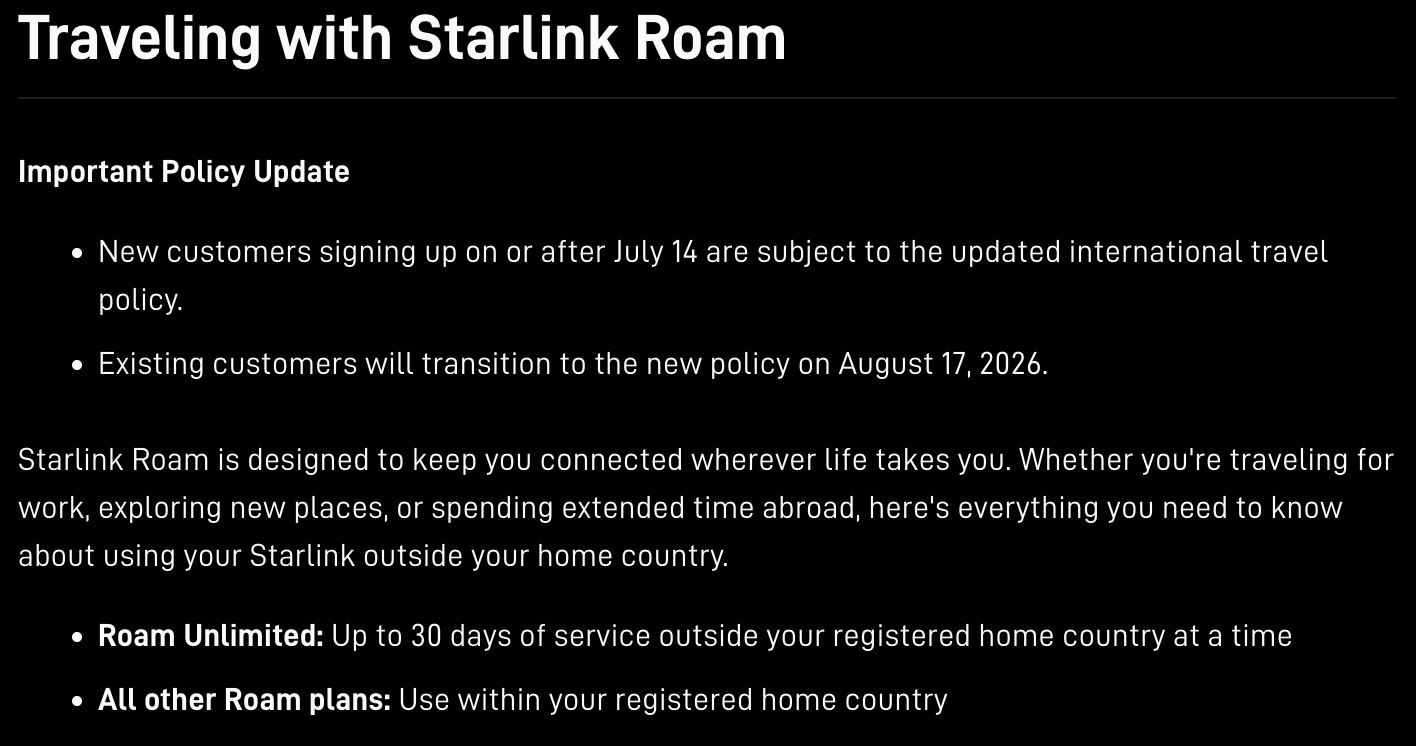
The recent round of changes includes significant tweaks to the rules around using your Starlink terminal in another country. For quite some time, Starlink has allowed roam plans to operate outside of their home country for up to 60 days. Now, that 60 day window is changing to 30 days and is only offered for Roam Unlimited. Roam 100 and 300 gigabyte plans restrict service to their home country or region.
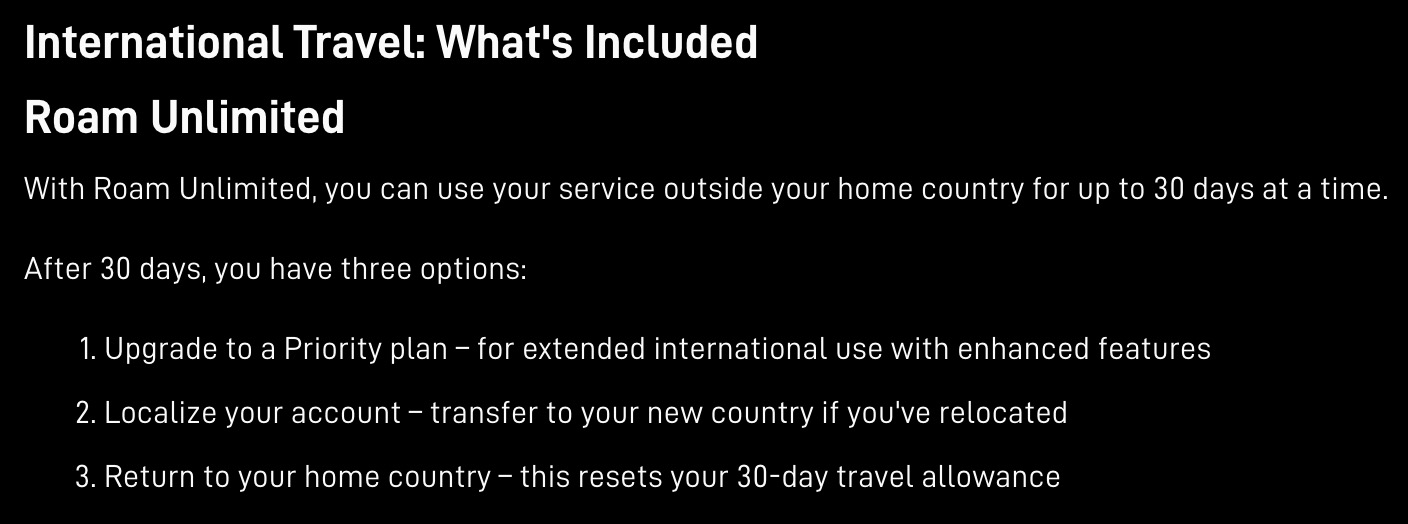
After 30 days out of your home country or region, Starlink offers three options. I believe there are limits to how often you can change your home country, so that may or may not be a viable solution for global cruisers.
Going all the way back to Starlink’s launch, I think the issue with changes is often less about absolute value and more about pulling back benefits previously offered. In my opinion, 60 days of international roaming was exceptionally generous and 30 days remains quite generous. However, subscribers became accustomed to these benefits so seeing them cut triggers some passionate responses. This change is no different.
The end of Global Roam
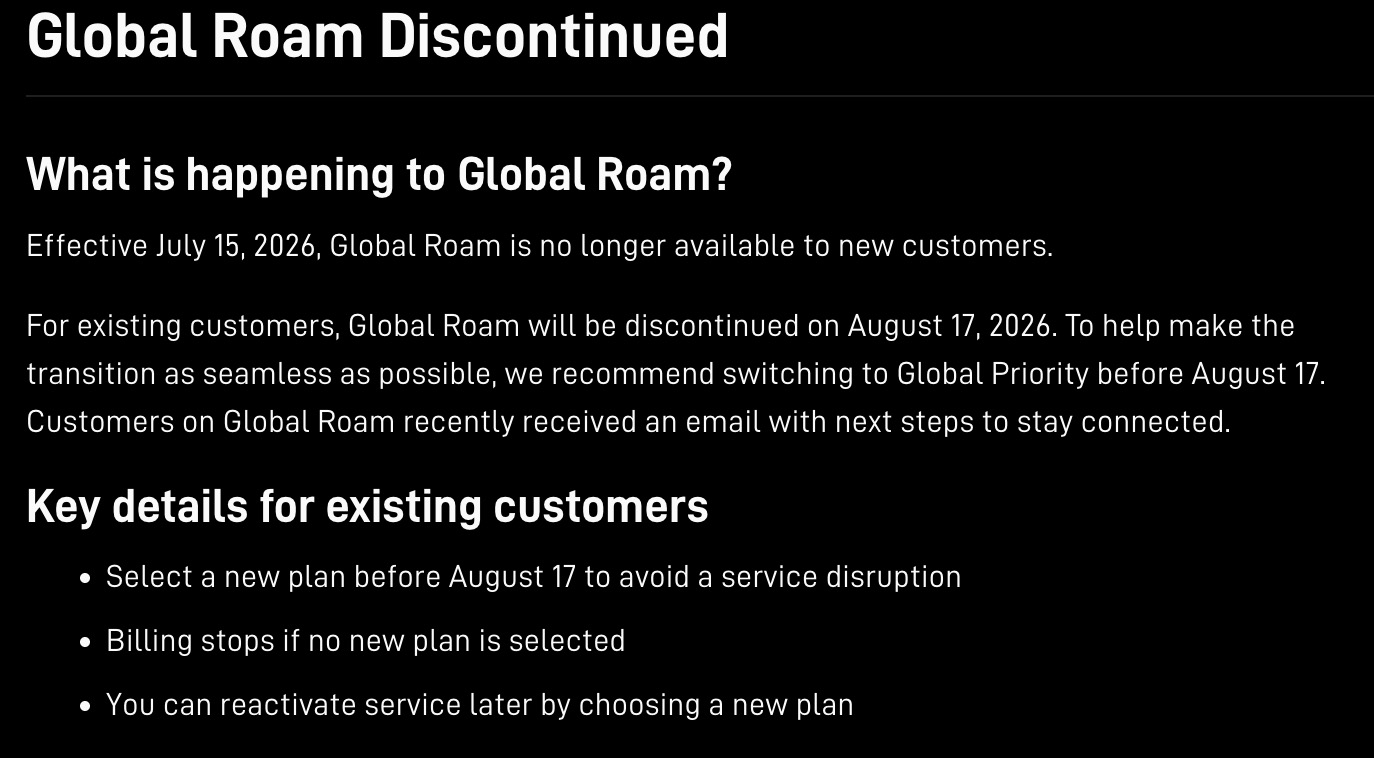
Two years ago, the cost of Global Roam (then called Mobile – Global) doubled from $200 to $400. At the time, the service plan made little sense at its new price. Other options delivered more service for less money. But, Starlink eliminated those other options and now Global Roam is the lowest cost option for service anywhere on the globe. However, it’s going away and quite quickly.
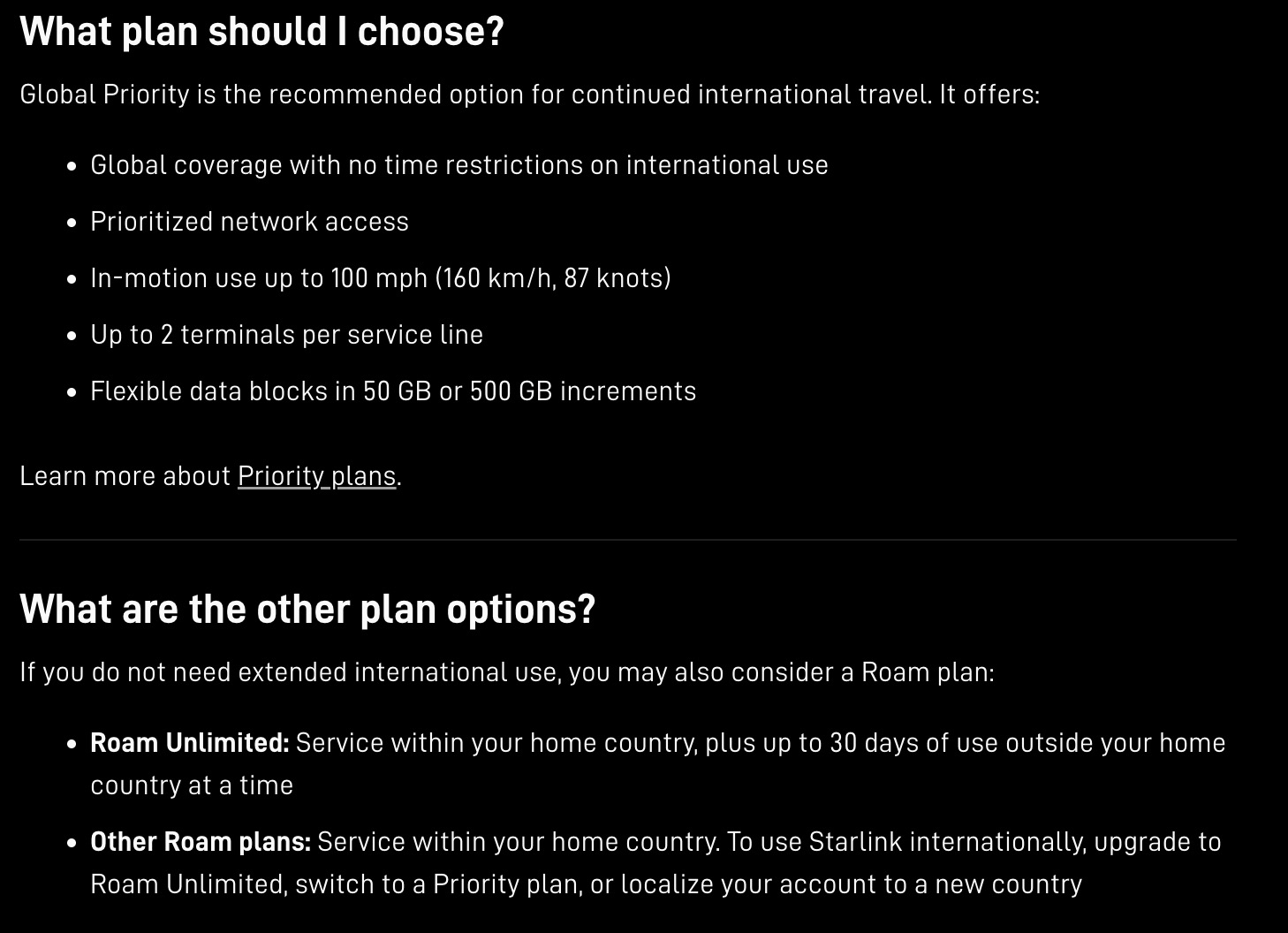
The Global Roaming plan will not be replaced with a new one. Instead, existing subscribers will have to choose from the existing plans. Where Global Roaming offered unlimited data transfers, any of the new plans that offer extended international connectivity require purchasing bandwidth in buckets.
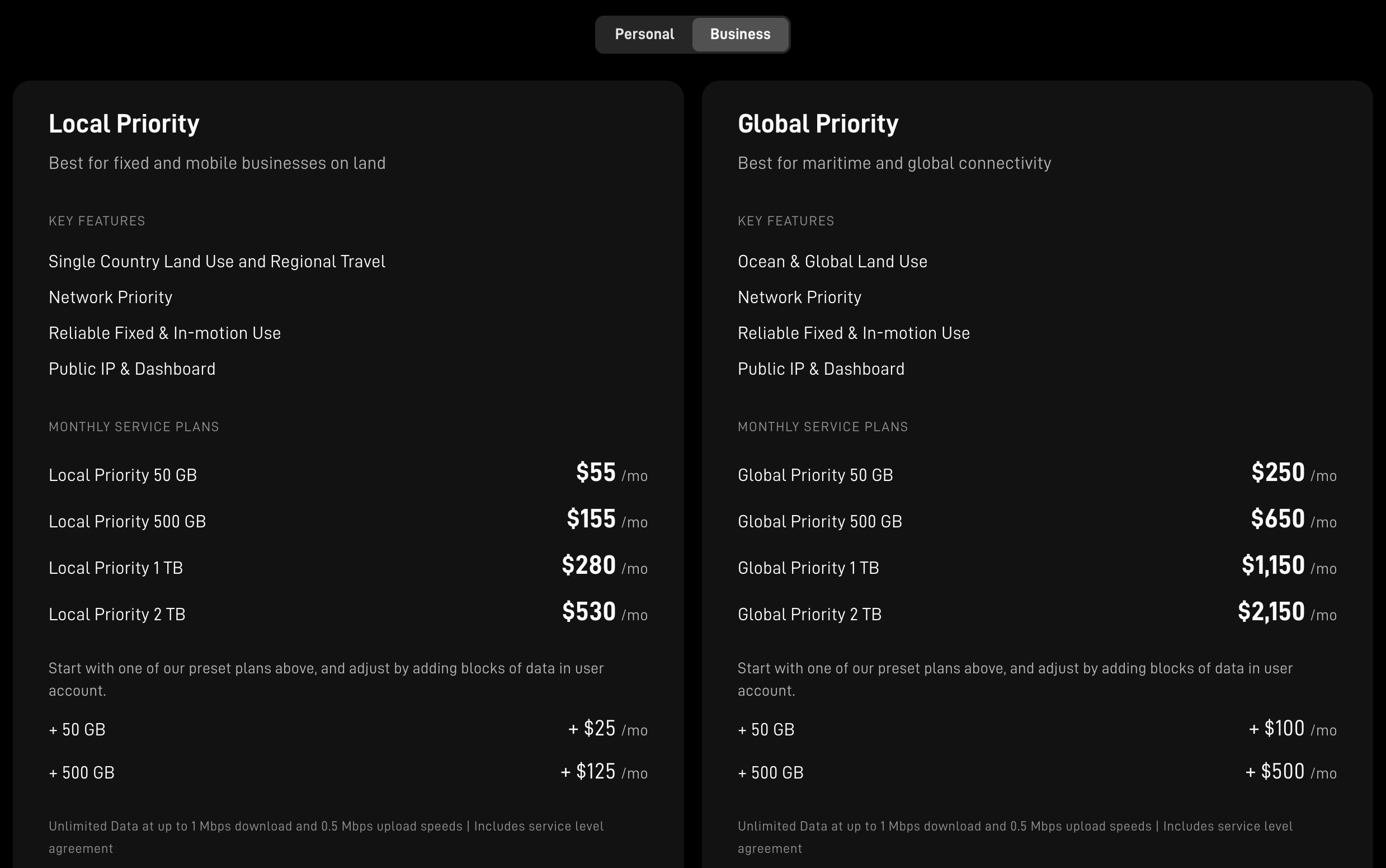
The remaining option for extended international travel likely represents a $250 per month cost increase. Assuming 500gb is enough bandwidth for a month, service costs will move from $400 to $650. However, that additional expense does include use outside of territorial waters.
Travel Registration
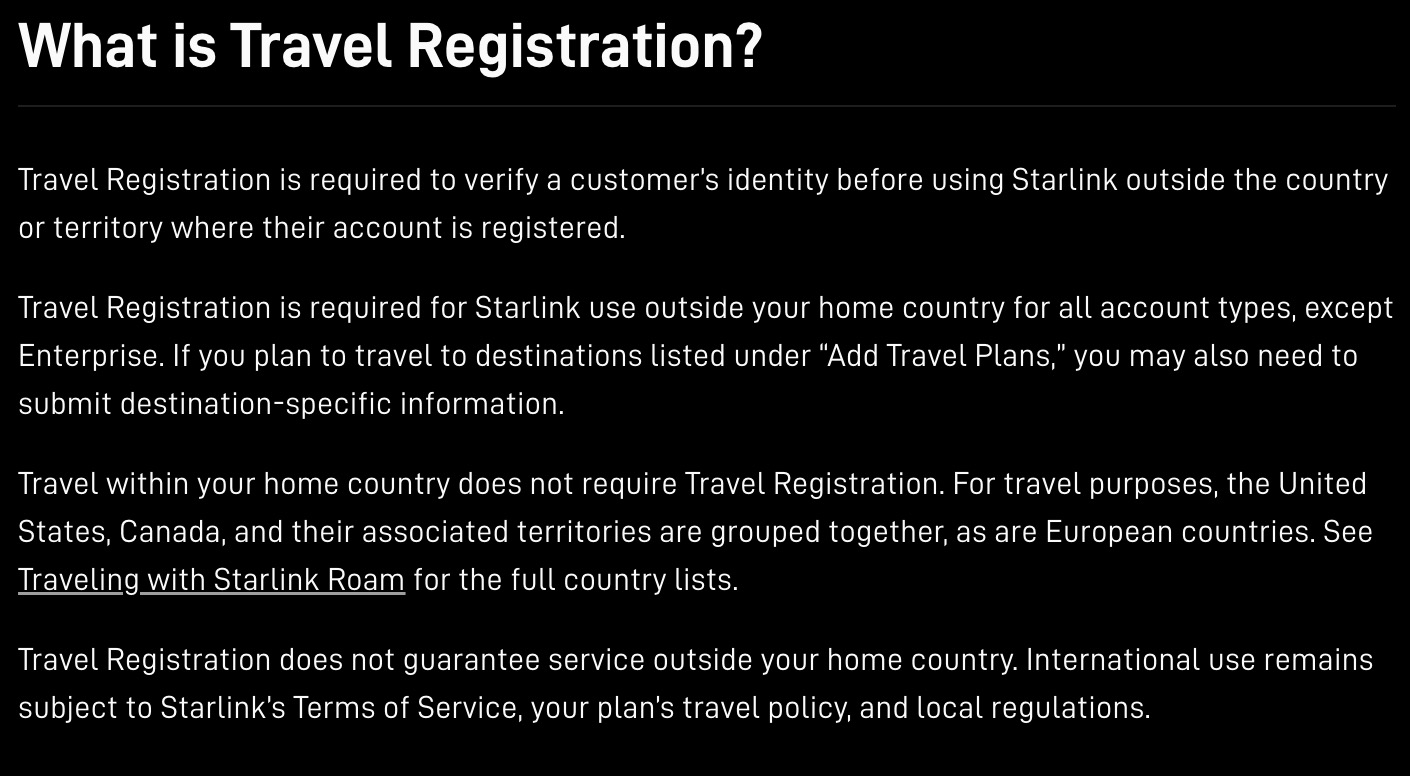
The last change to international travel requires registering with Starlink prior to using the service outside of your home country or region. Registration consists of a selfie and a picture of your passport. I am certain this requirement will ruffle some feathers, but I think it’s Starlink’s attempt to ensure they comply with the various regulatory authorities.
Final thoughts
The cost of Starlink connectivity continues to rise. But, even with the rate hikes, Starlink remains cheaper than the majority of the options it replaced, especially any with significant international options. Despite price increases, Starlink service is at least an order of magnitude cheaper than previous satellite options. At the same time, there certainly are those for whom other options may now be more attractive. Cellular carriers now offer home internet solutions that meet the needs of some and at significantly lower pricing.
If you made it this far, you likely have some investment in mobile internet connectivity. Despite the pace of change, the sometimes capricious appearance of that change, and the sense of uncertainty it breeds, Starlink remains the best connectivity option for those traveling by boat, RV, or any other mobile living approach.


Very interesting about the new mini2. The internal battery isn’t something we have seen a need for or been asked for. There are dozens of companies producing nice little 12-18v or so step ups and we have been hard wiring them to boats down to small 4mt aluminium tinny trailer boats . But I’d imagine hikers etc would love the battery option.
Yeah prices going up is the new normal for everything these days
Nice article though Ben! Thanks
I’m not surprised you haven’t seen much demand for battery power. I’ve used a Mini on my boat and RV and never wanted battery powering. I have also used it away from both and a battery would have been convenient. But, if there is an option for with or without battery, the battery would have to add very little cost for me to consider it.
-Ben S.
Would be nice if Central America got treated like North America or Europe.
Have you seen any indication of retirement of the V2 dish? It’s been around for almost the entire duration and I’m sure there’s a number of them out there.
I poked around a bit and no one I’ve spoken with has any indication the V2 terminal is going anywhere. At some point it is possible that the older terminals will have a greater impact on the network and it would be logical it will go away at that point. However, it doesn’t seem like that point is near.
-Ben S.
Have had enough of Elon Musk and his greed. Am quite happy to not use his products.
Any idea the process to “localize” your account? Using Bahamas seasonal cruiser as an example (say, 3-months in Bahamas), is it practical to ‘localize’ to a Bahamas account, then return to the US and re-patriate your account?
Ben, I appreciate your comment ” As a person, I have plenty of issues with Elon Musk.” The truth of the matter is, he is a morally corrupt man responsible for the deaths of hundreds of thousands of children due to his ineffective work with DOGE. As Dave Eggers said, “People will give up anything if they don’t have to get up off the couch.” That is the case with Starlink. Everyone says Starlink is ‘essential’ for our safety out here cruising. However, people have been cruising safely (possibly more safely) for decades without this type of connectivity. It is fracturing the cruising community as people leave their VHF off and communicate via social media channels. It is true that your 100 or 200 or 300 dollars / month doesn’t matter to Musk. But we vote with our dollars. And as long as we are willing to choose streaming Netflix while on passage over living our lives free from supporting evil and tying ourselves to huge corporations, we will continue to create a world where billionaires can take away food from hungry children in Africa and still be lauded as geniuses.
I share many of your concerns, Bruce, but I’ve rarely seen product boycotts work — Bud Light a weird exception! — and I think it was cell phones that so diminished use of marine VHF.
The most concerning part to me is that the use of unmanned aerial (uav) and sea vehicles (usv) will continue to become more widespread. It could soon be all too common to find yourself facing an explosive-laden drone in the air or at sea, virtually anywhere and at any moment.
I stumbled on an amazing and fascinating example of Starlink (and modern video tech) in action:
A 68 foot Spanish expedition sloop has begun a Northwest Passage attempt with a 24/7 livestream using multiple cameras — “stern, bow, crosshead, cockpit and saloon” — plus a feed from their B&G plotter/radar:
https://www.youtube.com/watch?v=AXBwrPsmToY
The stream is a bit glitchy right now, and may get worse as they get further North, but wow anyway!
More on the project: https://vueltavertical.com/