

Victron unveils faster Cerbo GX MK3 and emergency reverse charging for Orion XS
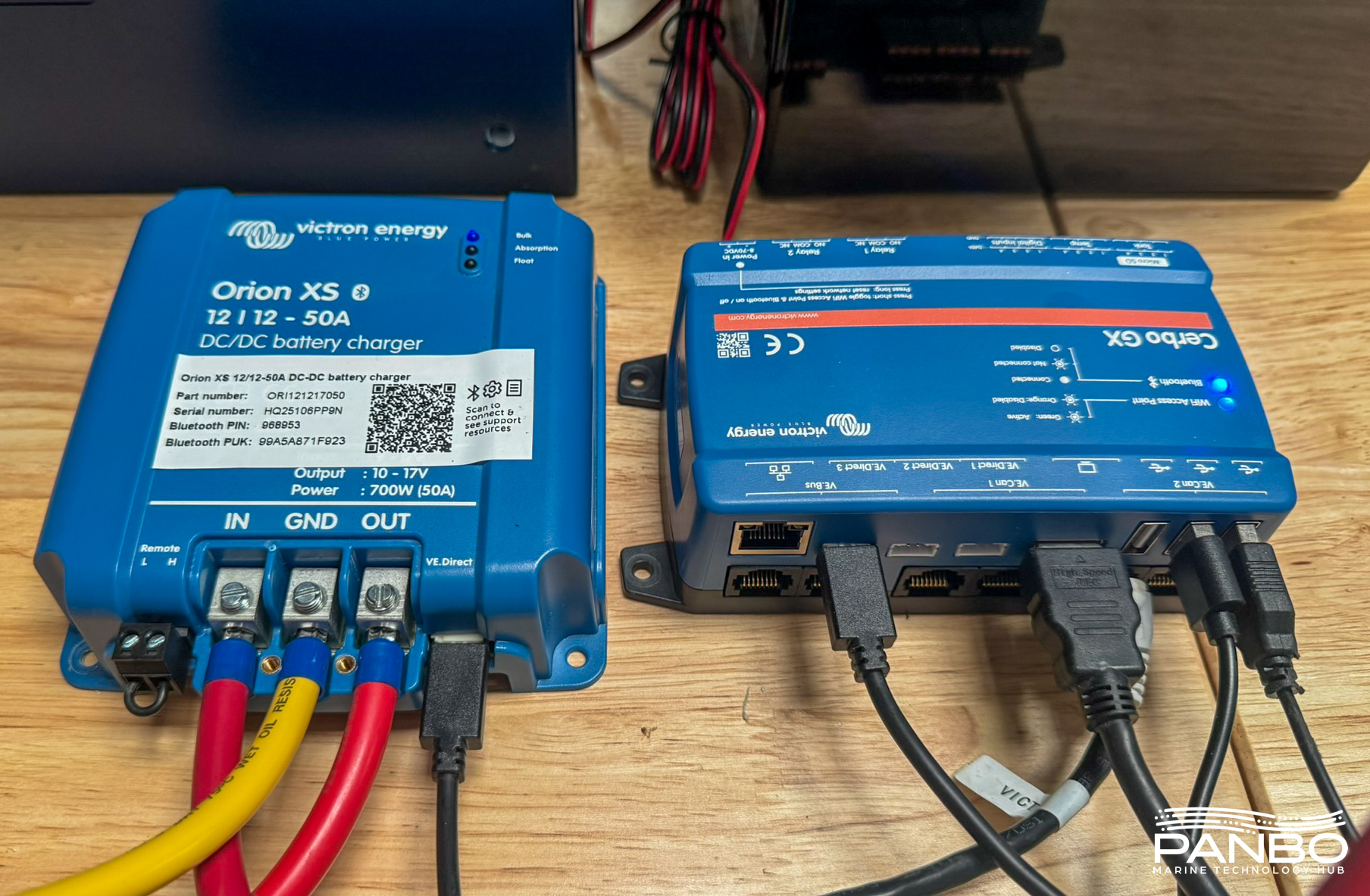
Victron recently answered two of the most common complaints about two of its most popular products. The Cerbo GX gets its third hardware generation, with a much faster processor for owners who have pushed the MK2 to its limits. The Orion XS hardware is unchanged, but a firmware update finally lets it charge in reverse, for now only to rescue a flat starter battery.
Cerbo GX MK3
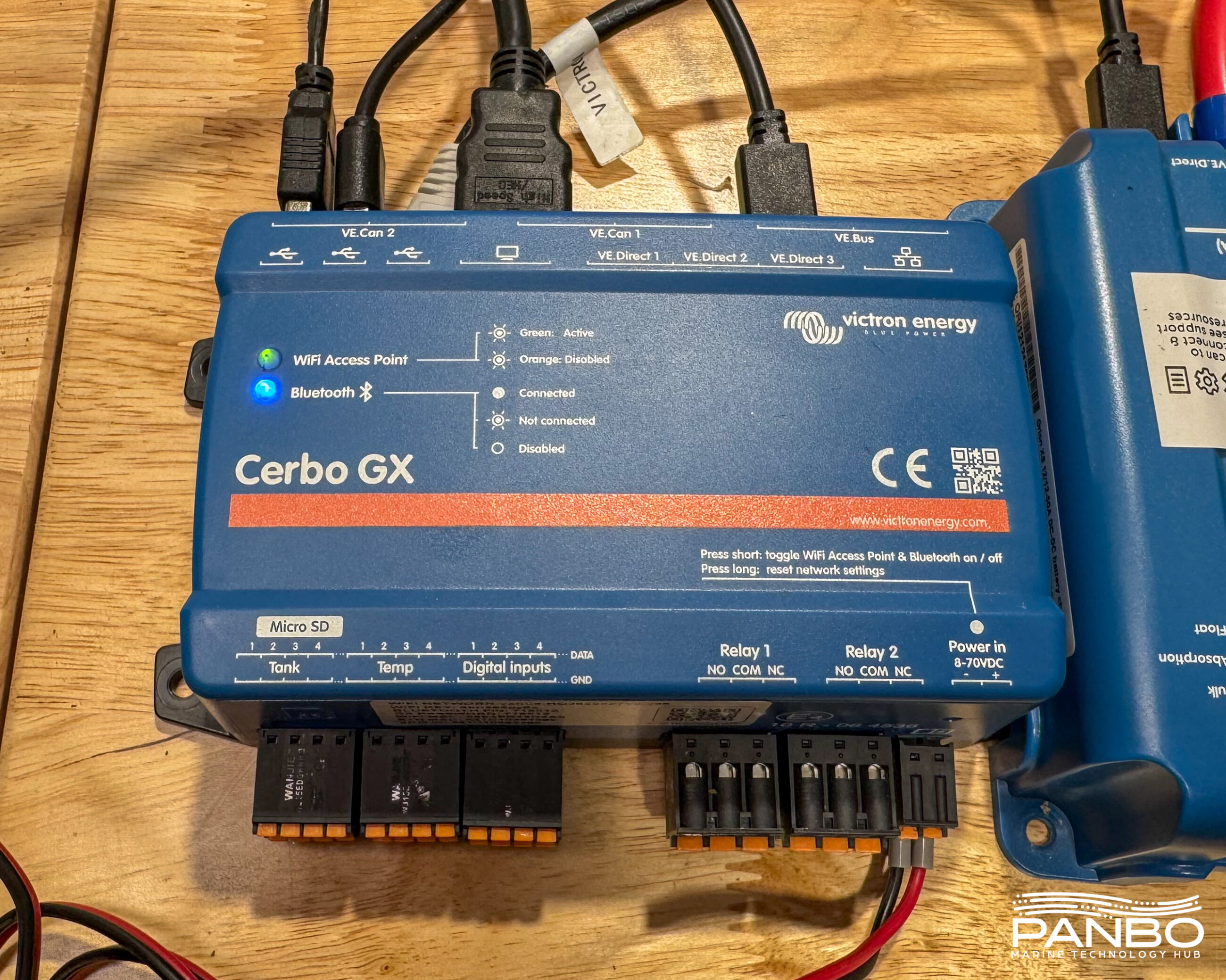
Victron unveiled the original Cerbo GX at Metstrade in the fall of 2019. In late 2023, the MK2 was announced with some changes to the port configuration, but the underlying processor carried on unchanged. Now, seven years after the original, we have the MK3 with an identical port selection but a much-upgraded processor.
| GX Model | SoC | RAM | Cores & speed | Arch. |
|---|---|---|---|---|
| Cerbo GX MK1 & MK2 | Allwinner A20 | 1 GB DDR3 | 2 × Cortex-A7 @ 1.2 GHz | 32-bit |
| Cerbo GX MK3 | TI AM625 | 1 GB DDR4 | 4 × Cortex-A53 @ 1.4 GHz | 64-bit |
| Ekrano GX | Allwinner H3 | 1 GB DDR3 | 4 × Cortex-A7 @ 1.2 GHz | 32-bit |
| Nucleo GX | Allwinner H3 | 1 GB DDR3 | 4 × Cortex-A7 @ 1.2 GHz | 32-bit |
| MultiPlus-II GX / EasySolar-II GX | Allwinner H3 | 512 MB DDR3 | 4 × Cortex-A7 @ 1.2 GHz | 32-bit |
Overall, the Cerbo GX hardware has held up surprisingly well. But Victron has added a lot of functionality and that new functionality places additional demands on the hardware. Interestingly, the recently introduced Nucleo GX uses the same processor as the Ekrano GX, rather than the TI AM625 in the Cerbo MK3.
| Feature | Allwinner A20 (Cerbo GX MK1 & MK2) | Allwinner H3 (Ekrano GX, Nucleo GX) | TI Sitara AM625 (Cerbo GX MK3) |
|---|---|---|---|
| Release year | 2013 | 2014 | 2022 |
| Architecture | 32-bit ARMv7-A | 32-bit ARMv7-A | 64-bit ARMv8-A |
| CPU cores | 2 × Cortex-A7 @ 1.2 GHz | 4 × Cortex-A7 @ 1.2 GHz | 4 × Cortex-A53 @ 1.4 GHz |
| Process node | 40 nm | 40 nm | 16 nm |
| RAM as fitted | 1 GB DDR3 | 1 GB DDR3 | 1 GB DDR4 |
Comparing the hardware used by the Cerbo GX MK1 and MK2, Ekrano, Nucleo, and finally Cerbo GX MK3 shows the MK3 to be the big outlier. The Ekrano GX and Nucleo GX move to quad CPU cores but little else. The TI AM625 in the MK3 adds a 64-bit architecture, faster cores, newer RAM technology, and the reduced heat and power consumption of a 16-nanometer fabrication process.
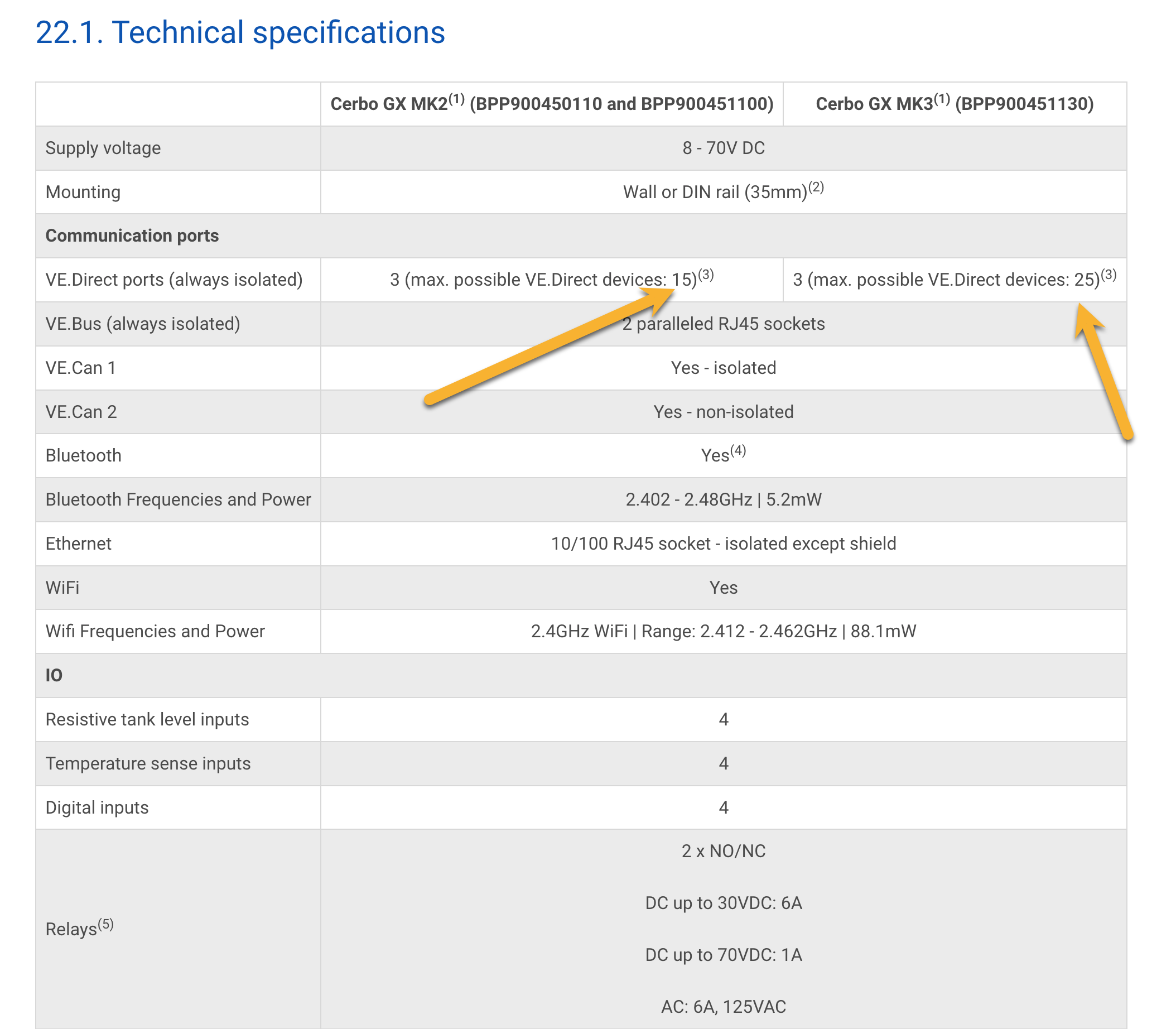
Although there are no port changes and most of the other specifications remain the same, there is one major spec difference between the MK2 and MK3. The maximum number of VE.Direct devices goes from 15 on the MK2 to 25 on the MK3. Fifteen devices may sound like a lot, but I see more and more installs with solar chargers, DC-to-DC chargers, and AC-to-DC chargers all ganged in groups of two to as many as six of each type of charger. JJust those three charger types, each in a group of six, exceed the limit.
Since the Cerbo was introduced, we have seen Node-RED, Signal K server, third-party temperature sensor support, digital switching, and many more features added to Venus OS. Those features all require resources, and when paired with ever-larger installations, they can exhaust the existing hardware. Victron says the vast majority of installations continue to run smoothly on the existing hardware. However, more complex installations with greater use of Node-RED, Signal K server, and higher component counts may find the limits of the current hardware.
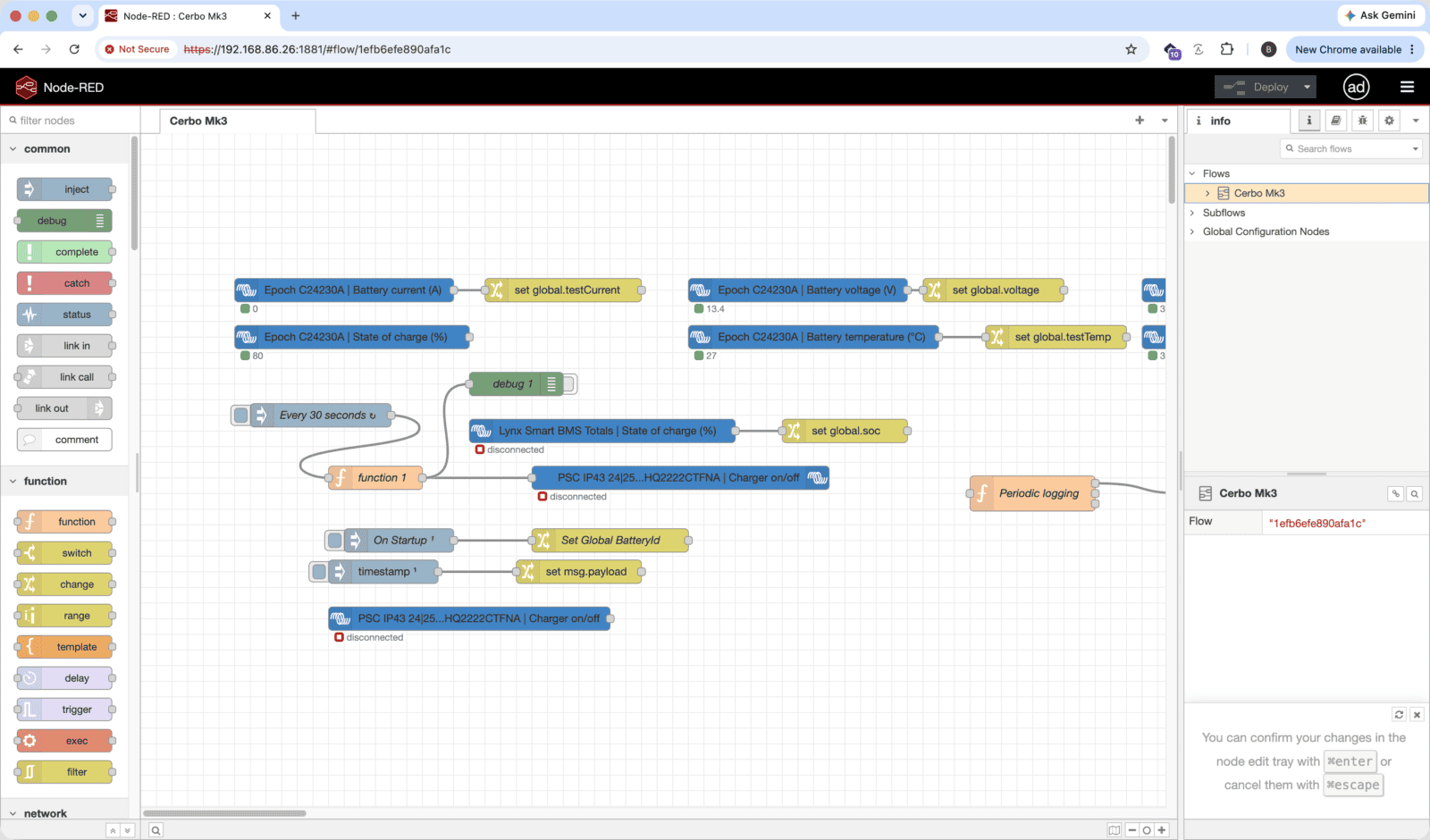
One of the indicators I’ve noticed with MK1 and MK2 Cerbos is the time taken to load Node-RED. If you load Node-RED through Victron’s proxy, as is the default via VRM, it takes quite a while, but much of that delay results from proxying traffic. However, just loading the actual Node-RED interface and nodes is noticeably slower on a Cerbo than on a Raspberry Pi 4 or 5 also running Venus OS. The MK3 seems to be just as fast as the Pi. Otherwise, the MK3 feels faster, but who knows; maybe that’s a placebo effect.
Orion XS bidirectional charging
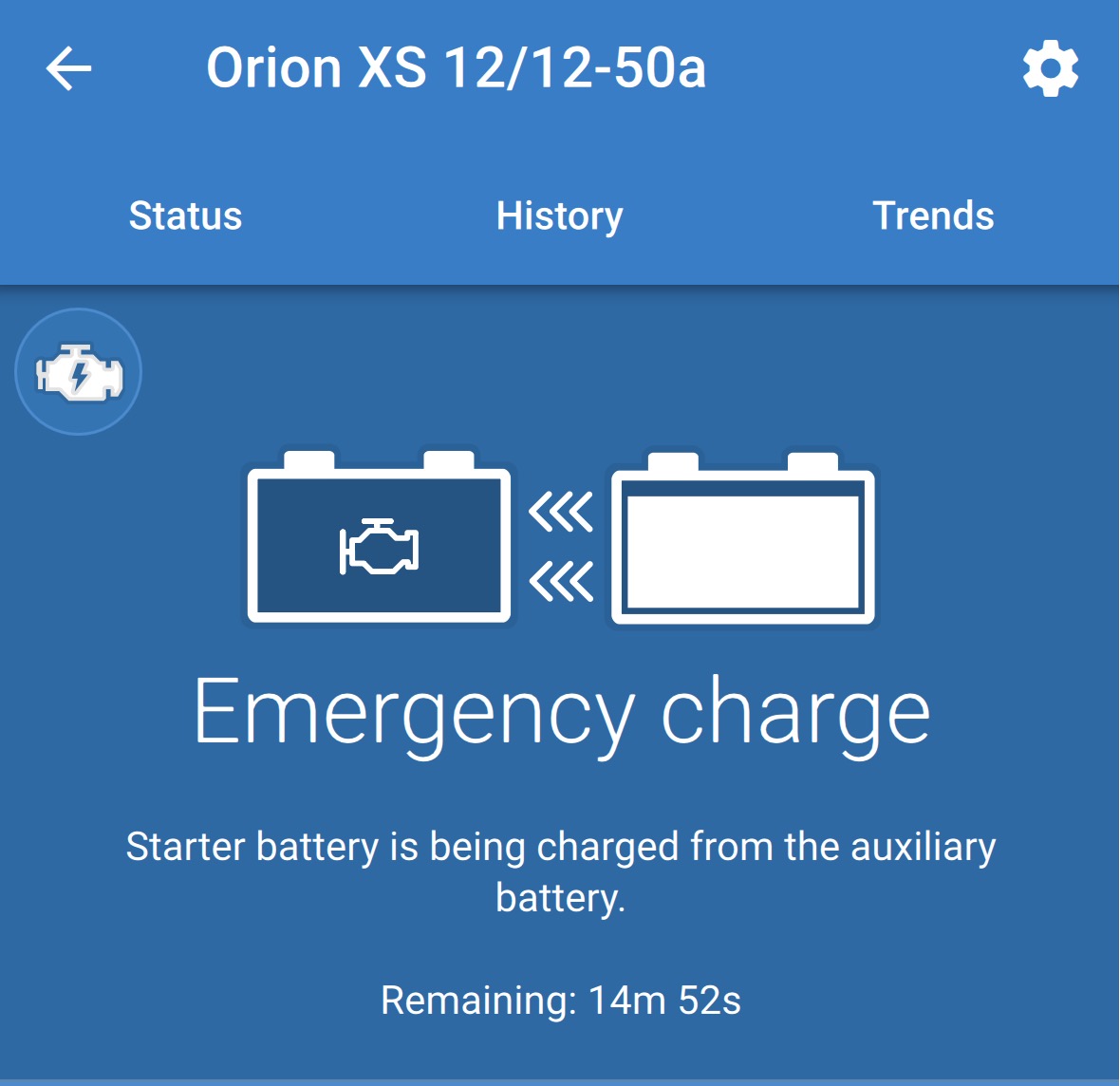
For several years, one of the worst-kept secrets of the Orion XS line of DC-to-DC chargers has been the hardware’s ability to support bidirectional charging. That means that, once the software is implemented, a DC-to-DC charger set to send energy from an engine battery bank to a house battery bank could also turn around and charge the engine battery when the house battery bank is being charged. Unfortunately, numerous conversations over the last few years revealed that the logic of how to control this feature proved more difficult than Victron originally thought.
This fall, Victron released updates to both VictronConnect and the Orion XS firmware to enable what it calls emergency reverse charge. This mode allows Orion XS 12/12-50A, 12/12-70A, and 1400 chargers to charge in reverse at up to half their rated current. So, an Orion XS 12/12-50A that is normally capable of charging at up to 50 amps can charge in reverse at up to 25 amps. Charge voltages are fixed at 14.4 volts for a 12-volt nominal battery and 28.8 volts for a 24-volt nominal battery. Lastly, charging is limited to 15 minutes, with a fixed 5-minute cool-down and settling period afterward.
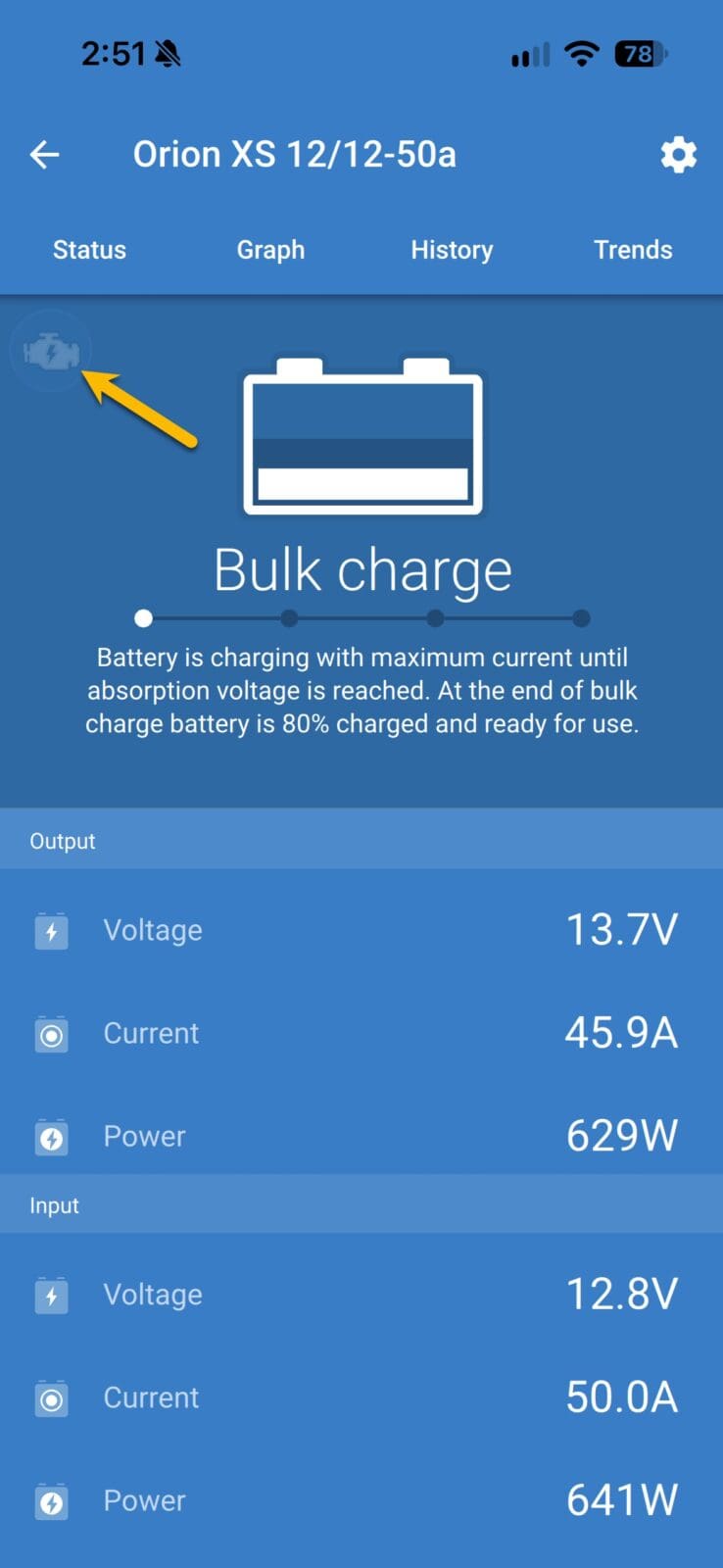
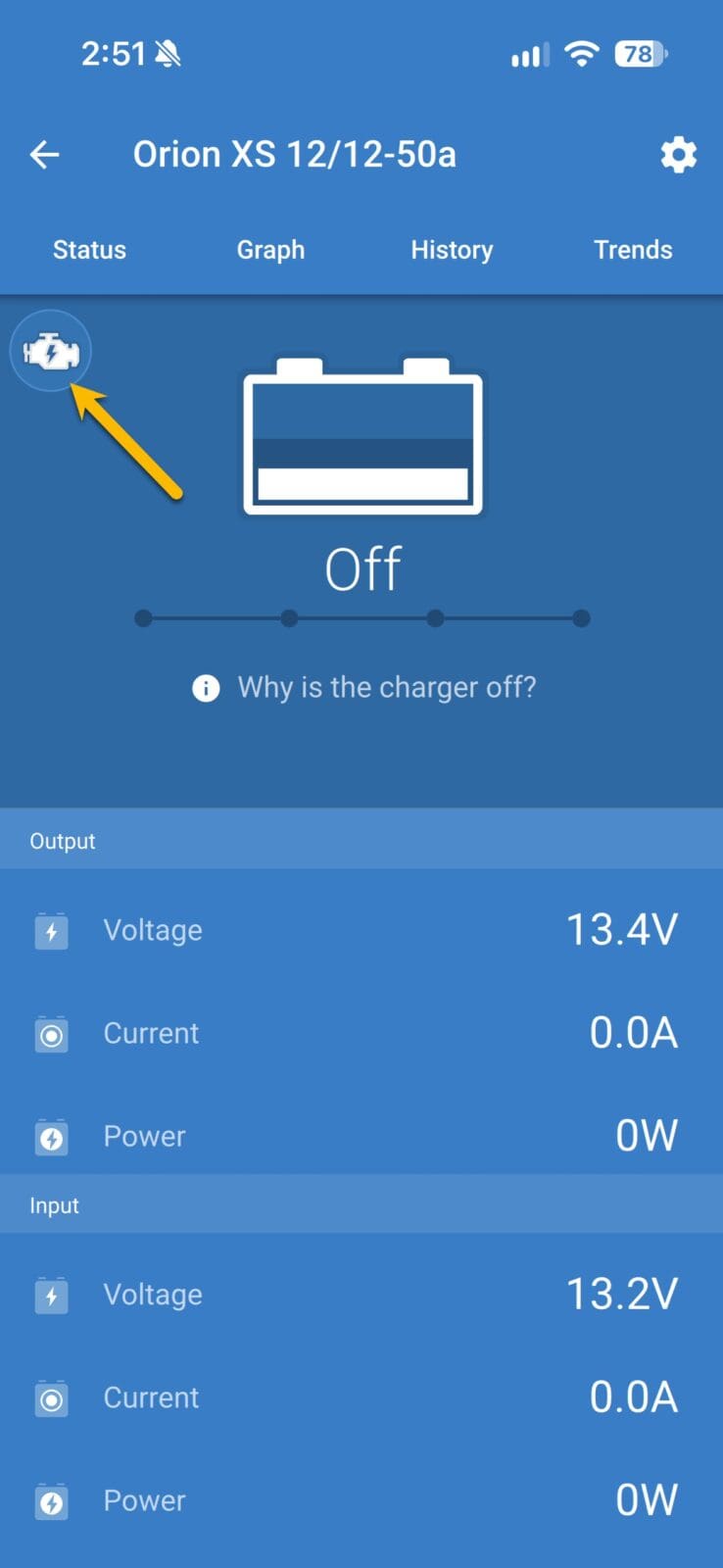
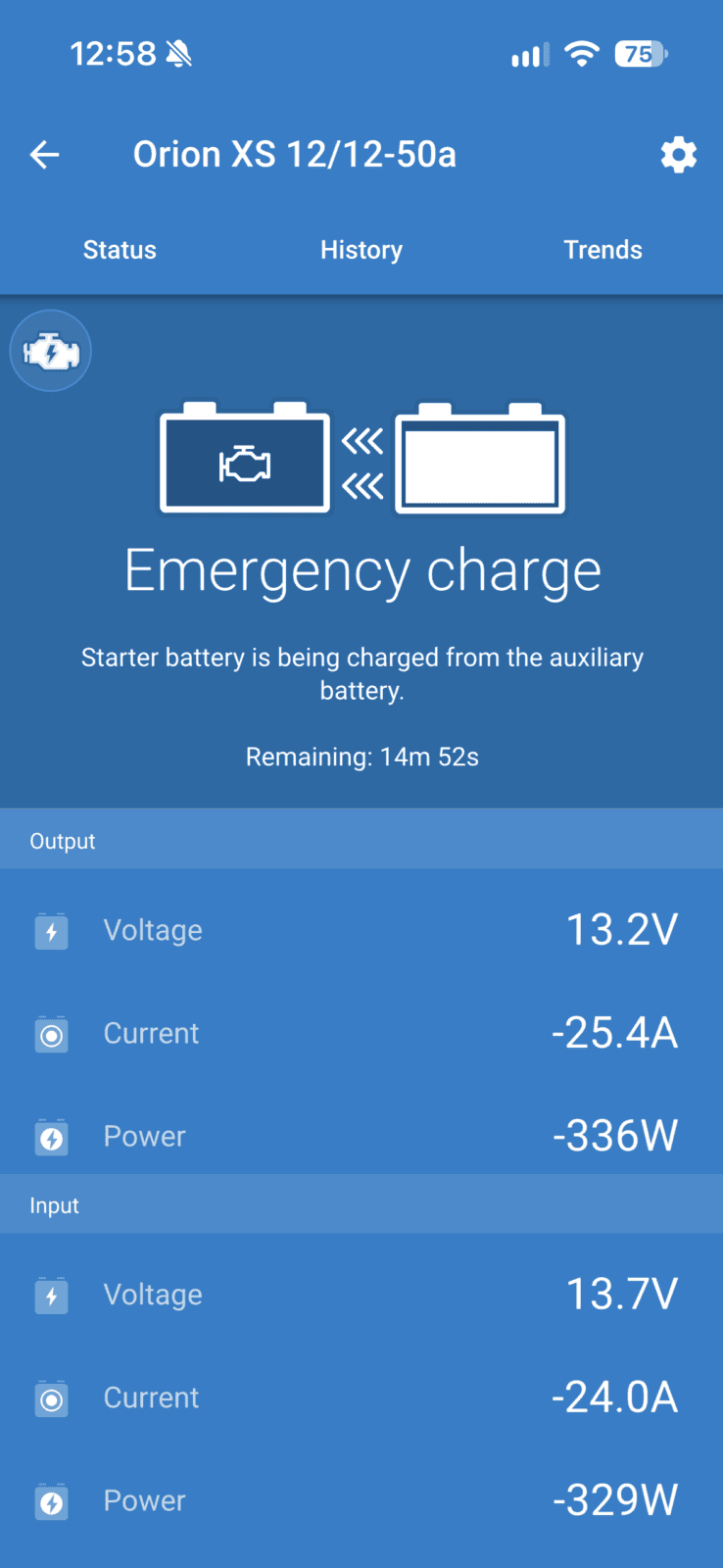
Emergency reverse charging is only available when the Orion XS is in charger mode (not power supply mode) and charging is off because of either input voltage lockout or engine shutdown detection. At least currently, emergency charging can only be activated from within VictronConnect version 6.43 or later. AAt first, I was a little surprised to see both currents shown as negative numbers. However, seen next to the standard charging modes, that display decision makes sense. The app indicates that both batteries’ energy flow at both batteries is the opposite of standard operation.

I have tried it a few times and everything implemented works exactly as advertised. I’m encouraged that this is a starting point for more bidirectional functionality. The biggest thing I would love to see is a lower amperage but continuous reverse charging ability. For example, a DC-to-DC charger installed to send power from the engine alternators to the house bank could also be used to tend the start batteries. Typically, that tending doesn’t require significant amperage. So, anything even approaching the half forward charging achieved in emergency charging would be great.
Neither update is flashy, but both show Victron listening. The MK3 gives heavy Node-RED and Signal K users the headroom they have been asking for without changing a single port. The Orion XS update turns a long-rumored capability into something you can use the day your starter battery lets you down. If Victron follows through on the reverse charging features it says are coming, that story is just getting started.



Thanks Ben, the reverse charging feature seems pretty useless to me at this point – emergency charging limited to 15 minutes? Pretty doubtful if the start battery is dead that you’re going to bring it back to life in 15 mins @ 25A. I certainly wouldn’t want that to be my safety “backup system”, as opposed to paralleling with another good battery…. but I guess as an additional no-cost software update, it’s better than nothing. Also – will you be reviewing the Orion 12/12-70 in any more detail? I saw one the other day and it appears identical in all respects to the 50A version, with a couple of tiny fans added to the rear. I’m curious if that (and a firmware change to allow 70A) were the only changes… seems like you could do the same thing with external fans. Thanks,
I’m bummed that they didn’t start with (potentially even lower current but) continuous reverse charging for maintaining banks. The most obvious one being a start battery. It probably would be fine with 10 or 20 percent of the forward current. However, I think Victron was really concerned about unintended consequences here and probably views the time bounds of emergency charging as a very safe first step. I just hope the next steps follow sooner.
I don’t have a 70a XS on hand yet. I’ll get one and give it a careful lookover. Might be a short review since, as you mentioned, it appears very close to the original with active cooling and revised firmware.
-Ben S.
Actually I think that 25A for 15 minutes is much more than you would get out of a typical “booster pack”, and more than enough to get the start battery up to a point where the engine will start. So a very useful feature IMO.
Thanks Ben, great wrap up of the new releases. Was unsuccessfully searching on VictronProfessional for Cerbo info last week. Had a play with the reverse charging and definitely a step in the right direction.
I have an Epever solar reg on my boat that provides trickle charging of the start battery (works well but an ugly quirk if a battery is disconnected/reconnected it will slowly discharge the start battery instead!). The Epever will trickle 1 amp max until the start battery reaches 13.8V which keeps it sitting at 13V plus. Some sort of trickle charging option combined with the emergency charge would be great, alternatively on a Cerbo controlled system being able to switch the start battery charging on when AC or Solar charging reaches Float would be nice.
A good summary of the change in the GX line of processors and models.
Recently, I ssh’d remotely into the cerbo Mk2 running a few simple node-red flows and signalK services (just looking at the LithiumSmart classic battery cell voltages remotely). Running the top command revealed load averages over 5.0. This was with the alternator external regulator through VE.CAN ‘on’ but with the engine off (remote ssh in through tailscale). Both the cpu (user + system) and the iowait were high. Dbus-spy and -monitor of the “…alternator” service showed missing messages.
Changing to the classic Venus OS gui and turning off both node-red and signalK dropped the load below 1.0. I can’t be sure, but this points to a reason why 3rd party charger DVCC drop-outs happen for some and not for others. At least it warrants further investigation.
I hope to have an mk3 by next week and do some testing of the mk3 vs the mk2. I’m also pulling an RPI5 out of the box of misfit toys and looking to see if I can see even better performance—at least lower cpu usage and less d-bus queuing with resource hungry services (gui-v2, signalK and node-red). Even the 32bit to 64bit Linux change should make a difference.
Bottom line, we may be asking too much of the older generation of 32bit GX device. This feels like the windows 3.11 on an 80286 with 1MB ram days…it ran, but you couldn’t do much, especially concurrently. The 64bit, quad core Cerbo mk3 (and rpi5) should allow much more headroom for all the services we want to run. The quad core ekrano/nucleo may be like the 80386sx…better, but not the 486 or pentium.
Good to see you at ibex.