

Long term LiFePO4 cycle life testing continues, claims looking better
About a year ago, I posted my first article on LiFePO4 cycle life after completing 525 cycles on a WattCycle 100 amp-hour battery. Since publishing that article, I’ve also added a Blue Heron Extreme 100 amp-hour battery to the testing mix. The WattCycle battery is nearing 2,000 cycles and the Blue Heron recently passed 1,100 cycles. So, let’s briefly check in on both batteries and see how they’re doing.
As a refresher, the batteries are being cycled from 100-percent state-of-charge (SOC) to 10-percent SOC and then back up continuously. Charge and discharge both run at roughly 0.5C, or about 50 amps. The WattCycle battery does not communicate at all via either CAN or Bluetooth, so I don’t have a way to measure internal temperatures. The Blue Heron communicates via both and indicates it cycles between 40 and 45 degrees Celsius.
WattCycle rates the 100Ah battery I’m testing for 5,000 cycles and Blue Heron rates theirs at 6,000 cycles. Both ratings are likely derived directly from the cell manufacturer’s specs. I don’t believe any LiFePO4 battery manufacturer is doing any sort of testing on their finished batteries to determine a real world number. My 100-10-100 percent test cycles are derived from the information I could find when I started testing the WattCycle battery. They’re designed to duplicate what cell manufacturers do in testing their batteries. However, other sources suggest that cell manufacturers are using extrapolation to determine end-of-life ratings because of the time required to test. As we will see in a moment, my results suggest degradation is not linear over the life of the cell, so depending on the models used for that extrapolation, it could be pretty far off.
Throughout the testing, I’ve watched the expected lifespan by straight-line extrapolation of the degradation. I’m treating 80 percent of original capacity as end of life, the same threshold cell manufacturers use. That extrapolation has yielded relatively consistent results for the WattCycle battery, though it did experience a dip around 700 cycles followed by recovery over the next several hundred cycles. The Blue Heron battery has shown much more variation in its expected lifespan. In fact, at 200 cycles, it was showing a capacity loss of 3.48 percent. Extrapolated out, that suggested the battery might only last 1,149 cycles. However, by the 1,000-cycle mark, the projection had risen to 3,378 cycles and that continues to rise.
With a sample size of only two batteries, it is difficult to draw conclusions with any degree of confidence. I plan to run these two batteries until their 80-percent end-of-life threshold and then begin testing on additional batteries. I also hope that by the time I get to that, Victron may have enabled greater bidirectional functionality in the Orion XSs which would greatly reduce my equipment costs. With bidirectional charging, I could halve the number of Orions required based on battery capacity.
I recently modified the automation behind the testing to handle the full capacity tests, still using the West Mountain Radio CBA V testers I’ve used from the outset. That has let me increase the frequency of full capacity tests from every 100 cycles to every 20. As I write this, the Blue Heron battery is undergoing a full capacity test at 1,100 cycles and will resume cycling once the capacity test finishes.
As it stands right now, the WattCycle battery is estimated to deliver 2,592 cycles and the Blue Heron 3,607. That is 51.8 and 60.1 percent of rated cycle life respectively. That doesn’t sound great but also doesn’t come as a surprise since the cell cycle ratings are derived in a lab under ideal conditions. But I think more important than the batteries’ performance compared to ratings is looking at their likely lifespan.
LiFePO4 batteries are generally sold as lasting ten years or thereabouts. Taking our current cycle life projections, over ten years, the WattCycle could deliver 259 cycles per year and the Blue Heron 361. That would mean that the WattCycle could be cycled completely once every 1.4 days. The Blue Heron could cycle essentially once a day every day of the year for ten years.
The data I see suggests that even boats with massive solar and no shore power very rarely cycle batteries once a day. Additionally, looking at the charts in this article, I believe the total count will continue to rise for both batteries. With all those things in mind, I strongly doubt cycle life will prove the limiting factor in the life of these batteries. On the other hand, well-treated batteries are also running well past 10 years of calendar age. My experience from some of the more extreme testing I’ve done leads me to believe that storage temperature may have the biggest impact on battery life.
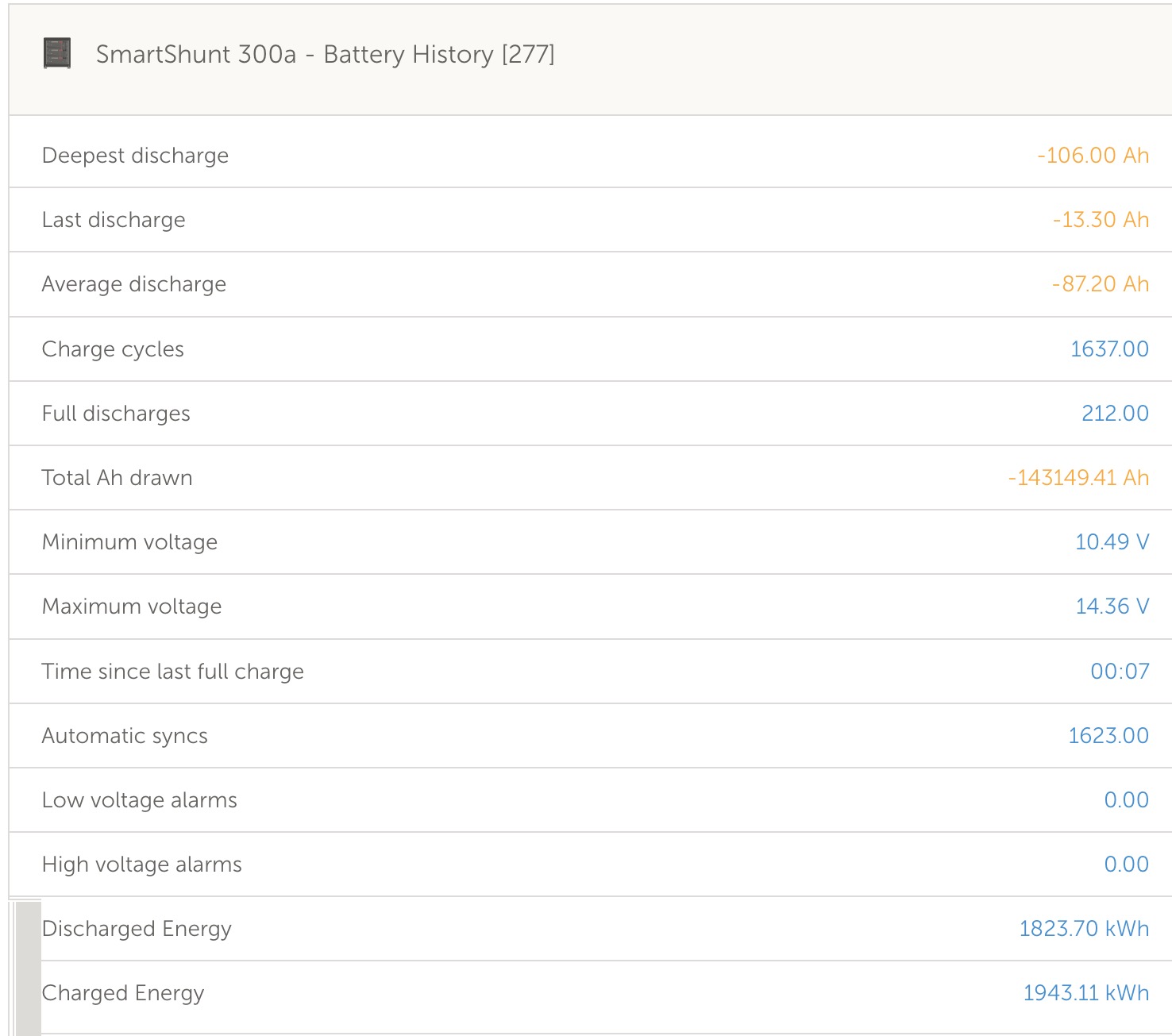
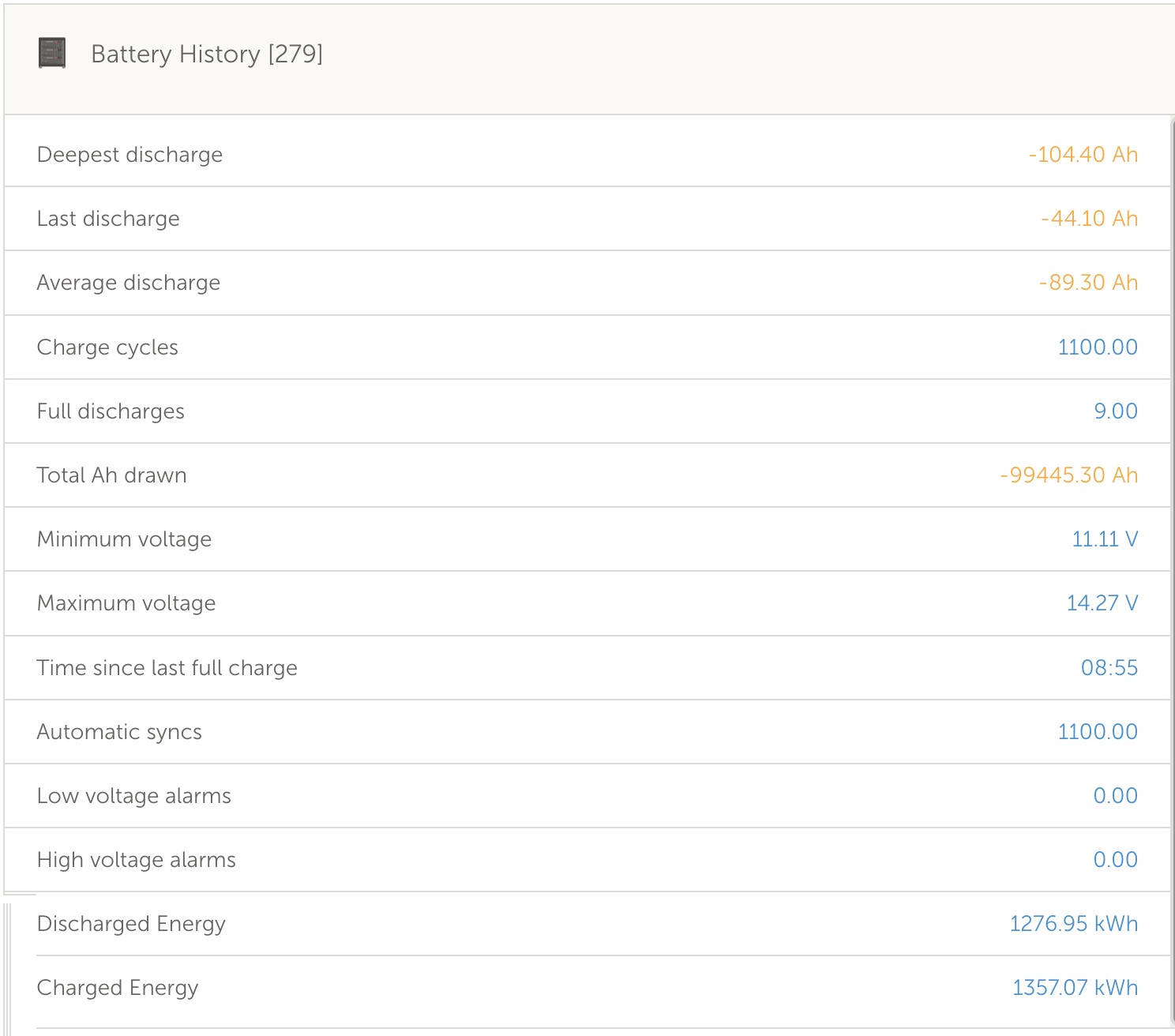
Some of the history numbers on these batteries are staggering. For example, testing the WattCycle has drawn 143,149 amp-hours out of the battery. This battery was $170 new. It has now discharged 1,823 kilowatt-hours or 1.823 megawatt-hours. That puts the cost of energy storage and delivery at less than $0.10 per kilowatt-hour. And, there’s still plenty of life left in this battery. The Blue Heron Extreme is more expensive from the outset, so it will need to far outlast the WattCycle to achieve the same cost per kilowatt-hour. However, it also delivers numerous features the WattCycle doesn’t including heating, CAN communications, and Bluetooth communications.
In my last update on continuous cycling, I promised to put a lead-acid battery through the testing as well. A few months ago, I undertook that testing. Unfortunately, the testing was a miserable failure. To be honest, I forgot about the fiddly nature of charging flooded lead-acid batteries. The main thing I succeeded in doing was boiling over the battery and leaving a stain on the concrete floor of my shop. I am going to have to spend more time getting a better automated cycle scheme for lead-acid batteries. To do that, I have to answer quite a few questions that I haven’t had to think about for some time. Questions like the charge parameters I want to use to determine full charge, how far down I discharge the battery for cycling and how far down I discharge for capacity testing. Those capacity tests are going to come at a greater cost to the battery and the overall life will be dramatically shorter.
It appears that I’ll end this entry as I ended my last: with a promise to continue this testing as well as a promise to work in the results of running similar testing on a lead-acid battery. I am looking forward to more steady progress without the pauses in testing associated with manually running the capacity tests. As the WattCycle nears 2,000 cycles, I think we will continue to glean valuable insight into how LiFePO4 ages.


Recent Panbo Comments