

Blue Heron Extreme series battery, feature rich and high performance
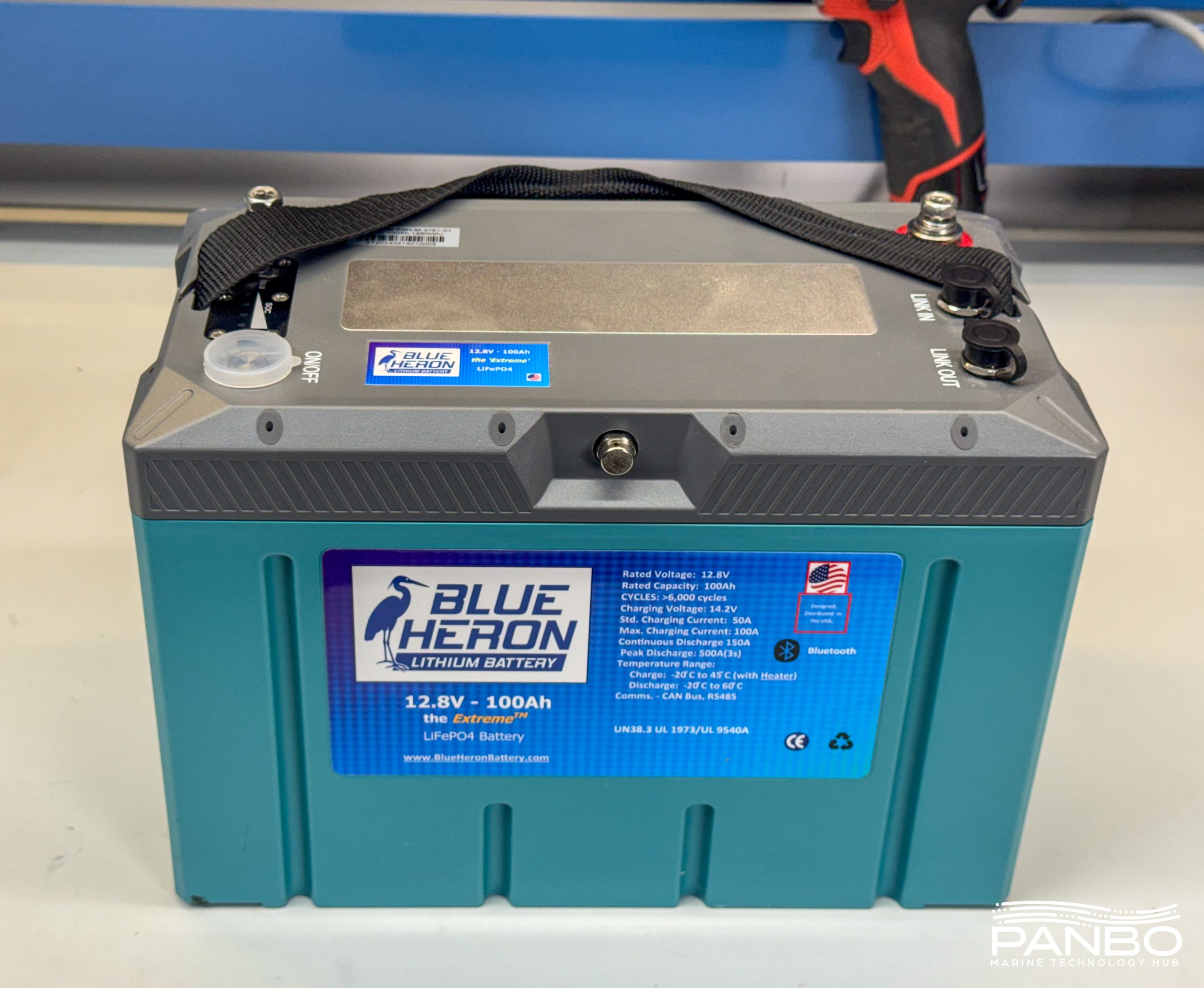
Blue Heron is a relatively small battery brand. So, you may not have heard of them as they have less marketing power than the bigger battery brands I’ve reviewed. But, that doesn’t stop them from offering a premium battery with impressive features and customer service. Perhaps in part because of their smaller size, Blue Heron provides services not typical of similar batteries, like testing and balancing the batteries prior to shipping. Let’s take a look at the battery, the service, and the value that Blue Heron offers.
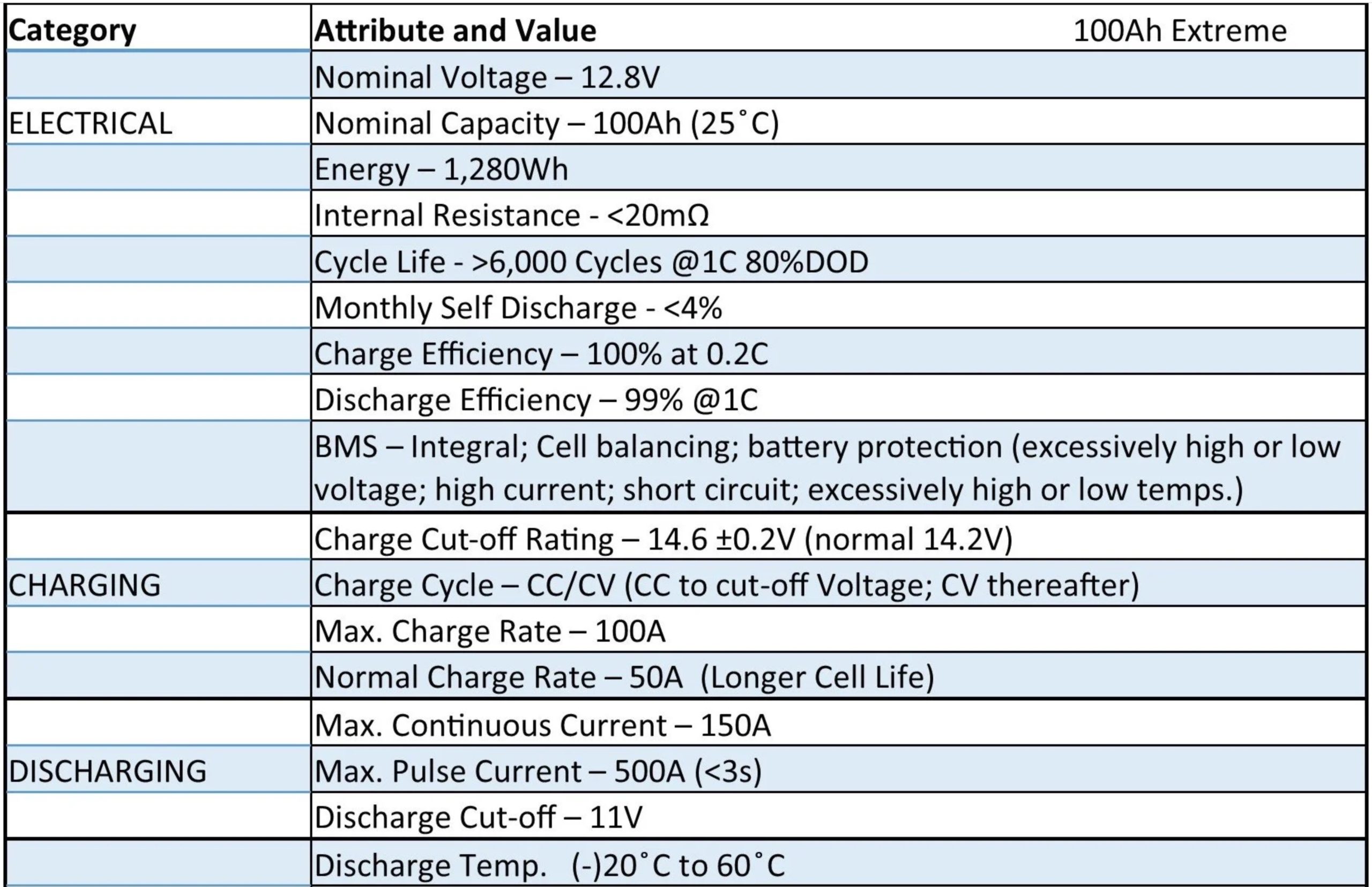
Blue Heron currently offers a 100 amp-hour and 300 amp-hour Extreme battery. A 460 amp-hour battery is coming soon. The 100 amp-hour battery sells for $789 and the 300 amp-hour battery fetches $1,459. Both sizes of battery are capable of accepting charge at up to 1c. The 100 amp-hour battery supports discharge loads up to 1.5C with a 3 second pulse of up to 500 amps or 3.333C. The 300 amp-hour battery sustains 1C continuously and up to 1,000 amps for 3 seconds (also 3.333C). Both batteries utilize cells rated for 6,000 cycles at 80 percent depth-of-discharge. The 100 amp-hour battery also carries UL’s 1973 certification for stationary energy storage systems and vehicle auxiliary power.
| Description | Battery cost | BMS/Hub Cost | Watt-hour capacity | $/watt-hour |
| BattleBorn 100ah 12v Smart | $949 | $149 | 1,280 | $ 0.86 |
| BattleBorn 270ah 12v Smart | $2,399 | $149 | 3,456 | $ 0.74 |
| Blue Heron Extreme 100ah, 12v | $789 | $0 | 1,280 | $ 0.62 |
| Blue Heron Extreme 300ah, 12v | $1,459 | $0 | 3,840 | $ 0.38 |
| Epoch 460ah V2 Elite 12v | $2,199 | $0 | 5,888 | $ 0.37 |
| Epoch Essentials 105ah, 12v | $499 | $0 | 1,344 | $ 0.37 |
| Epoch Essentials 460ah, 12v | $1,499 | $0 | 5,888 | $ 0.25 |
| Lithionics 630ah 12v | $8,923.95 | $0 | 8,064 | $ 1.11 |
| LiTime 280ah 12v Smart | $609.99 | $0 | 3,584 | $ 0.17 |
| Mastervolt Mli 12/6000 | $6,088.26 | $0 | 6,000 | $ 1.01 |
| Victron 1x100ah 12v | $973.25 | $803.25 | 1,280 | $ 1.39 |
| Victron 2x200ah 12v | $2,966.5 | $803.25 | 5,120 | $ 0.74 |
| Victron 4x100ah 12v | $3,893 | $803.25 | 5,120 | $ 0.92 |
| Victron 4x300ah 24v | $15,735.2 | $803.25 | 30,720 | $ 0.54 |
| WattCycle Dual Purpose 12v 100ah | $399.99 | $0 | 1,280 | $ 0.31 |
Before we go much further, let’s talk about something that may be apparent to those who pay careful attention to LiFePO4 batteries. The Blue Heron extreme series may look familiar. That’s because the battery comes from one of the major battery manufacturers in China, Top Band. It’s no secret that there are relatively few manufacturers of LiFePO4 cells, additionally, a large percentage of the finished batteries come from one of just a few finished battery assemblers. But, don’t assume that just because the case is the same, the battery is the same. Individual battery brands, like Blue Heron, often specify specific cells, construction modifications, and custom programming of the BMS. So, although we may see similar batteries, it is prudent to test and evaluate each battery individually.
With that out of the way, let’s take a careful look at Blue Heron’s Extreme series. What makes these batteries extreme? In large part, their current handling and voltage flexibility. Looking at the specs for these batteries, other battery brands might well call them dual purpose. Dual purpose typically indicates a battery suitable for both engine starting and deep cycle applications. The trouble with the dual-purpose terminology, much like the term drop-in for LiFePO4 batteries, is the many caveats with engine starting and direct engine connections. For example, outboard motors that use stators for power generation are often poorly matched to LiFePO4 batteries and large diesel engines can easily eclipse the inrush capabilities of even the most robust LFP dual purpose batteries.
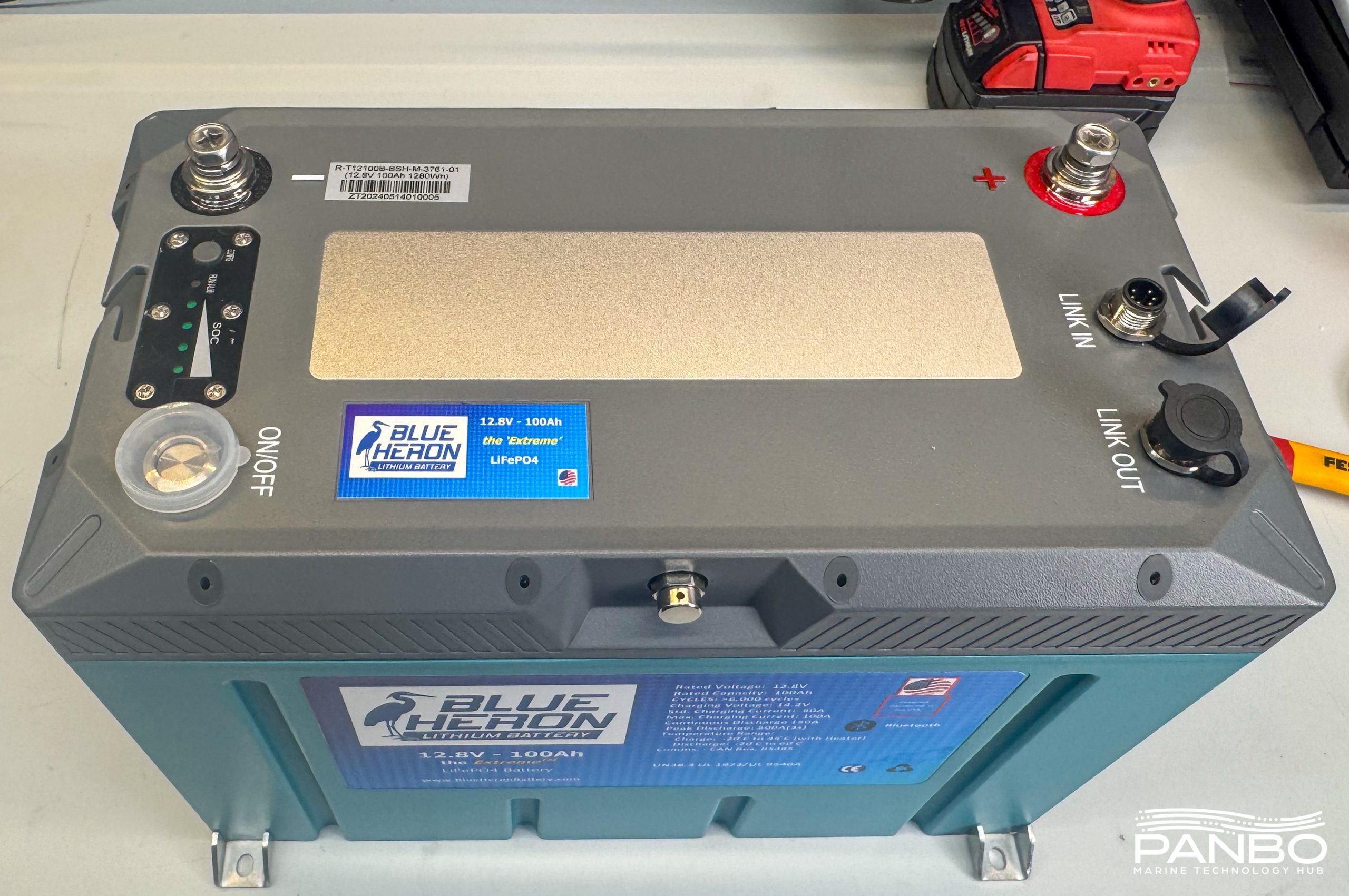
In addition to robust current throughput capabilities, these batteries offer numerous other features as well. They support up four batteries in series and sixteen batteries in parallel. The batteries feature heating, Bluetooth monitoring, Victron communications, NMEA 2000 capabilities, a latching external power switch, four segment state-of-charge LED, and included brackets to mount the battery. Blue Heron offers the Victron and NMEA 2000 communications cabling as accessories ordered in addition to the battery.
Performance
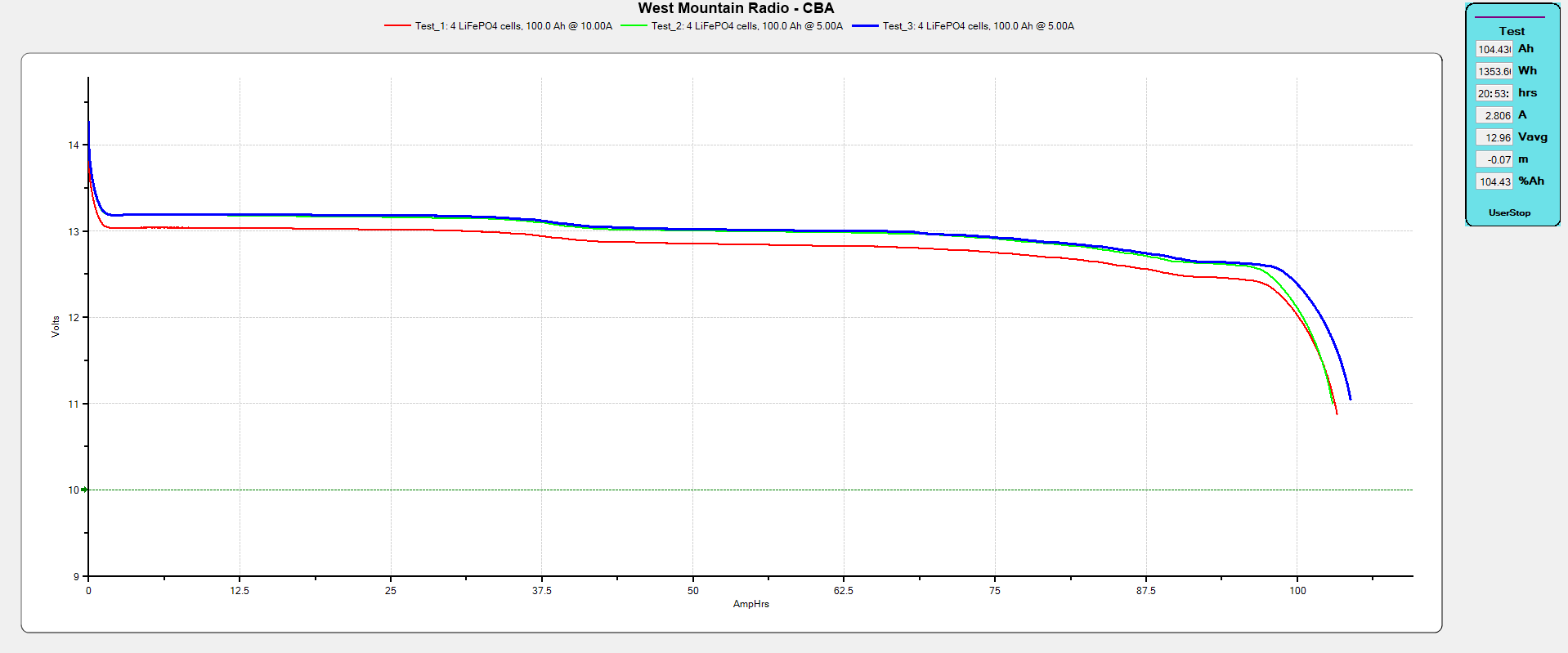
Before subjecting the battery to harsh testing, I performed several capacity tests at the battery’s 20 hour rate of 5 amps. Those tests all yielded capacity between roughly 103 and 104.5 amp hours. Interestingly, the last test yielded the highest capacity. These capacity results are one or two amp hours less than I often see with brand new batteries, but there’s a darn good reason for that. Unlike most battery brands, Blue Heron tests their batteries for balance and capacity before they leave their hands.
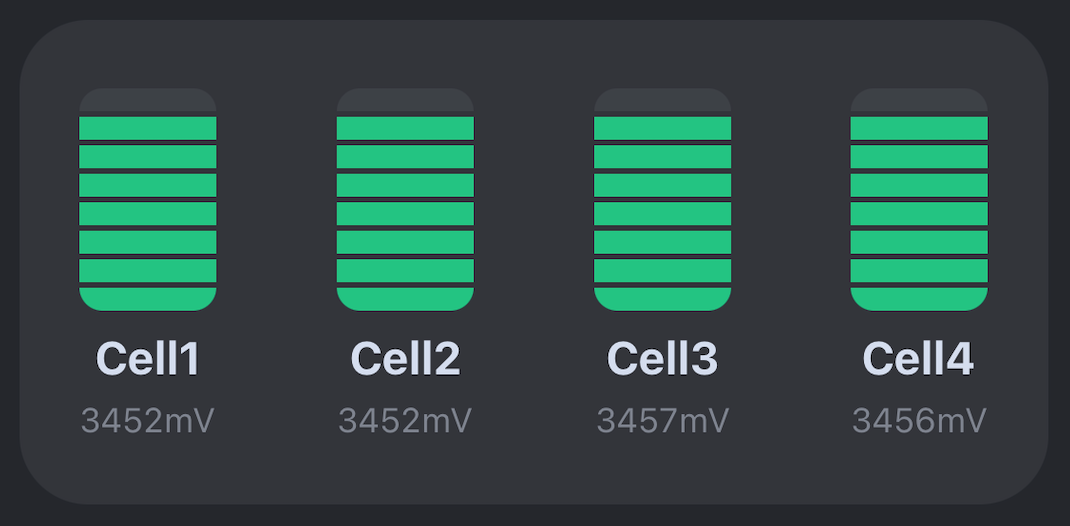
As a result of that testing, I received a perfeclty balanced battery showing a few cycles already on the clock. Typically, LiFePO4 batteries produce their highest capacity numbers when brand new. It is not uncommon in my testing to see capacity fall by 1-2 amp hours in just the first few tests. I think the results I got reflect that little bit of diminished capacity already baked in. However, the battery also reflected ideal balancing and was ready for work from the moment it came out of the box.
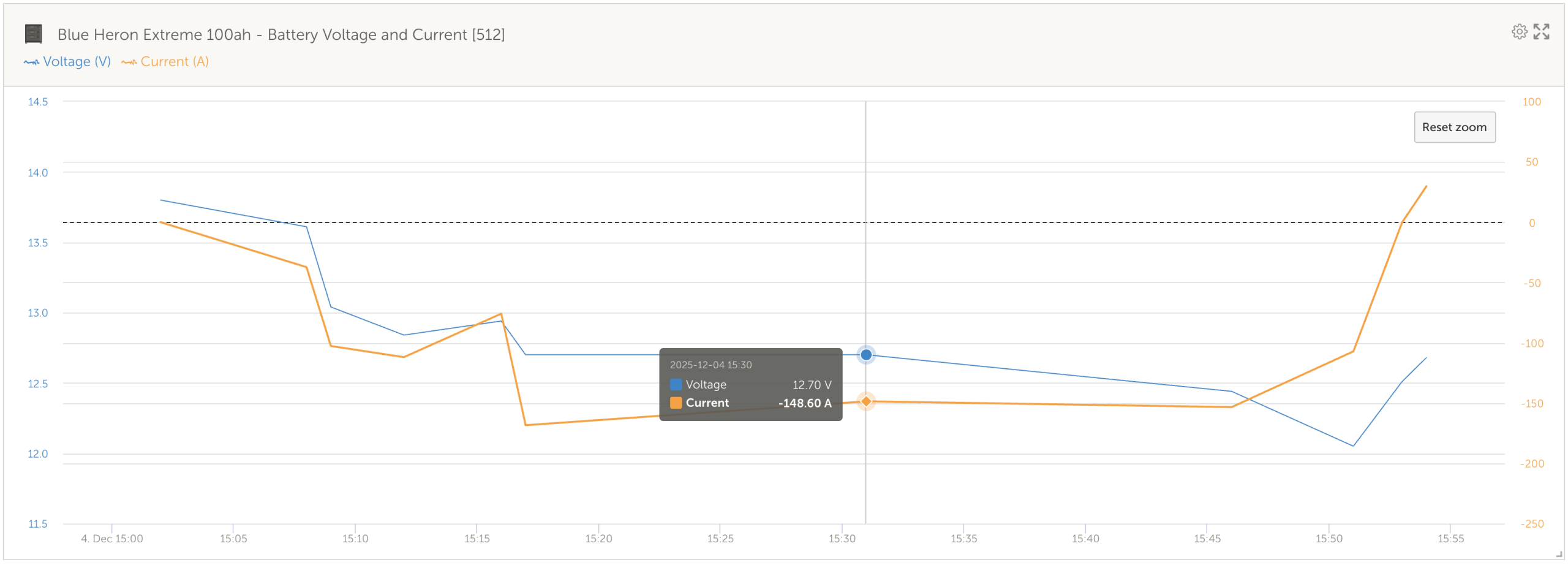
The Victron VRM chart above depicts all of the energy from this 100ah battery depleted in about 40 minutes. That’s a lot of power from the battery in a very short order. It is great to know the battery holds up to large loads, but hopefully no one sizes the house power system on their boat for sustained loads like these. On the other hand, standing up to loads like this demonstrate the effectiveness of a properly sized battery bank’s ability to handle large, short duration loads like windlasses, bow thrusters, and inverted loads like cooking appliances.
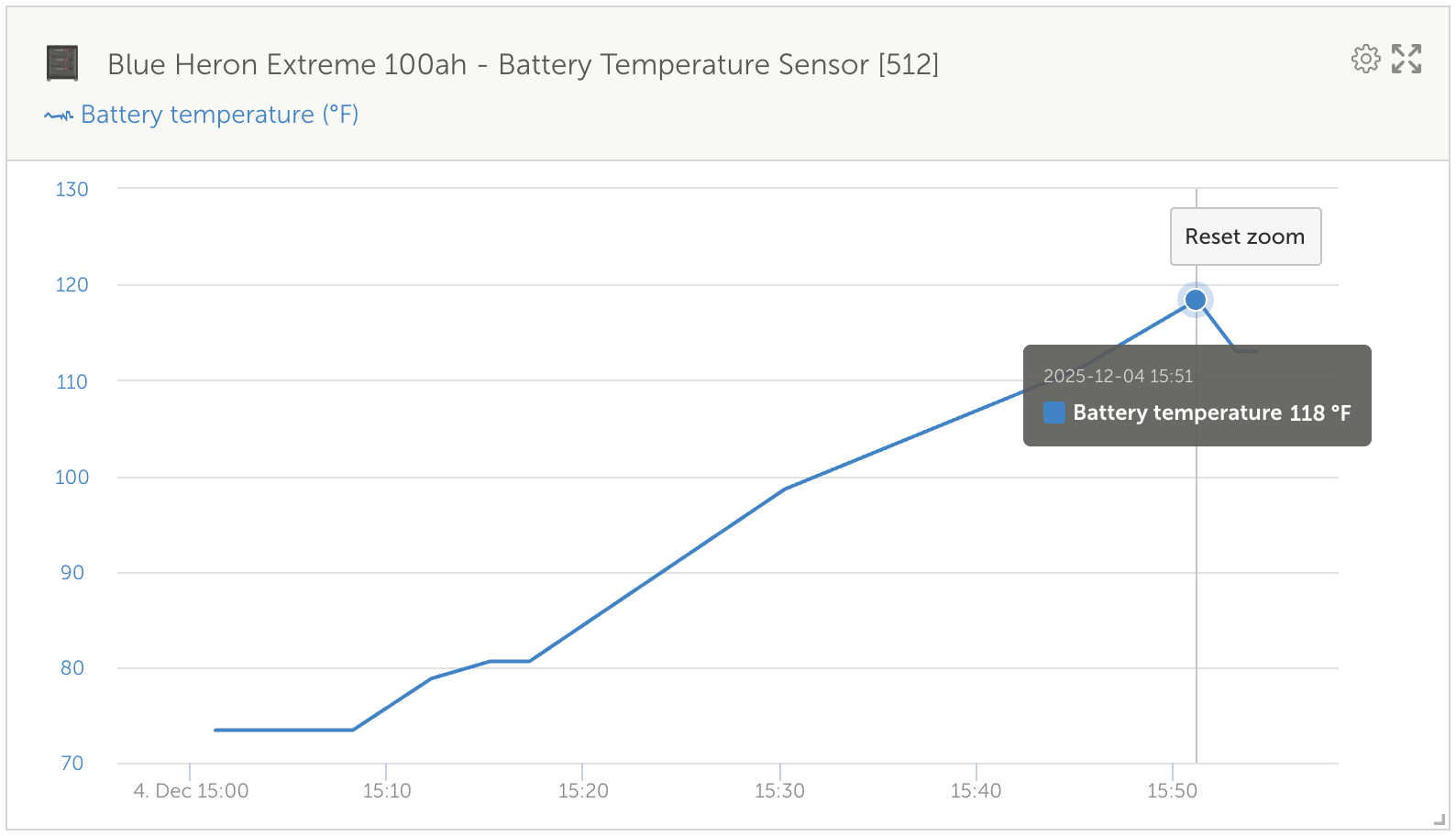
During the high load testing, the battery temperature climbed from the low 70s ambient temperature of my shop to 118 degrees Fahrenheit or 48c. The silver heat sink on top of the battery was noticeably quite warm to the touch, but the rest of the battery remained much more moderate. Although a temperatrue trend line like what the one above would be problematic if it continued, the reality is that the battery had just exhausted all the energy it stores and remained an acceptable temperature. So, I believe the thermal performance proves well matched to the battery’s capacity. Additionally, when connected via Victron communications, the battery will communicate via DVCC a low charge current limit until the temperature drops.
The app
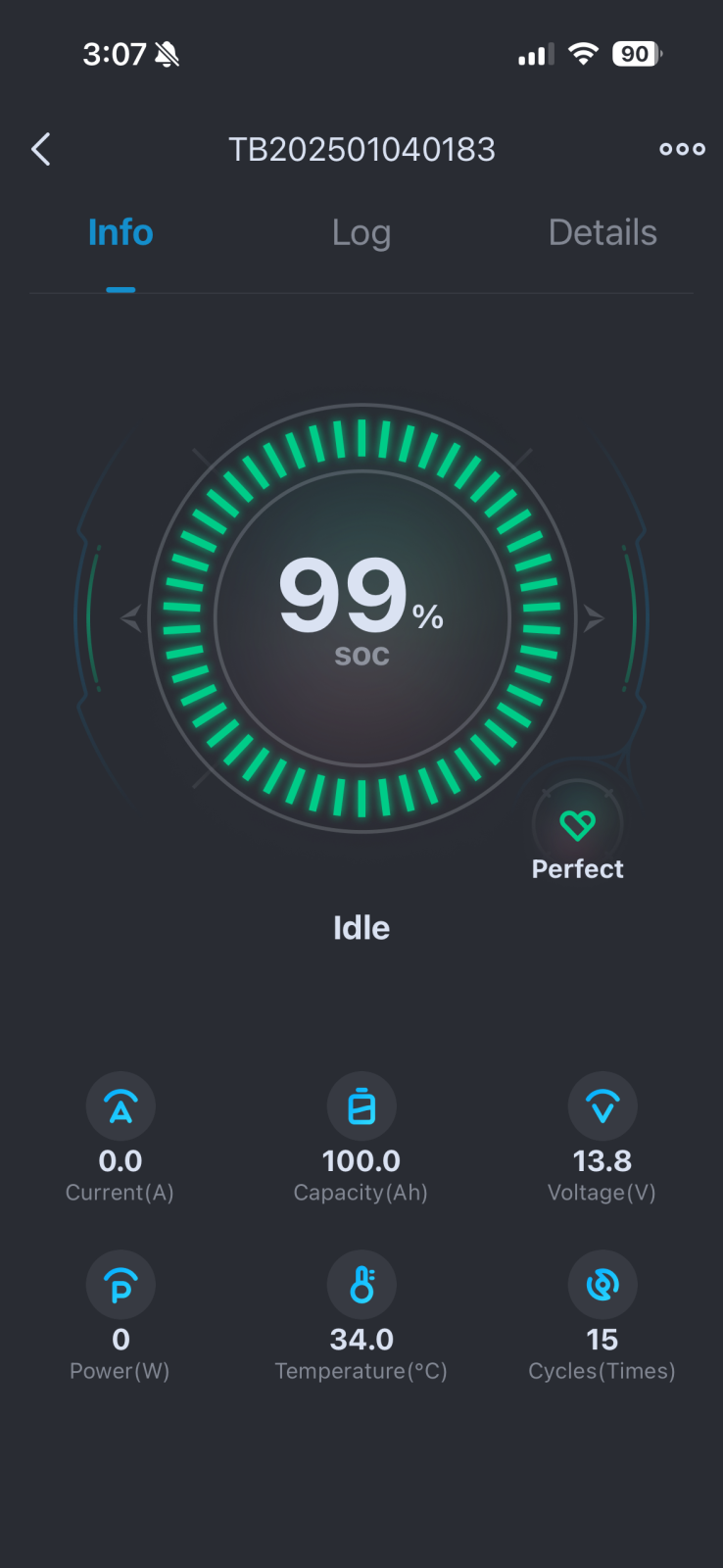
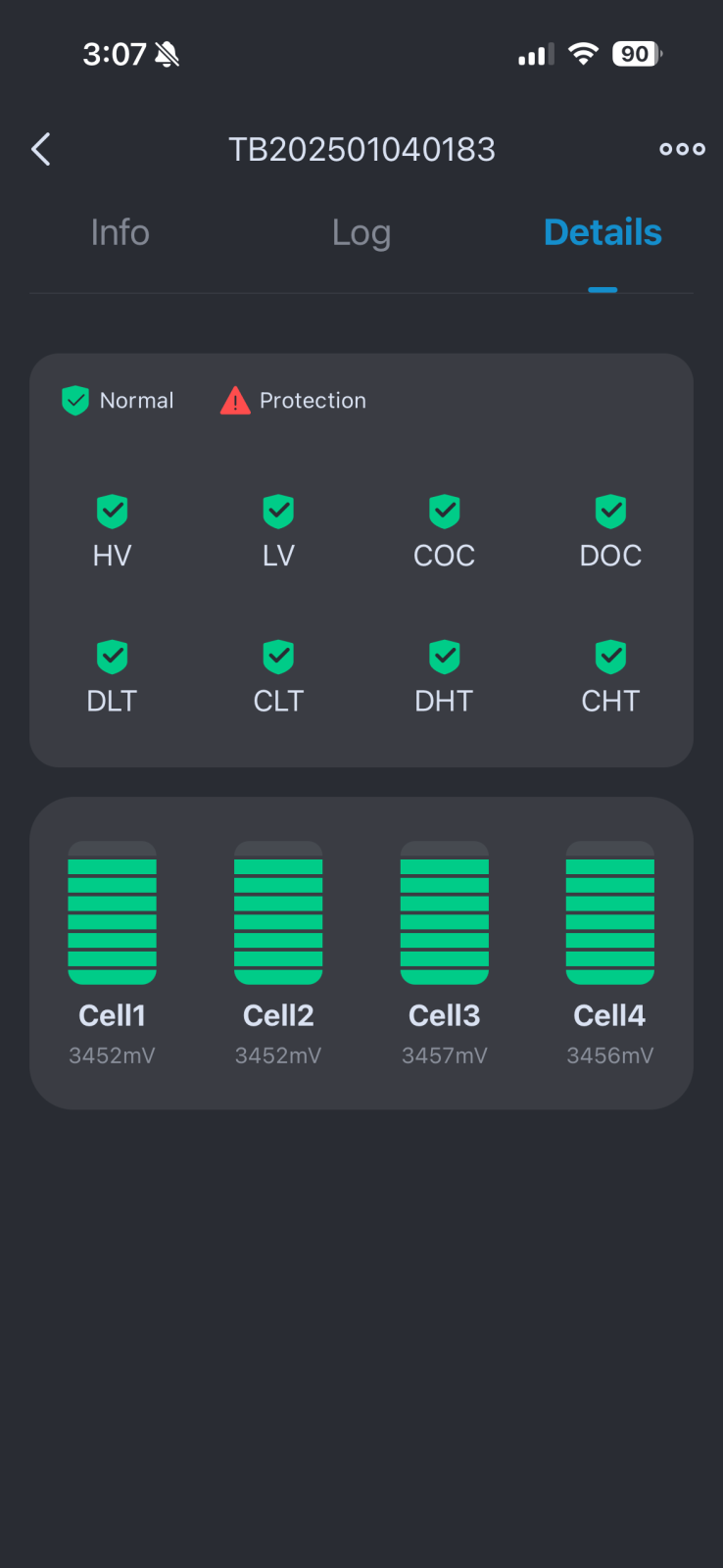
Blue Heron’s Extreme series batteries utilize the TB Battery app. Developing apps is an expensive and challenging process. Developing good apps proves elusive to many companies. Rather than try to develop their own app, Blue Heron is using Top Band’s app. Top Band assembles the batteries for Blue Heron and manufactures several of the components, including (I believe) the BMS. If the app above looks familiar, you may well have used another battery brand that also relies on Top Band for their assembly.
Overall the app is simple and effective. It reliably connects to the battery (I know that sounds trivial but I’ve seen it provide real challenges) and quickly displays at a glance statistics and operational information. The app does not provide any control over the battery but allows a user to check on any errors or warnings that may have been raised.
Victron communications
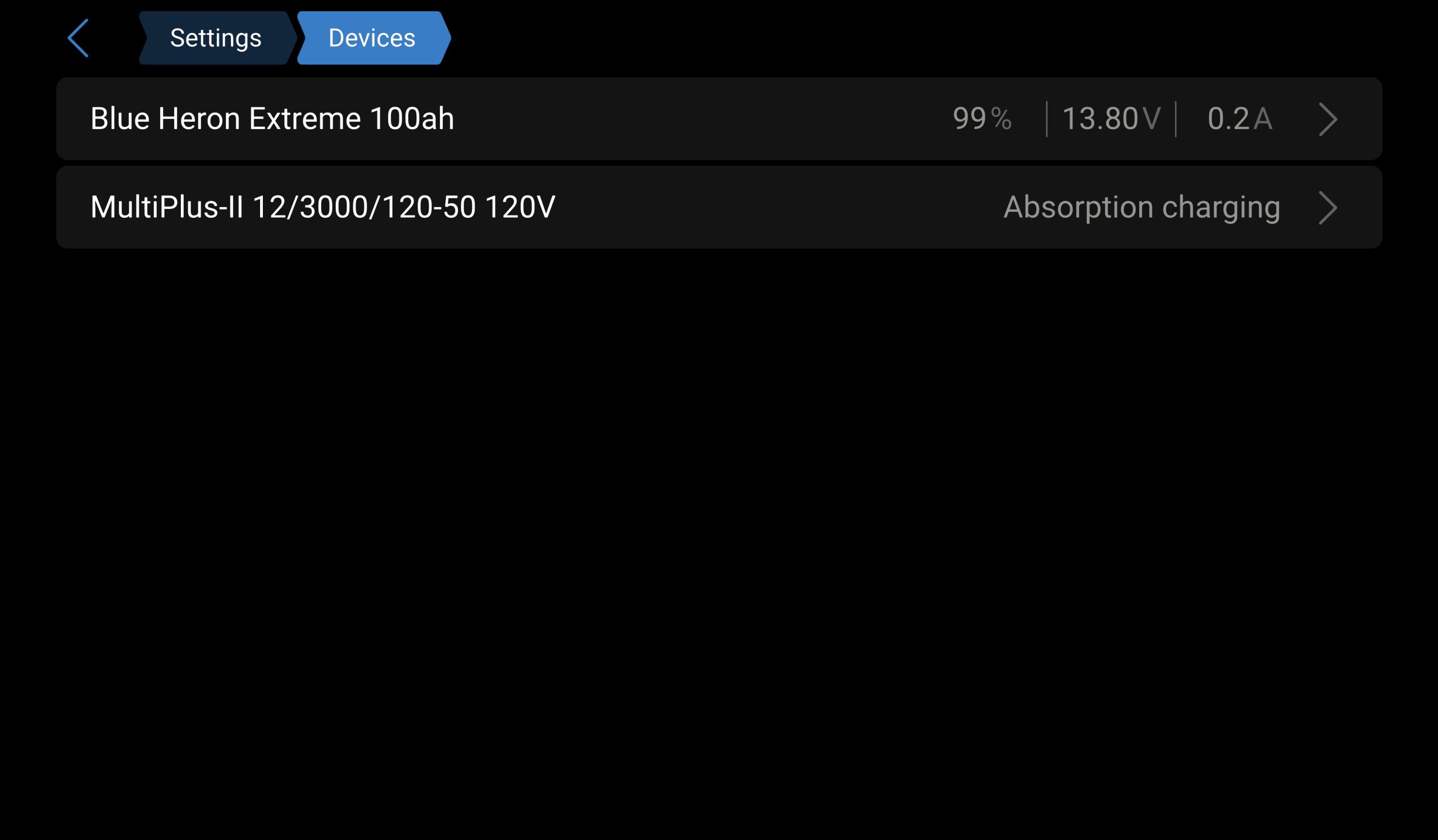
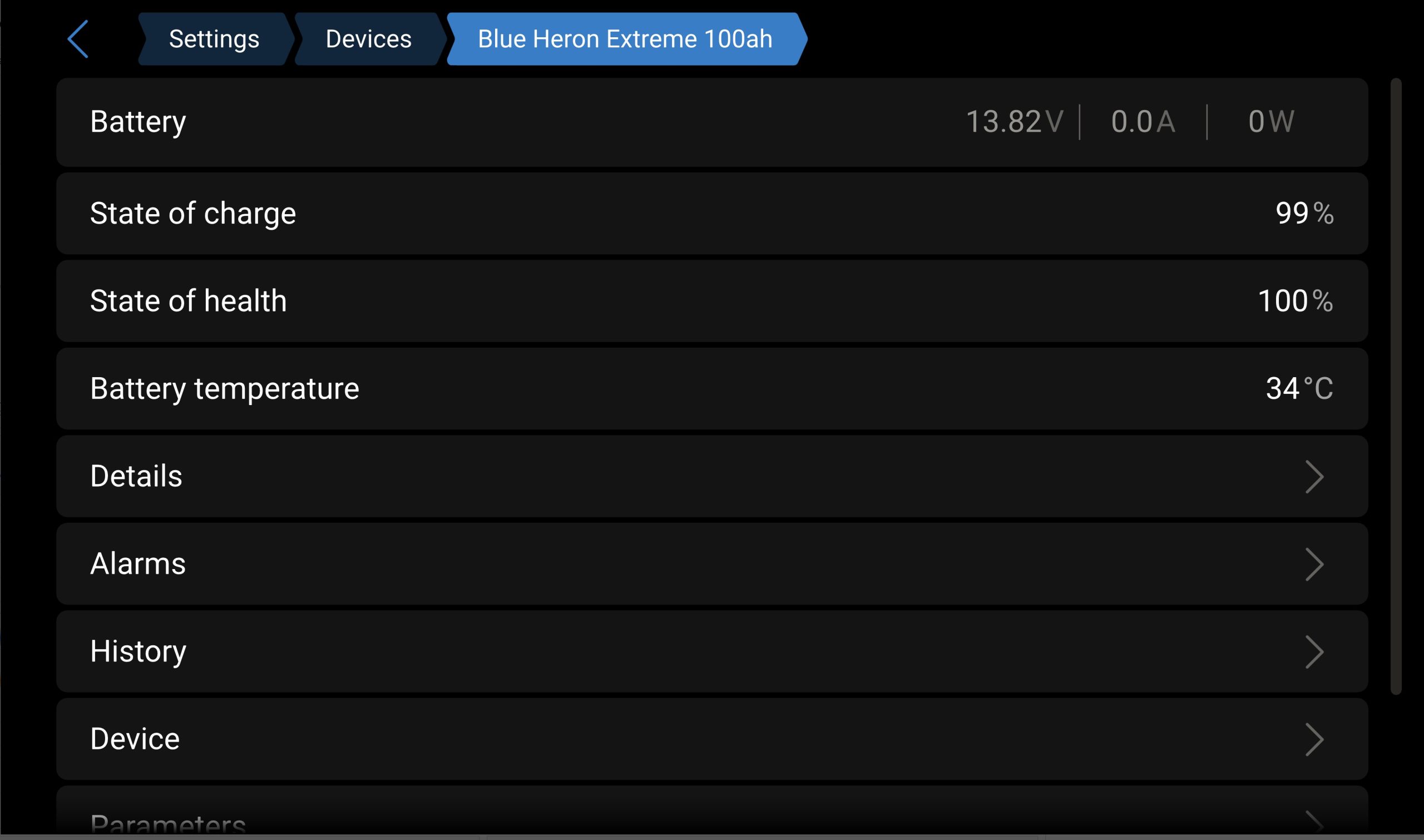
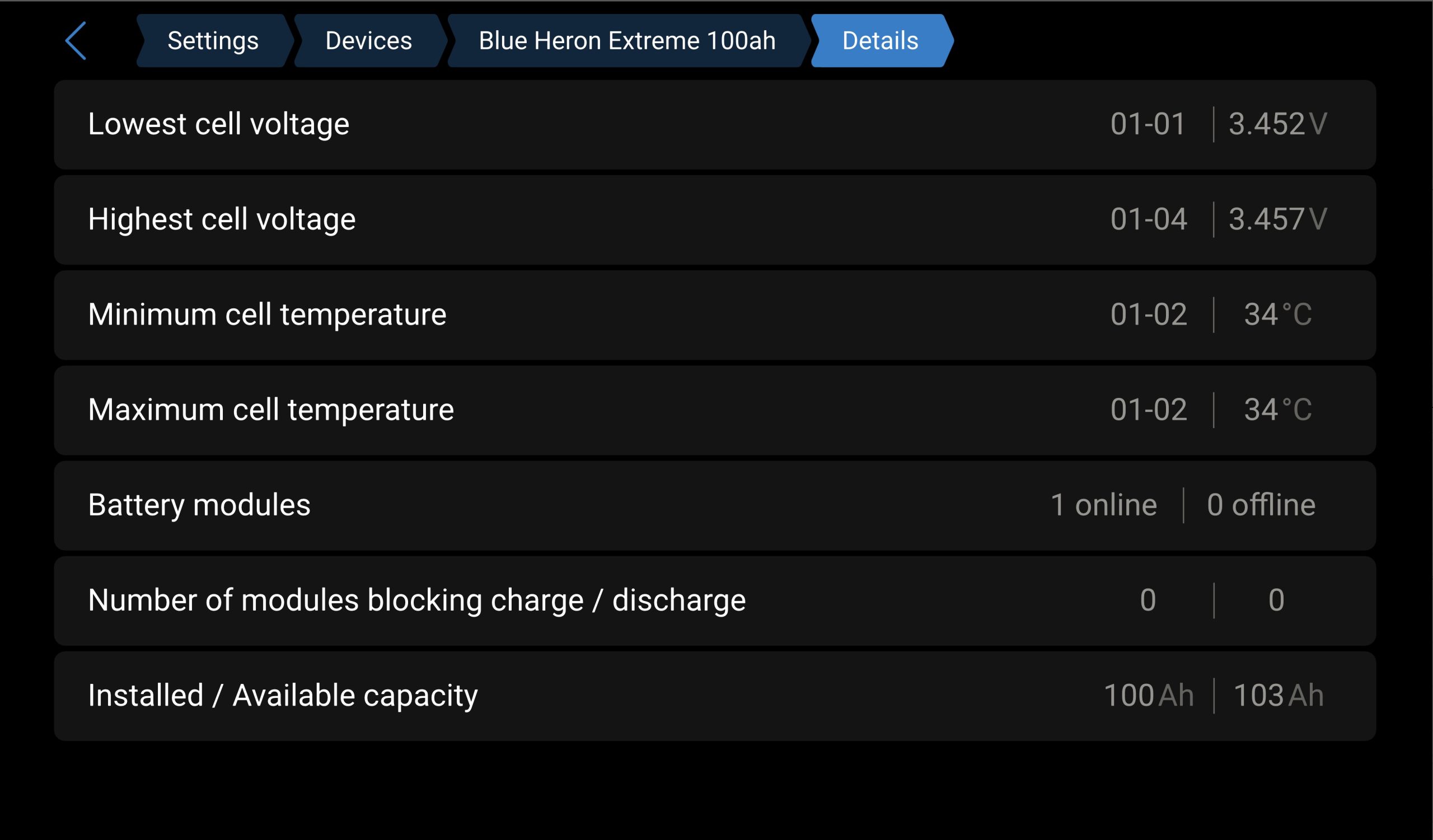
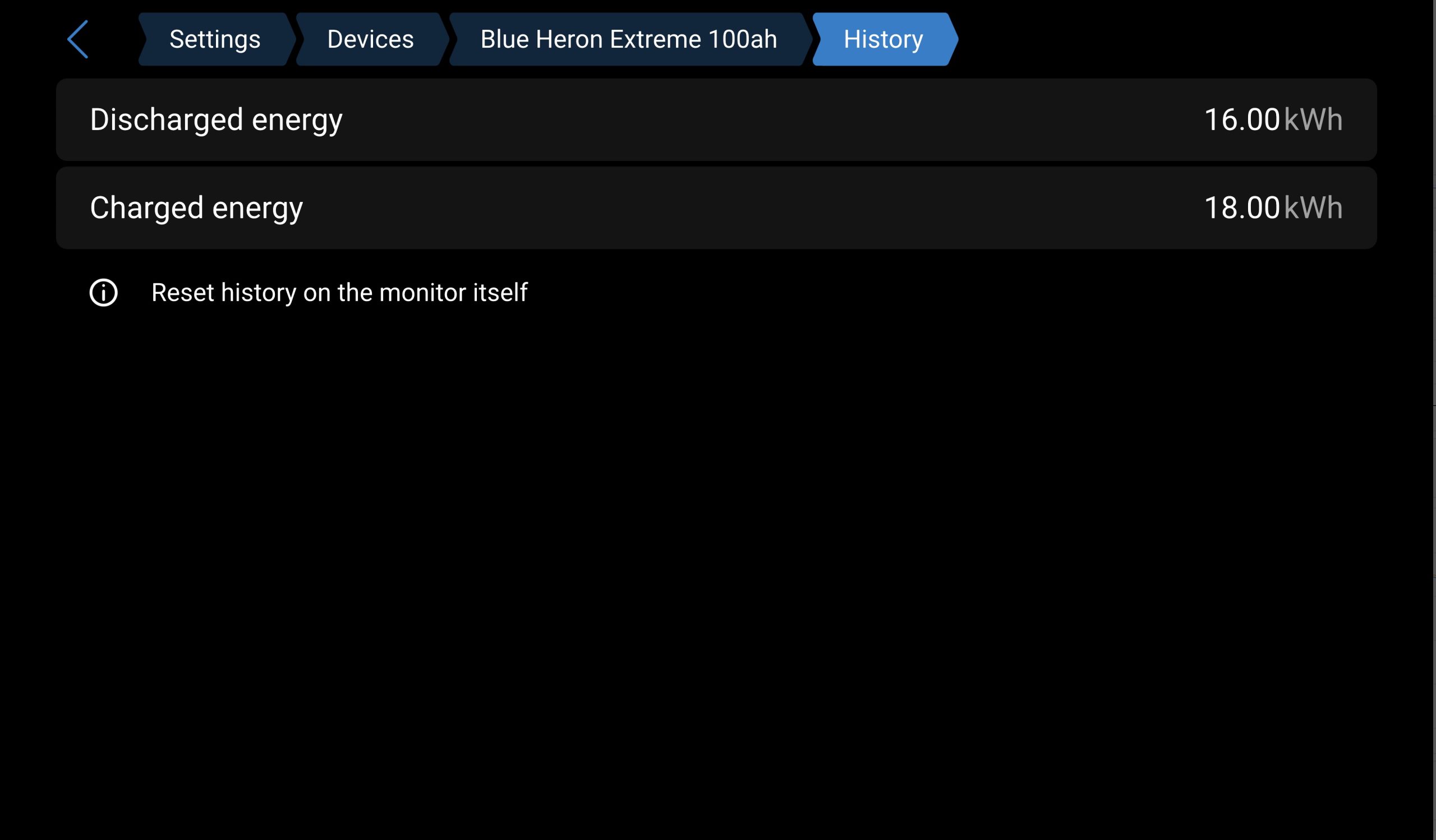
The battery proved easy to connect to a GX device. Simply plug the communication cable into the In port on top of the battery and into one of the VE.CAN ports on the GX device. Then, in the GX device’s console, set that CAN port for 500kbps and the battery appears. I did rename the battery just to make it easier as I tested. With the battery connected, it immediately begins communicating with the GX system and populating lots of information about the battery. You can then use VRM to dig into the data, see it charted over time, and investigate if anything seems amiss.
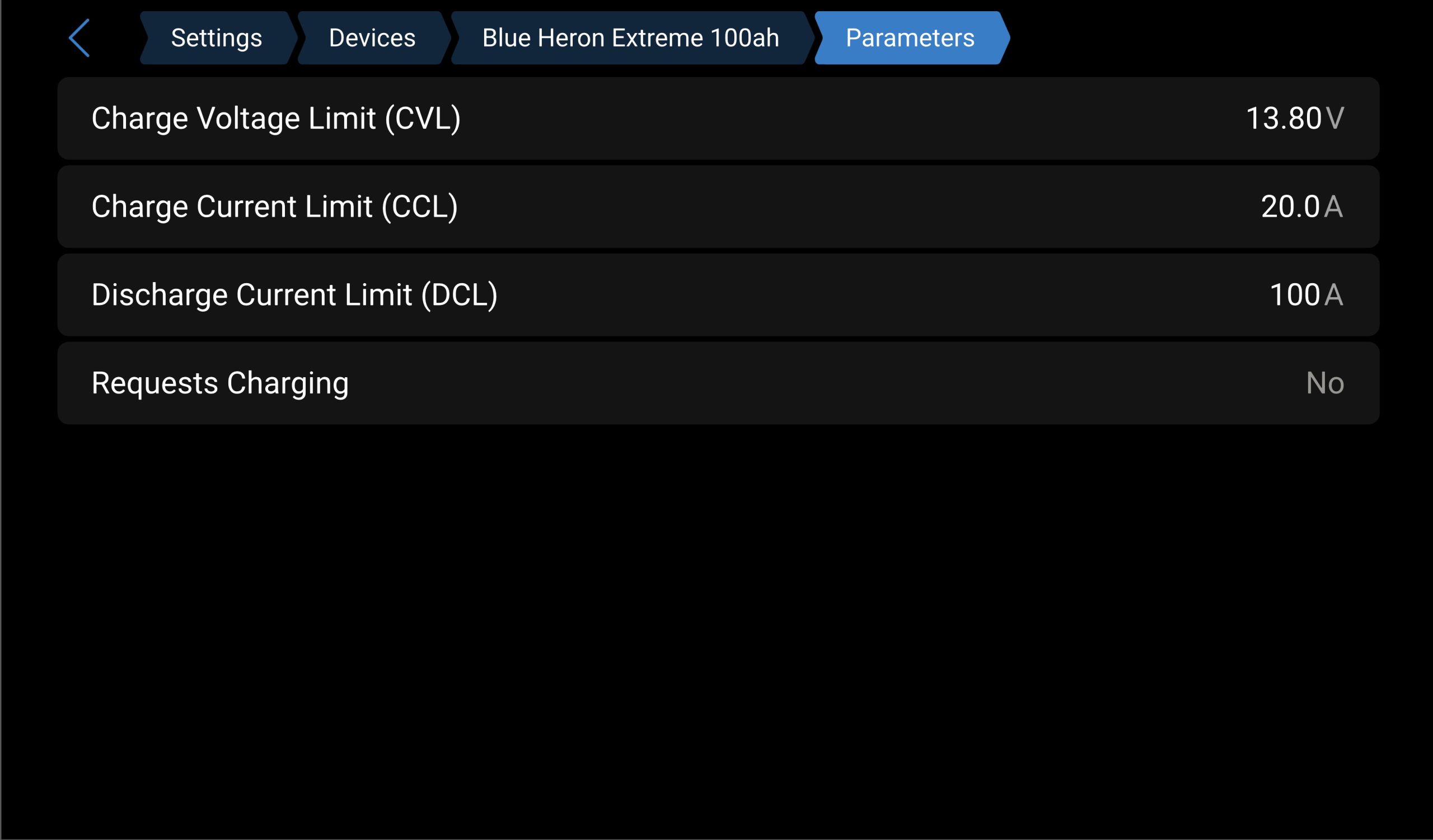
Nearly everything about the integration with a Victron ecosystems is smooth and easy. However, I do have a concern about the charge voltage limit (CVL) used in float. For reasons that escape me, the battery specifies a CVL of 13.8 volts rather than the far more typical 13.5 or 13.6 volts. I don’t think it will meaningfully hurt the battery, but it is unnecessary extra wear on the battery. At 13.5 or 13.6 volts, the battery sits just below its fully charged resting voltage. That prevents the charge source from trying to charge the battery when it is full. Instead, power produced by the charge source serves loads on the DC system while allowing the battery to happily sit just below 100% SOC.
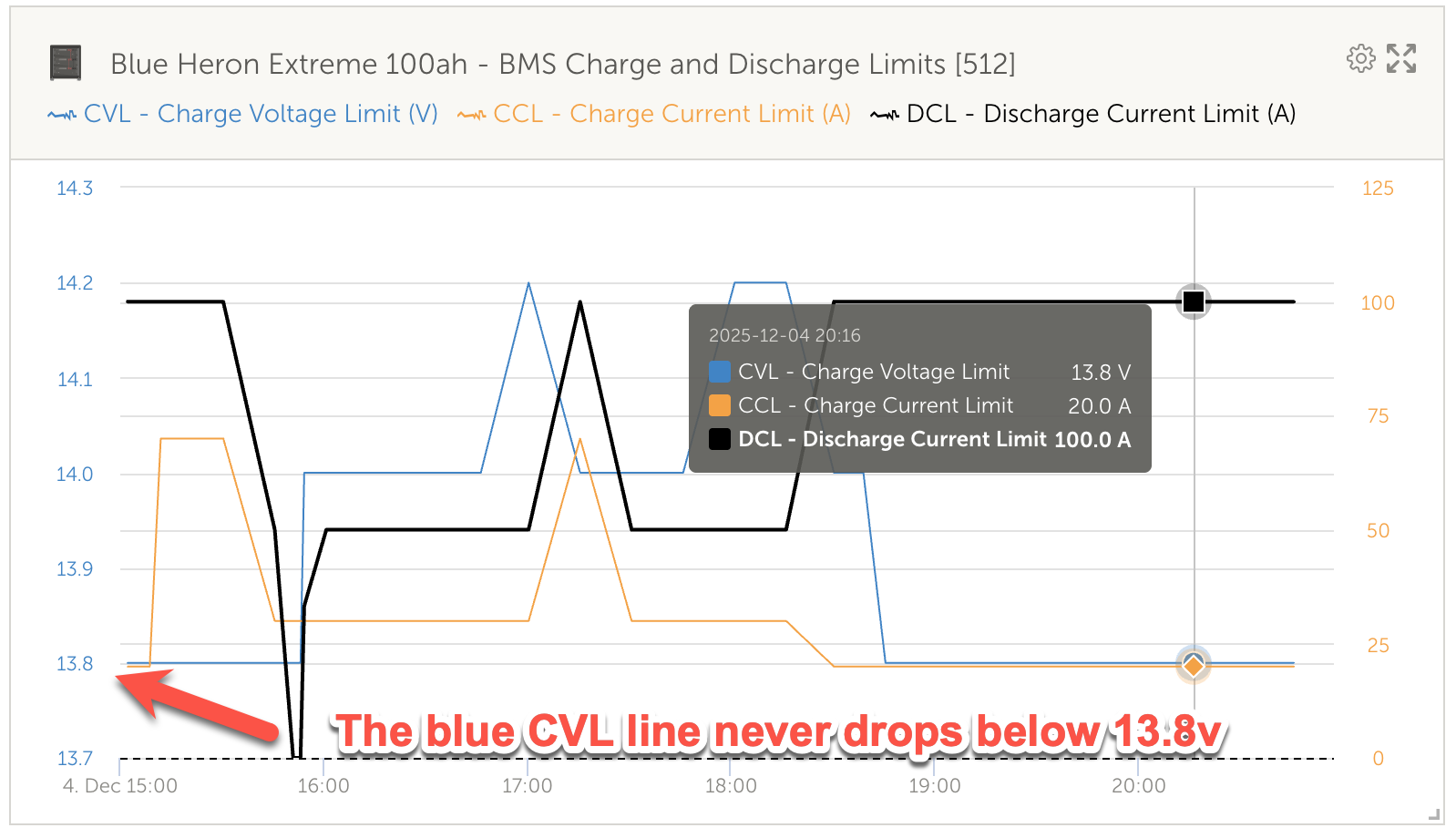
Just to make sure I didn’t miss anything, I checked the VRM history for DVCC’s commanded voltages and current levels. Charts over a multiday period verified the CVL never dipped below 13.8 volts.
Physical construction
Opening the Extreme series battery raises no red flags at all. Inside, I found a well built battery with quality components put together with care. It was also a pleasure to dissassemble a battery without lots of goo or other glue. Everything is secured with screws and proved easily removed for inspection. That same ease of removal also aids in the event of component replacements.
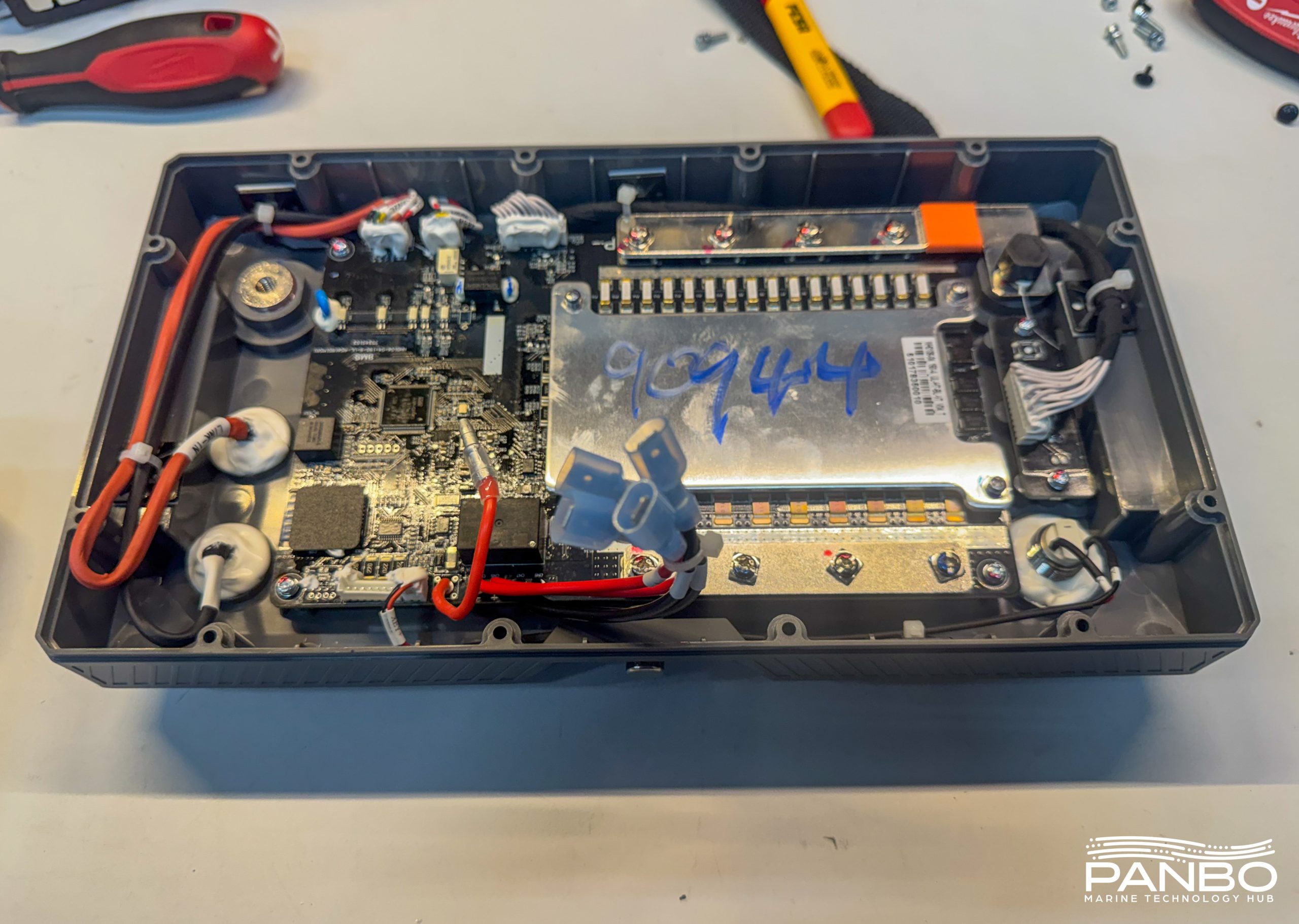
I’m a fan of the design choice to mount the BMS to the underside of the lid. Placing it there puts the BMS itself in direct contact with the aluminum heatsink in the lid. Additionally, access to the cells is eased by the BMS not sitting on a mounting plate or substructure on top of the cells.
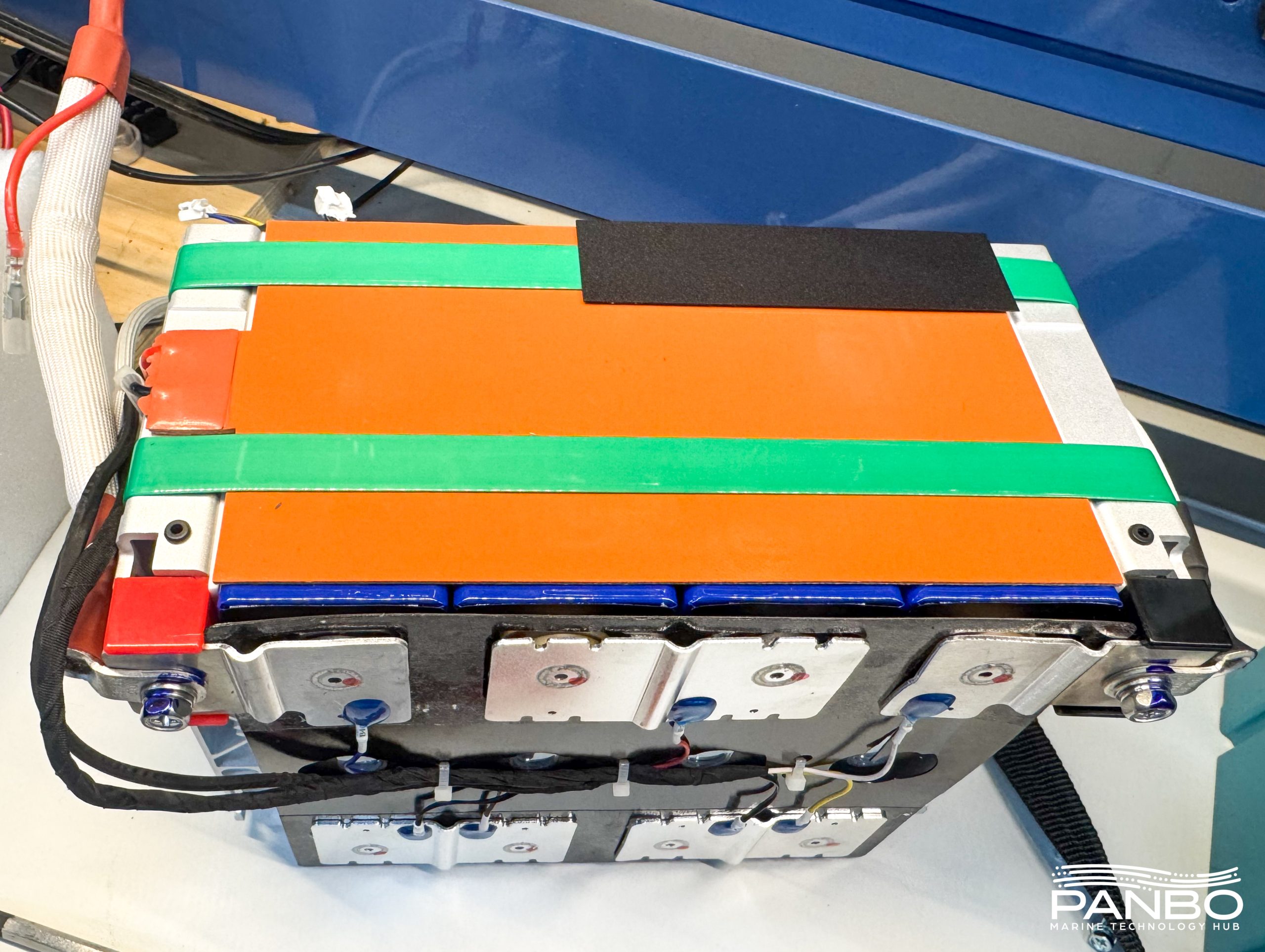
The cell pack itself shows several positive traits. First, the cells are held in compression by well made, reinforced aluminum stiffening plates at each end. Compression is held with straps wrapped around the stiffening plates. Laser welded busbars connect the cell terminals and appropriate chafe protection guards all wires. The cell pack’s cold weather temperature is maintained with two heating pads, one top and one bottom.
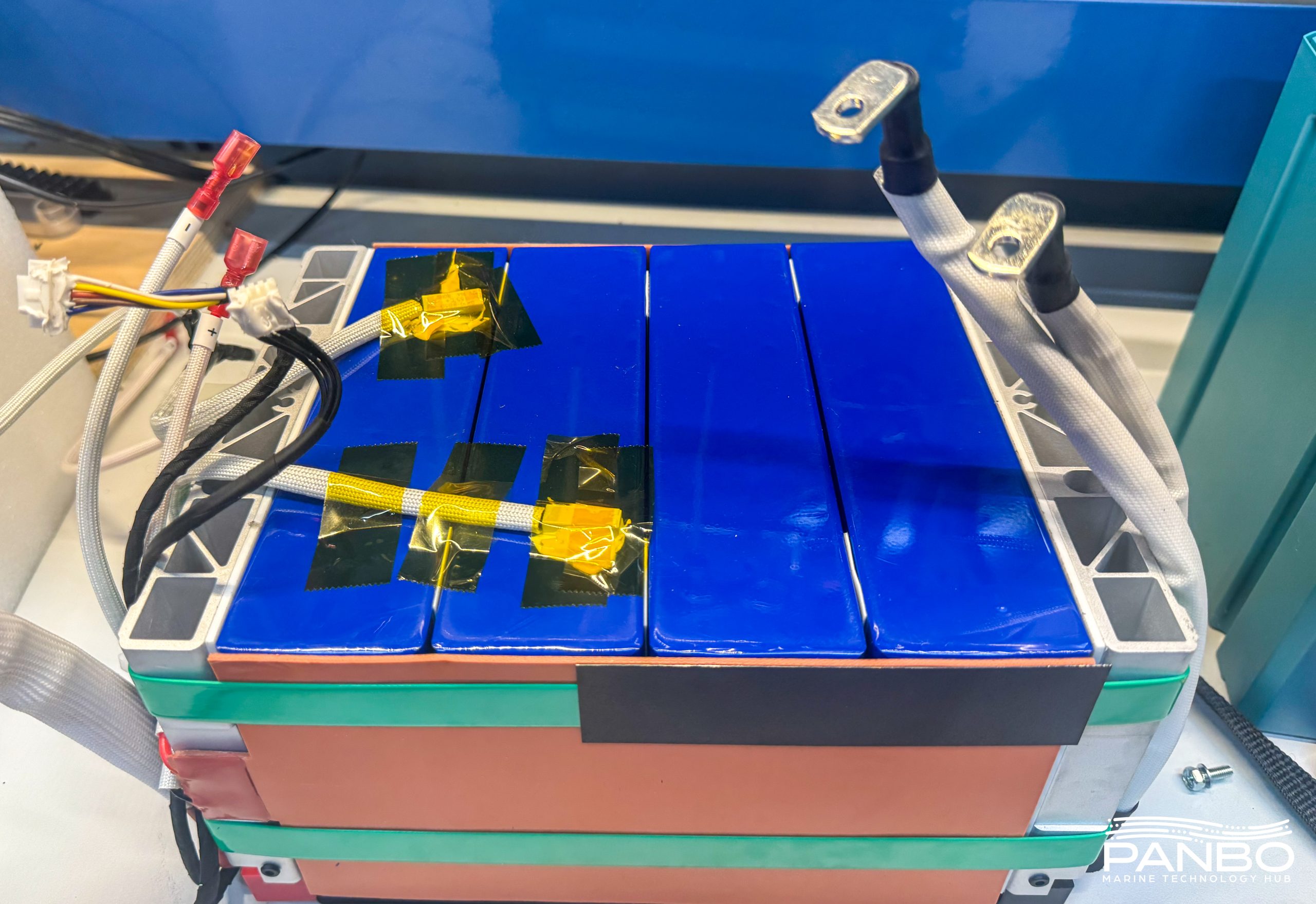
I’m definitely knit picking here, but I would prefer not to see both of the cell temperature sensors on one side of the battery. If anything happened with the far right cell, it would take a while for heat to saturate through the middle cell and reach the second from the left cell with the second temperature sensor on it. I don’t have any idea if this is a quirk of this specific battery or if this is how all of them are produced.
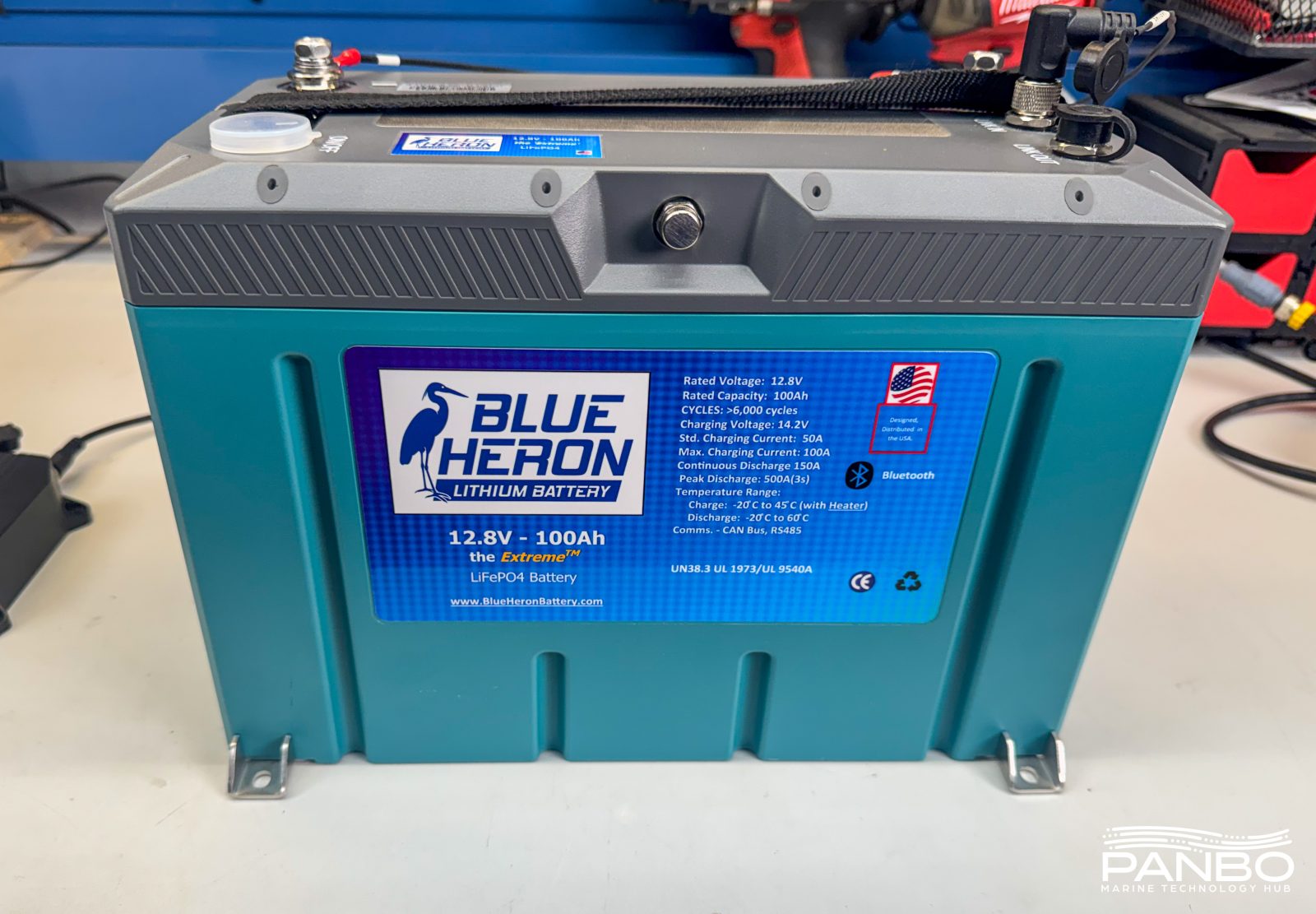
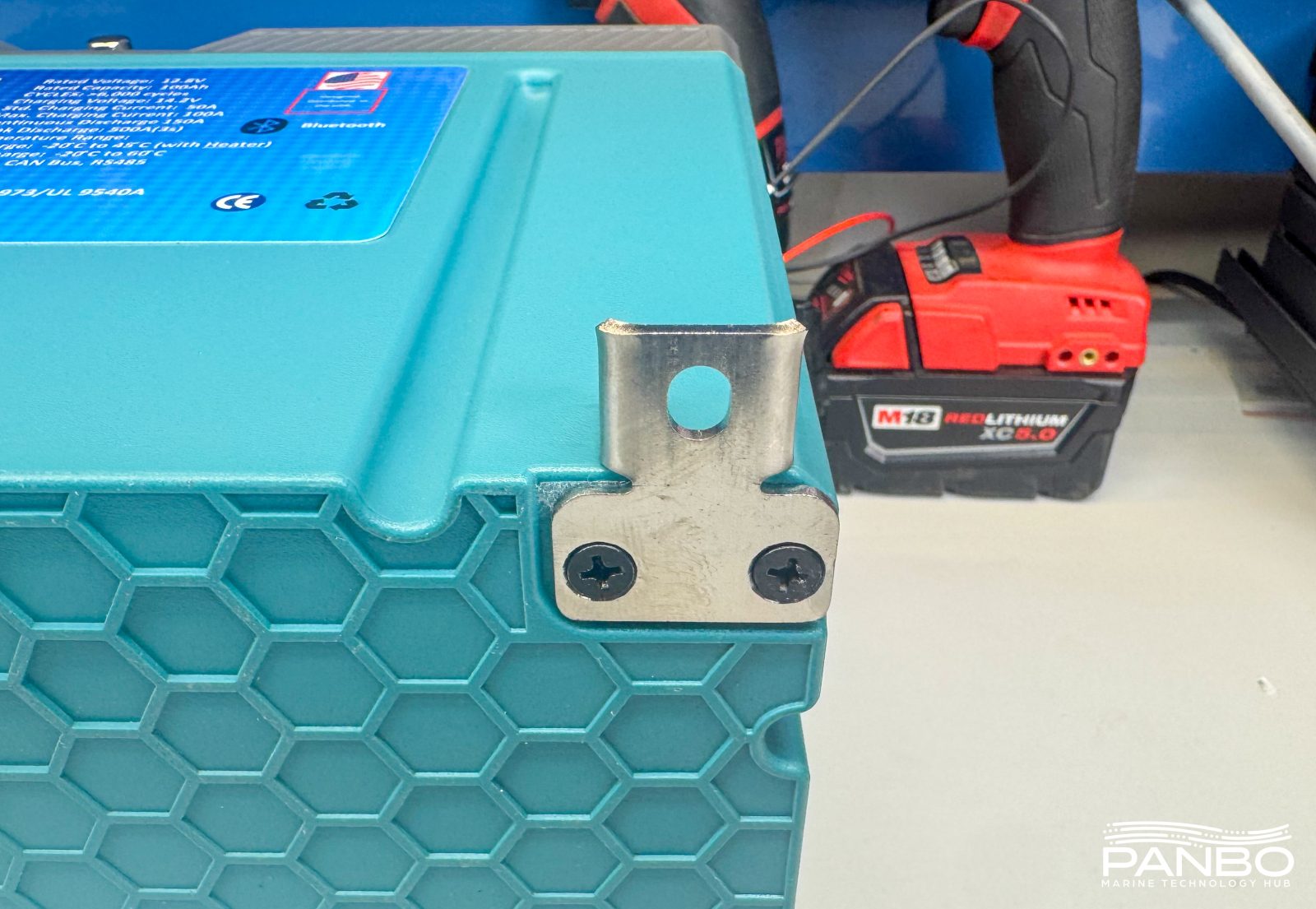
The 100 amp-hour battery’s group 27 size means it will fit in a group 27 battery box or tray. Alternatively, mounting feet are provided with each battery. The feet make it easy to secure the batteries to the floor on which they sit.
Final thoughts
As LiFePO4 batteries get more popular and upgrades become more common place, the number of battery options expands continuously. Additionally, the cost floor just keeps dropping. Blue Heron’s batteries are far from the cheapest, but they bring a strong set of features. These are premium batteries with high performance. As the table at very top of this article shows, there are cheaper batteries out there. But the price of these batteries, in light of the features and functionality they offer, is quite fair.
If you’re specifying a battery bank with a diverse group of workloads including some large motor loads like thrusters and windlasses, these batteries perform and give you a lot of options. Additionally, many house batteries are wired to provide emergency engine starting in the event of an issue with engine start batteries. I don’t expect these batteries and their robust surge ratings to have any issues with emergency engine starting.
My biggest reservation is the DVCC float value. I believe these batteries are field upgradeable, so I am hopeful that Blue Heron will be able to put out a minor tweak to address that value. With that in place, Blue Heron offers a high performance battery at a reasonable price to solve a wide variety of needs.



So I posted on the diy solar forum a few months ago ….trying to find who the man behind the curtain is with these batteries.
Blue heron seems to be another brand using the same ..everything ..as
Invicta
Bla
Redarc
Enerdrive -dometic
Epoch
SOK
No shade…the I run Invicta batteries in alot of builds for that reason. But all of these brands are being built by somebody. Would love to know who.
I questioned if roypow may be the wizard. Being they build epochs batteries but no answer.
I’m such an idiot I totally skipped the paragraph where you mentioned this exact thing lol
Carry on !
I’m such an idiot I totally skipped the paragraph where you mentioned this exact thing lol
I will add that looking at the internals. I’d say the Invicta battery has a better construction but no doubt more expensive. The app however is identical
Carry on !
I totally agree that the 13.8v float CVL (and manipulation of CCL) is not an ideal approach. The low absorption (13.8 or 14.0v) voltage is fine, just a bit slower to fully saturate the cells and a minimal capacity hit, if they aren’t fully absorbed nearer the top end of the SOL, but holding the cells, potentially 24/7, so far into the knee of the charge curve at 13.8v and well above full charge resting voltage is an approach I have turned off on my two 12v Topband “family cousins” and won’t employ in the 60 ah 24v version I have for my bowthruster upgrade. In my year with the 12v’s, they have done very well with the 14.2v/13.5v profile but the balance has been disappointing, perhaps because of the limited time above 13.8v in 14.2v absorption with a 3% tail current. The balancing circuit may need more time above 13.8v…IDK. I do know the BMS SOC will reset at 13.8v.
I keep my sloop in the same small sleepy town in the Northern Neck as Blue Heron. The folks at Blue Heron are top-notch systems builders and these are great batteries…especially if they can get the firmware configuration to operate a little more like the conventional LFP charging profile. I’d like to see that with the other Topband cousins, too.
Nice review. I think these are a great value in the higher tier internal BMS batteries.
Choosing one of these batteries also requries, short of just using our smartphone, a choice to replace or reconfigure battery monitors.
E-13 requires we rig an audiable alarm, there is mention of having 30 seconds warning of a BMS shut-down. Almost all of us will be installing batteries where an integrated alarm signal won’t be audiable at the wheel. I understand from installers on two battery installations, a common scenario is to have one battery shutdown and remain so escaping the attention of the boat owner for much of the season.
I would value a future article around all the options for external battery monitoring to address this. For example for this battery many Victron options are shown and an NMEA-2000 communication option (with little detail). Maybe include other battery monitors that are common like the Balmar SG-200 that claim to also support LiFePO4.
Thank you!
the E13 disconnect audible alarm recommendation in the 2022 E13 standard was never a requirement. It was a note and therefore a “should.” By the way, That note was dropped in the 2025 E-13 revision.
It IS still a great recommendation and it can be done in several ways. The Blue Heron/Topband family have canbus signaling which make this even easier through a GX. (Signal K and/or node red).
Here’s my plug for joining ABYC for all the included standards, it at least buying the standards you want and reading them directly. They are not easy, at first, to interpret and there are many, many nuances that can get convoluted without experience or context. E-11, is the meat and potatoes. E-13 is still only a small component of the LFP upgrade safety standards.
Got it, good to correct my post for others.
Nice article.
Does this battery include an internal fuse (similar to the Epoch high end batteries)?
Lewis,
It does not include an output fuse as the Epcoh Elite series does. There are fuses on the board itself, but I believe those are there to protect against individual component failures on the board. If any of those trip, it’s the end of the BMS.
-Ben S.
Hi Ben,
I’m a bit confused about the issue of the CVL being 13.8. If you had properly configured charging sources (solar, AC or alternator) wouldn’t they drop their “float” voltage to a lower level and solve the problem? It would be nice, of course, to have the battery do it, but it shouldn’t be a problem.
Hartley
Hartley,
My apologies for missing this and your next question.
To answer this question first, no, a correctly configured charger following DVCC won’t drop its float voltage lower than what is being requested by a DVCC integrated battery. Effectively, DVCC overrides the charge profile settings. While you can set upper limits on DVCC parameters, you can’t override the rest without disabling it.
-Ben S.
I see – OK, the concept of the battery controlling the “controller” for those charging sources had be confused 🙂 For sure I don’t have any of that on Atsa, so it just didn’t occur to me.
Hartley
I notice in the Victron screen shots “Request Charging = No” Doesn’t this mean the battery is sending info over the Victron comms but is not implementing DVCC?
It’s my understanding that this parameter isn’t really evaluated by the GX system. But, most batteries I have observed seem to use the flag to indicate the battery NEEDS charging. So, usually the parameter flips on when SOC is low, pack voltage is low, etc. I found this thread on the Victron forums, though you will have to translate a little of it: https://community.victronenergy.com/t/pylontech-requests-charging/51485.
-Ben S.
And now I’ve thought of another question.. 🙂 I see that this battery (like many others) offers heating for low-temperature charging. How, exactly does it work? When I built my external heater for my Victron battery, I set it so that it uses raw solar panel power to run the heater (22V or so) – that way it doesn’t draw power until the system is ready to charge. In Maryland in January, I could see the battery warming up as soon as the sun cracked the horizon, raising the battery 4-5 degrees C in a couple of hours.
I had heard that these internal heaters somehow use power from the charge side, but since charge & load would seem to be both connected to the same terminal, how does that work?
Hartley
Hartley,
The exact functionality varies from manufacturer to manufacturer and battery to battery. But, the basic ideas remain fairly consistent. Most BMSs use logic to control heating. If there is charge current coming into the battery, turn on the heater. If, with the heater on, the battery is operating at a deficit, that is now discharging, turn the heater back off. Typically, there are tiered delays associated with these actions. If there’s a lot of current coming in, turn the heater on quickly. If there’s a lot of current going out, turn the heater off quickly. If the current flows are smaller, use longer delays. In many cases, and depending on the temperature of the cells, the BMS will disconnect the charge MOSFETs to ensure no energy reaches the cells when they’re too cold to accept a charge. But, there are complications to that approach. The biggest of which is that when a MOSFET is disconnected, it directs current through the body diode and generates heat. So, if there is a large discharge current on the battery, the BMS can’t leave the charge MOSFETs disconnected or they risk cooking them.
Hopefully that answers your question.
-Ben S.
Hi Ben! It does – I am pleased to hear they’ve done some innovation in this area, as the potential for just running the battery flat trying to keep itself warm on a cold (and chargeless) night would be discouraging. I ran into this where we store ATSA for the winter these days – we can’t leave her plugged in, and the nights can be very cold & long in December! I was surprised how few watts of energy were required to bring them back up over 5 degrees C on some of those frosty mornings 🙂
Hartley
Notwithstanding the features and quality of the batteries reviewed the fact that Blue Heron is a newer, smaller vendor weighs against paying such a premium price. What reason does a buyer have to believe that Blue Heron will be around for the expected lifespan of the batteries they are offering? The LIFEPO4 market is volatile and rapidly changing, brands come and go, and the price gap between good quality budget batteries and premium models have become absurd. Kilovault was another premium brand made by Topband. Their main claim to fame was that they were UL listed and had a communication port. They closed abruptly without ever implementing any features using the port, there is no support ,and even the Bluetooth app is unavailable to IOS users. It would seem that for most people buying cheap makes more sense and for that small segment of the market that actually needs Victron or other communication capabilities they would be better off going with a vendor that is unlikely to go away.
I believe Blue Heron has been around for 15 years.