

Garmin announces Signal VHF radios, Vesper’s DNA lives on

I’ve been waiting for this announcement for a long time. Ordinarily, VHF announcements from major marine manufacturers aren’t that exciting. Manufacturers often rely on third parties to design and build their radios. Those radios frequently just complete the line and ensure a brand matching helm. But, Garmin bought Vesper, an AIS specialist, in January of 2022. My piece covering that acquisition asked if Vesper’s innovation would continue. We’ve had to wait more than four years, but the pictures of the Signal series radios look promising.
I ran Garmin’s press release announcing Signal earlier today, but as I was putting that up I was also busy firing off emails to learn a bit more about Signal. My first question was about Signal’s relationship to the intellectual property Garmin purchased when they bought Vesper. My own path following Cortex ended with the loss of Have Another Day back in September of 2022. The eval Cortex unit I had was on board and although Garmin offered me another one, I didn’t feel there was enough gained to take them up on their generosity. So, my familiarity with Cortex is based on my experiences prior to losing my unit.
Garmin responded to my inquiries about Signal with the following information, “The Signal VHF series is really the best of both worlds — it has a strong Vesper DNA found in the cutting-edge features and functionality which is held within the robust engineering processes from Garmin which bring reliability and ease-of-use into the product.” Additionally, Garmin confirmed that Signal is built entirely in house leveraging their design, integration, and manufacturing capabilities.
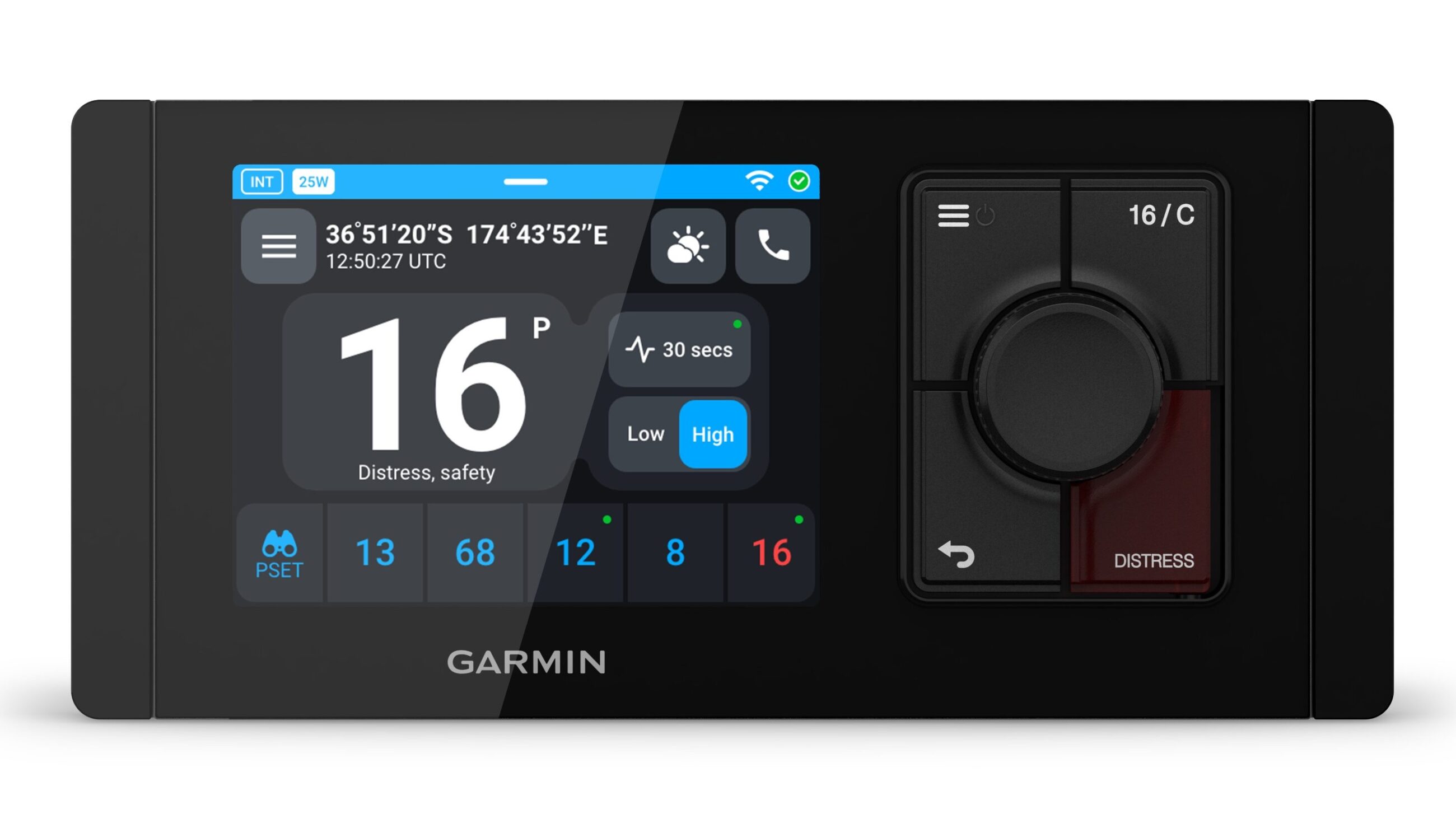
The Signal line-up, as announced today, includes The Signal VHF 220 and 400 VHF radios. It appears the radios are identical except that the 400 incorporates VHF transceiver functionality compared to the 220’s receive only. Additionally, the Signal lineup includes the RM 100 remote station. Visually, the RM 100 is identical to the two radios and serves as a complete remote station to either radio. The VHF 220 and 400 each support up to five RM 100s. The VHF 220 carries an MRP of $999, the 400 sells for $1,499, and RM 100s are $699.
Cortex shines through
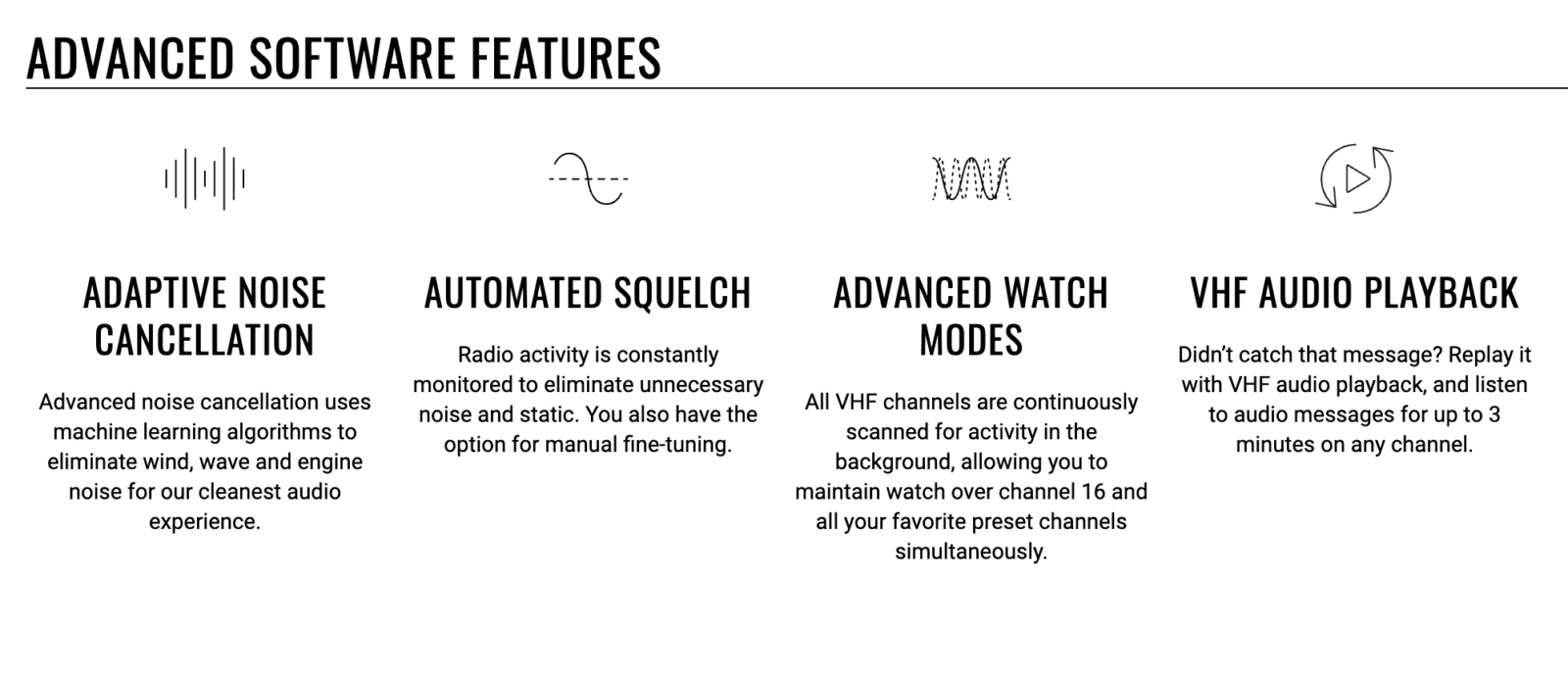
Perhaps I should have looked at the product pages more carefully before bothering Garmin with my questions. Scrolling down a little further in the product pages shows clear Cortex features and capabilities. The available integrated AIS transceiver, automated squelch and full channel scanning all demonstrate the Cortex roots. At the risk of speculating badly, I’m pretty sure Signal radios use the software defined radio (SDR) from Cortex to deliver the integrated AIS and VHF voice functions. That means that there is truly only one VHF radio in the unit doing double duty as both the VHF voice radio and AIS transceiver. The SDR gave Vesper (and now Garmin) the ability to monitor and analyze all VHF channels simultaneously and perform many of the other advanced tricks unique to Cortex.
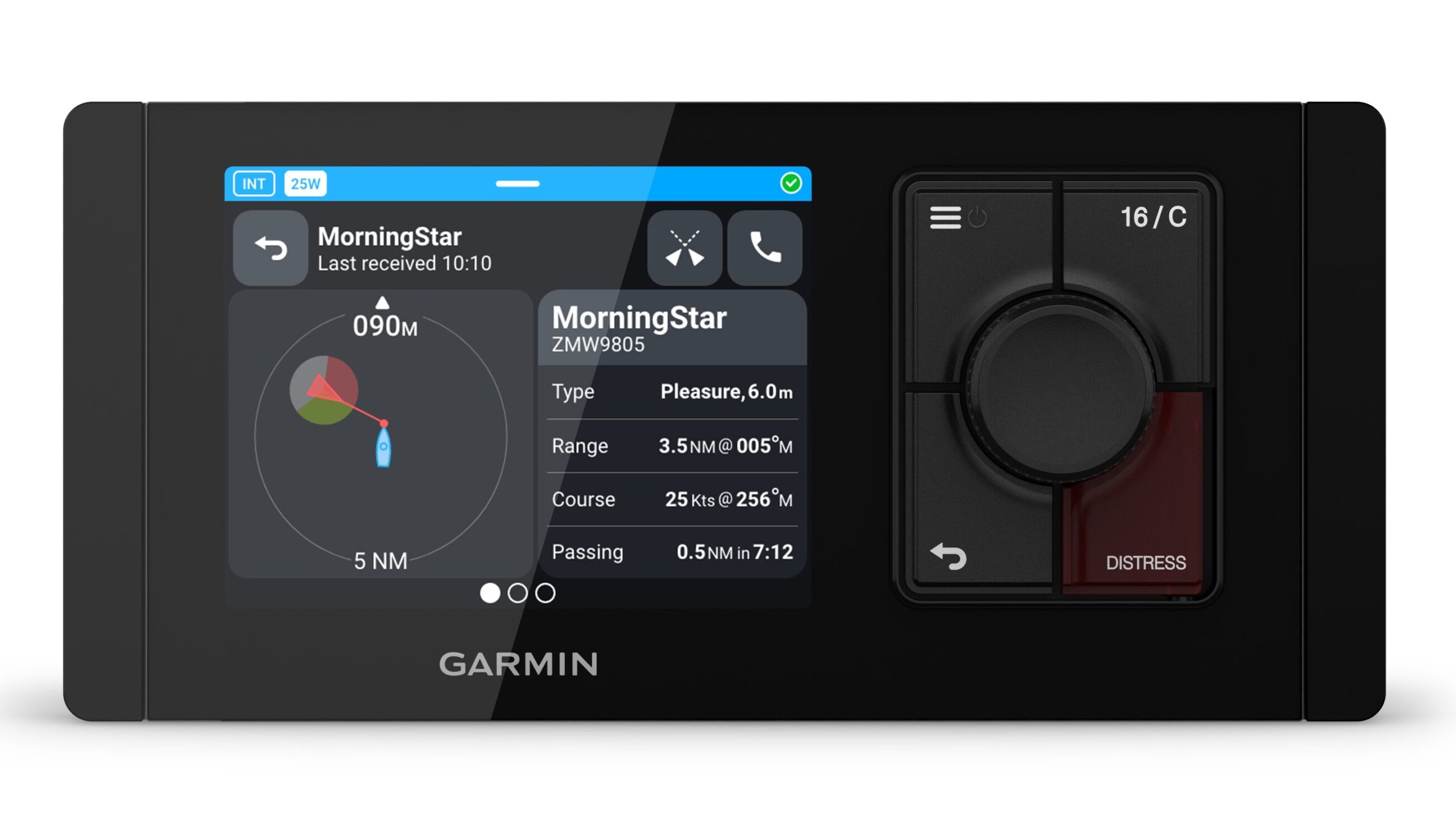
I am anxious to see what of those advanced capabilities continue in Signal. Cortex was a hugely ambitious project undertaken by an AIS specialty company. In my observations, Garmin prioritizes features that reach the largest possible number of boaters. So, some of the unique capabilities that made Vesper Vesper might be hard to justify across Garmin’s customer base. But, I see real reason for optimism. Buried in the materials I received is a mention that Signal is compatible with the Navionics Boating app. That caught my eye, so I read further. I’m happy to see that Garmin reports Signal will relay AIS, GPS, and heading data via WiFi. That’s a long standing Vesper feature carried forward.
Time will tell if Vesper’s superior anchor alarm and AIS collision avoidance features also make an appearance in Signal. The early screenshots I see give me reason for optimism. Even the simple screenshot above is far more information than nearly any other radio provides. It is apparent Garmin has left behind the monitoring capabilities Cortex offered. Based on where a VHF radio is typically installed, I always felt monitoring was the hardest aspect of Cortex to harness. So, the decision to jettison that functionality doesn’t trouble me.
Wireless fist mic
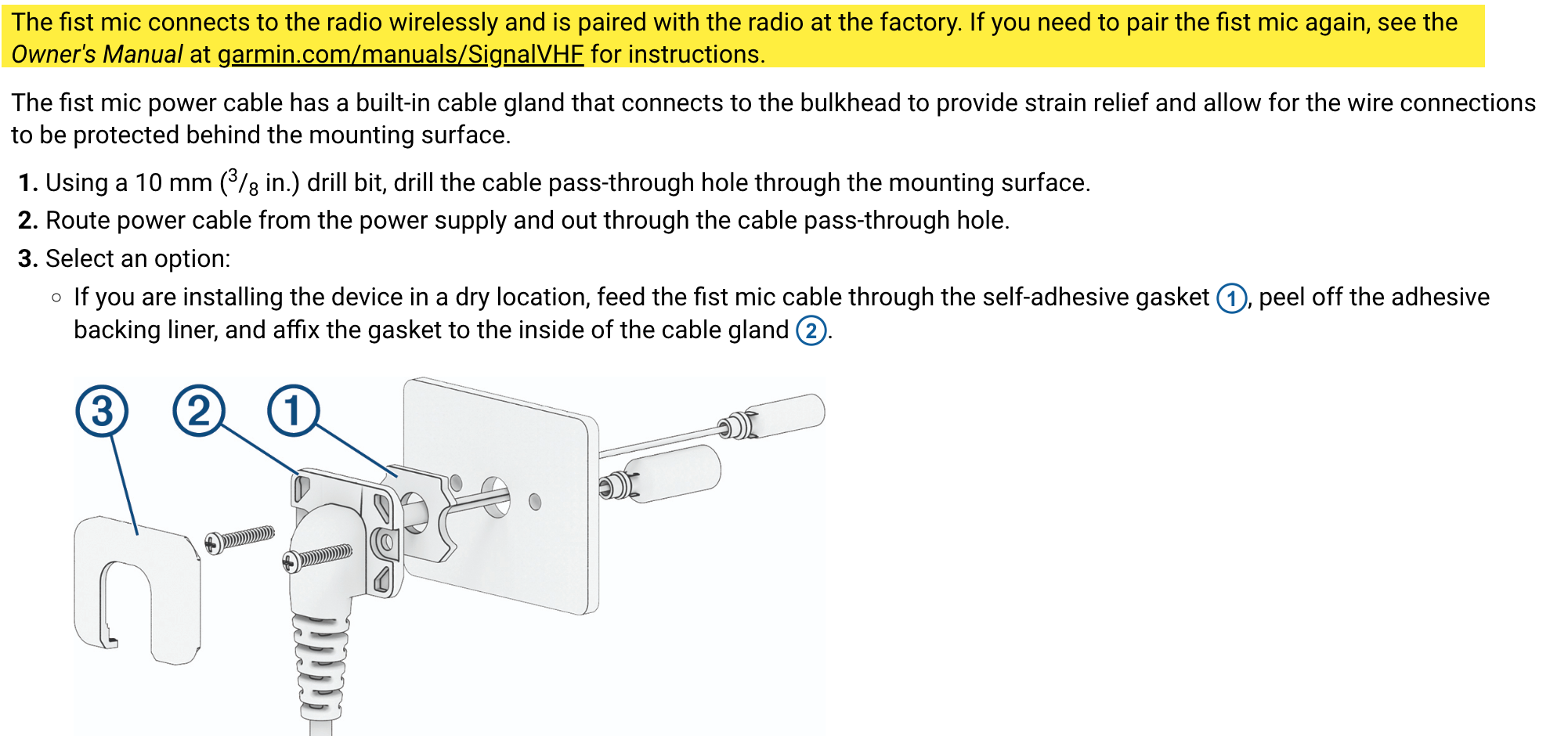
Cortex generated a lot of feedback from early adopters. Much of that feedback centered on the decision to use a phone style integrated display and mic. The Signal radios adopt a more traditional radio and fist mic. However, it turns out the fist mic’s relationship to the radio is very similar to the Cortex handset’s relationship to the hub. The connection between the mic and radio is wireless and the mic only requires power. I found the snippet above from the RM 100’s installation manual which is the only Signal series manual published at this time.
The fist mic specs also list the speaker in the mic at 5-watts and don’t discuss any speaker in the radio itself. Those specs combined with the photos suggest there isn’t a speaker in the radio. I look forward to getting my hands on a radio and investigating both the sound quality and connection reliability of that arrangement.
Connections
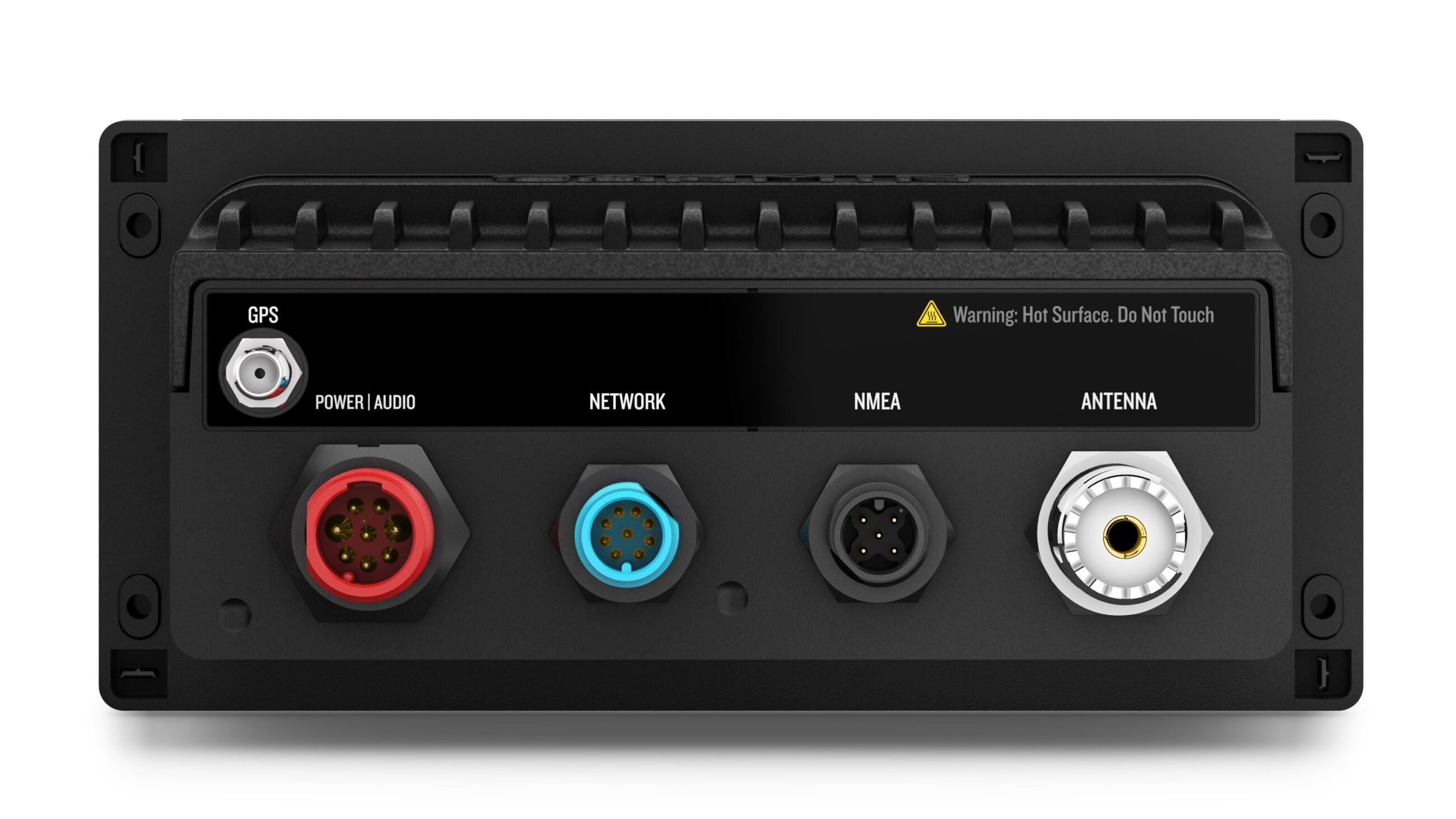
The Signal VHF 220 and 400 both have the exact same connections. The single antenna connection provides a further indication that a single radio is employed for both AIS and voice. Both radios have a built-in GPS receiver and support an external antenna if the mounting location compromises reception. NMEA 2000 connectivity allows sharing of AIS, DSC, and Navigation data. The BlueNet network port enables connectivity between RM 100s and Signal Radios. Each RM 100 has just two connections: one for power and a BlueNet network connection.
Notably absent from that list of connections is a fist mic connection. As we’ve discussed, that connection occurs over RF, though I don’t know anything about the technology used for the connection.
Looking forward
At $1,500, the Garmin Signal VHF 400 is a premium radio. But, when you look at everything included, I think it represents a great value. Those features include:
- Built-in AIS
- 3.5-inch color touchscreen
- Adaptive noise cancellation
- VHF audio playback of up to 3 minutes on any channel
- Advanced watch modes scanning all channels
- Hailer with listen back
- Intercom between units
The $999 Signal 220 includes all those features minus the AIS transmit capabilities.
I mentioned at the top that I’ve been looking forward to Garmin’s next VHF announcement for a long time. If I’m honest, I’ve also been nervous about the announcement. Cortex was an ambitious quantum leap forward. It showed what could be achieved, but the rollout was messy. There was so much technology bundled into it and Vesper was a small company with limited development resources. Garmin has the resources to pour on a project like Cortex but I questioned if they would see the value. Signal indicates to me that they do see the value and they’ve invested mightily. This is an exciting product and I’m genuinely excited to get my hands on one and enjoy the fruit of years of work.



I am very happy to hear about the new Signal lineup. Like you, I loved the software defined radio and very innovative features in the Cortex when it came out, and my review from almost 6 years ago still has a lot of traction with folks looking for a new radio. I personally still use the Cortex as my primary radio and AIS device aboard Aruna, even with it’s frayed cables and funky handsets. It’s hard to find another radio that allows for listening to so much at once, replaying quickly, and an interface that is intuitive and easy to use. I look forward to seeing the new product as soon as it becomes available!
Its about time! There goes another boat buck! Thanks for the great article.
ive been happy with the cortex range, its been by far the easiest AIS transponder to set up. i think the handset works super well. we havnt had many clients partake in the vessel monitoring/switching side of things they often have anothe brand on board for that. but its still pretty cool. i am happy to see that these bring the price point down a little. they look pretty nifty too. 😀
moose
I was a beta tester for Garmin Cortex V2 software in 2023, and wrote about it as part of this advanced VHF roundup:
https://panbo.com/em-traks-premium-nexus-vhf-ais-mob-system-will-compete-with-improved-garmin-cortex-icom-m510-evo/
I’m still using the same Cortex on Gizmo and will stick with “Indeed, after a great many hours of testing Cortex v2 on board Gizmo last season, I think that it now offers the most sophisticated marine VHF ever seen and heard, and by a wide margin!”
So I think it’s great that Garmin has incorporated the same, maybe even better, SDR features in the new Signal line. But also sad that so many of the Vesper Cortex features were left out, like the advanced AIS target plotting with NMEA data multiplexing to the Cortex Onboard app, outstanding anchor watch via hardware and/or app, wireless mics, built in heading sensor, etc.
Vesper saw the many functions that a VHF/AIS could serve, often when other electronics were shut down. But then again, we don’t really know yet all that the Garmin Signal can do, and certainly not what added features and/or hardware is in the works. So looking forward to Ben S testing.
Nice review, Ben. Personally I prefer the redundancy of a stand-alone AIS, but it’s a nice looking radio regardless. I’m not sure what’s gained by eliminating the wired voice connection for the mic – if it still needs wires for power anyhow, what’s the point? One more failure point if the RF signal between Mic and radio gets disrupted. Seems like more “tech” for the sake of tech, instead of a useful feature or improved reliability….
It’s good to see that Vesper’s innovations have not gone to waste.
No wired mic? That makes me nervous. There are so many sources of potential RF interference on a boat and in the environment.
A) Will there be a companion app equivalent to Vesper’s Watchmate? The Watchmate app has the best anchor watch functionality for a mobile device, IMHO.
B) I’m on a sailboat with the VHF radio mounted below, and a remote mic with built-in display in the cockpit. So, the RM100 doesn’t work for me. It’d be nice if there were a similar compact remote mic for us sailors in the future product plans. I’d settle for limited functionality. The remote mic’s primary purpose for me is to hail and respond to VHF traffic. (and $700 for a remote? Ouch!)
I also have been waiting, and a bit worried about losing features on the next evolution of cortex. I am a bit disappointed that monitoring is gone, now I need to find a solution for that if I have to replace my current unit. Likewise my radio mount is not easy to see from the helm, so I enjoyed setting the handset on a cradle I could pivot and easily manipulate. Perhaps this will move to the MFD itself? (Collision avoidance, changing channels etc) Look forward to digging in more, but not a home run for me.
Matthew,
I think the architecture makes it clear that Garmin has all sorts of options for what hardware they produce. The RM 100 is basically a full remote. Why couldn’t that full remote be of a form factor more similar to the Cortex handsets? I think it could. The big question is just whether Garmin sees a large enough market to produce a new black box style remote.
-Ben S.
I have recently created a Cortex Users Group Wiki and Discord server. It looks like this new Signal model uses the same software base and interface between the handsets and the hub. A small group of enthusiast owners have gotten together to understand all the underlying interfaces of the system. It’s quite powerful, but there doesn’t seem to one definitive location that describes all of its features, documented and not. If this steps on some toes here at Panbo I apologize.
Vesper Cortex Users Group
https://cortexusers.instantchow.com/
https://discord.gg/5rVbJhb9
All Garmin Vesper Cortex users are welcome to join both the Wiki and Chat. We are just getting started so feel free to reach out to us and make an introduction!
That said, a lof the the headaches of the Cortex system were the handsets. Funny you mention the intercom feature, i recall seeing that on the roadmap before Garmin took over. Guess what, there’s a capability flag for an intercom already in the APK files for the handset…
The documentation for the Signal VHF radios themselves is now up as well.
So they fixed the stupid design decision in Cortex to have radio traffic over WiFi, this is probably using BT or ANT. They also added wired ethernet. All good. The “look & feel” is improved, has a sort of “Fusion” feel?
But now for the downsides:
– No anchor watch
– No AIS alarm profiles
– No AIS vessel list
– No monitoring
– No built in compass
– Limited control over NMEA 2000 output
– No cloud connection for monitoring or anchor watch
– Not a black box so not a drop in replacement
For my installation the problem starts with the considerable depth of the device. It makes it impossible to install in many sailboats in the traditional place which is somewhere near the companionway. You’d have to shell out for a RM100 to fix this but then you end up with a useless display you need to put somewhere.
The anchor watch is less critical to me now that B&G/Simrad have an even better one, but still I don’t get why you would drop this unless they really don’t care about sailboats.
And there you have it I think: Cortex for the short-distance small console style motorboat. Just so those people don’t need to install two boxes.
I forwarded this comment chain on to Garmin for some comments and here are a few of their responses. Overall, I don’t think they’re disagreeing with anything Kees concluded. However, I do think there is a certain implication to the fact that this is a refresh of their console mount VHF radios and not a replacement of Cortex. I think (and this is just my speculation) that might be coming next.
So they fixed the stupid design decision in Cortex to have radio traffic over WiFi, this is probably using BT or ANT. They also added wired ethernet. All good. The “look & feel” is improved, has a sort of “Fusion” feel?
Garmin: The link between the Fist Mic and Head Unit is proprietary (but correct that it’s not over WiFi).
We would say the look and feel is more Garmin. 🙂
But now for the downsides:
– No anchor watch
– No AIS alarm profiles
– No AIS vessel list
Garmin: There is a AIS vessel list. You can interact with it or the AIS plotter to view information about an AIS target or initiate a DSC call. There are AIS alarm tuning options for collision alarms but we have removed the concept of profiles. Instead we have provided a quick shortcut to silence collision alarms from the controls panel (slides down from the top of the screen). This effectively provides the two most common profiles we found were actually being used: marina (off) and underway (on).
– No monitoring
– No built in compass
– Limited control over NMEA 2000 output
– No cloud connection for monitoring or anchor watch
– Not a black box so not a drop in replacement
Garmin: Yes, the Garmin Signal VHF400 and VHF220 are not intended or designed to be a replacement for Cortex. Signal is Garmin’s new premium fixed mount VHF offering and really should be compared with the VHF215 AIS it replaces and other premium fixed mount VHFs from competitors in the market. The VHF400 is designed to compliment the modern helm so will always output AIS, DSC and GPS data over NMEA2000 for use by an MFD.
For my installation the problem starts with the considerable depth of the device. It makes it impossible to install in many sailboats in the traditional place which is somewhere near the companionway. You’d have to shell out for a RM100 to fix this but then you end up with a useless display you need to put somewhere.
Garmin: Given the overall size of the unit, this feedback is a little surprising to us. We did choose to prioritize dash space, so focused on getting the dimensions of the front panel as small as we could while also providing a large color display interface. This meant a small compromise on depth, but the depth is actually still shallower than most premium VHFs in market. There are many spots around a sail boat that this can be mounted. The flexiblity of the fist mic placement also opens up installation options in and around a compainon way that would normally be too difficult.
The anchor watch is less critical to me now that B&G/Simrad have an even better one, but still I don’t get why you would drop this unless they really don’t care about sailboats.
And there you have it I think: Cortex for the short-distance small console style motorboat. Just so those people don’t need to install two boxes.
Garmin: While AnchorWatch is not included, this is not a sign that we have written off our sailboat customers. We believe there are a ton of features in the Garmin Signal VHF400/220 which will assist all boaters, make their journeys safer and their VHF easier and more enjoyable to use.
Thanks a lot for sharing this. I am hoping to see a new concept similar to the Cortex coming then from Garmin soon.
Garmin made a realy good working VHF with build in AIS transponder have it on my boat now for a few weeks and reception is great auto squels works fantastic AIS reception and sending works how it should be , the UI is Garmin so easy to use no extra’s you do want on youre VHF because the Ancor watch AIS list and AIS danger list is all in my MFD because there is the place I need it. don’t tink this deveice is a follow up for the Cortex it is a VHF with build in AIS transponder nothing more nothing less .
I just got notice that UPS delivered mine. Sadly, I’m out of town for a bit so my installation will be delayed until I return.
Very happy to hear your early review and report that it just works. Fundamentally, that’s what a VHF radio and AIS transponder should do… work!
-Ben S.
Hi Ben!
According to that RM100 manual, the fist mic connection is 2.4 Ghz – I would assume the same as wireless mice, etc. The same manual reveals the ability to connect an external speaker through the “Power/Audio” connector.
The depth would also be an issue for us, as our helm VHF is mounted in a console with limited depth. Getting our current IC-M506 in was a tight squeeze!
Hartley
S?V Atsa
I am a marine electronics for almost 30 years now and familiar with all the brands (accept for one ,in Holland Furnuno is not used a lot), mounted a lot of B&G on racing yachts in the early days of my career ( before Simrad bought it) , did a lot of Raymarine (repair and commissioning ) when I worked at the local dealer , now being independent for almost 20 years I work with all the brands , with Garmin as leading brand because off there great U.I. and the minimal product loss.
I see it this way, all brands have a depth sounder who gives depth information and a wind transducer who gives wind information and a compass who sends out heading information, and that is how it should be!! A product has a function and that data go’s in a network and from there you can use it for whatever its need
Garmin produced a great VHF with build in AIS transponder, the VHF part is crisp clear because of the auto Squelch, the speaker in the handmike is good enough no speaker needed but one extra is always ok, the reception of both the AIS and VHF are exceptional!! seeing AIS targets over 30 miles with an antenna just 3 mtr above the waterline is pretty ok. So that is what they build!! a great VHF with build in AIS. When I need a compass it sits in my autopilot when necessary or better needed I put a MSC10 or something like that on the top of the boat. All of my alarms : AIS , anchor watch, the AIS alarms list , the monitoring of all the ships around , all of that is on my MFD (Multi Function Display name says it all), it is a nice big screen good read out and touchscreen.
Why do I want all of that in an small VHF screen . that VHF device is for keeping in touch with other sailors and rescue when needed. I do not want boat remote monitoring on my VHF, I take a sentinel unit for that purpose.
The Cortex wash multi-function VHF with a lot of BS you do not need on a VHF but that is just an opinion , I mounted only one and that wash the first and the last one to much BS.
The Cortex cannot be compared with the new signal VHF for that reason I think.
I think Garmin made a great VHF with build in AIS nothing more nothing less and for dimension discussion it has the same dimensions as the B&G V20 or Simrad RS40 . nobody complained about that … and be creativ there is always a way to build something is a yacht ,I know
This is such a disappointment. I’ve been living with crumbling Cortex handsets for years now with misplaced hope Garmin would work on a V2 for that system. Instead the fork it with a much less capable unit.
I’ve been testing the Signal 220 for a few weeks now, and it gets quite hot in standby RX mode (49°C – 120°F).
Automated Squelch works great.
Clear reception of broadcast stations.
Very easy to use.
https://youtu.be/RV4E9yKJG94
I have a Signal 400 and I’d be really interested to see how its working for other people. I am finding it buggy.. which is a really bad thing for a VHF!
* Its lost my heading sensor (MSC-10) mutliple times for periods up to 10min, but the rest of the network still hears AIS messages and a reboot gets it back right away.
* I’ve key’d the mic, spoken and then let go of TX and the radio never switched back to RX/Standby (monitoring on an HT it was not transmitting..)
* I’ve had it just stop RXing – I called my local launch multiple times before realizing I just couldn’t hear *them* – auto squelch was on, lookin at the plot showed no bursts in signal level (grabbed an HT and heard myself TX and the annoyed launch operator on the HT, but not the Signal).
This seems like all software bugs and very worrying. I have it on an older Garmin network via adapter cable (garmin said this is the way with older plotters). My NMEA is pretty populated but this was a net drop of one device (AIS/VHF -> Signal 400)
A few other really questionable times now that I’ve had provable bad experiences.
Side note: it really needs an option to ignore the power signal from the chart plotter. I usually leave the radio on to launch pickup, chartplotters go off earlier.