

Solid-state lithium-ion batteries, the future of energy storage onboard?
I sat down to write my initial review and findings of Safiery’s 48-volt, solid state lithium ion battery. But, before I get into the meat of the battery’s performance, I feel I need to dive into solid state lithium batteries in general as well as the differences among the products available in the marketplace today. So, what follows will be a primer on the technology in general and why we likely all care about the development of solid-state batteries. Following this entry, I’ll share my experience with Safiery’s battery.
So, with a hands-on update coming soon, let’s start with why we care about solid-state batteries and what it all means. When it comes to lithium ion batteries, the term solid state means literally that the batteries are constructed using a solid electrolyte rather than the liquid electrolyte in use in traditional lithium ion batteries. Okay, so we replace liquid with a solid, but why? The simple answer is the promise of improvements in four main areas:
- Energy Density – Solid state lithium batteries should offer significantly higher energy density than those with liquid electrolytes. The main increase in energy density comes from swapping graphite or silicon-graphite anodes for pure lithium-metal anodes. That swap could offer up to sixty-percent greater energy density on a watt per weight basis. That is on top of the already dramatic increase in energy density for traditional lithium batteries compared to lead-acid.
- Safety – removing the flammable organic solvents used in traditional lithium ion batteries dramatically reduces the fire and thermal runaway risks.
- Faster charging – In theory, solid electrolytes should enable dramatically faster charging. The promise exists of stats like charging from 10-percent to 80-percent in fifteen minutes. But, for now, that sort of performance remains in testing labs and not in cells offered for sale.
- Longer Cycle life – With liquid electrolytes, parasitic reactions in the electrolyte cause life shortening side effects. Solid electrolytes will slow or eliminate those reactions and cause the cells to last longer.
Not all solid-state batteries are truly solid-state
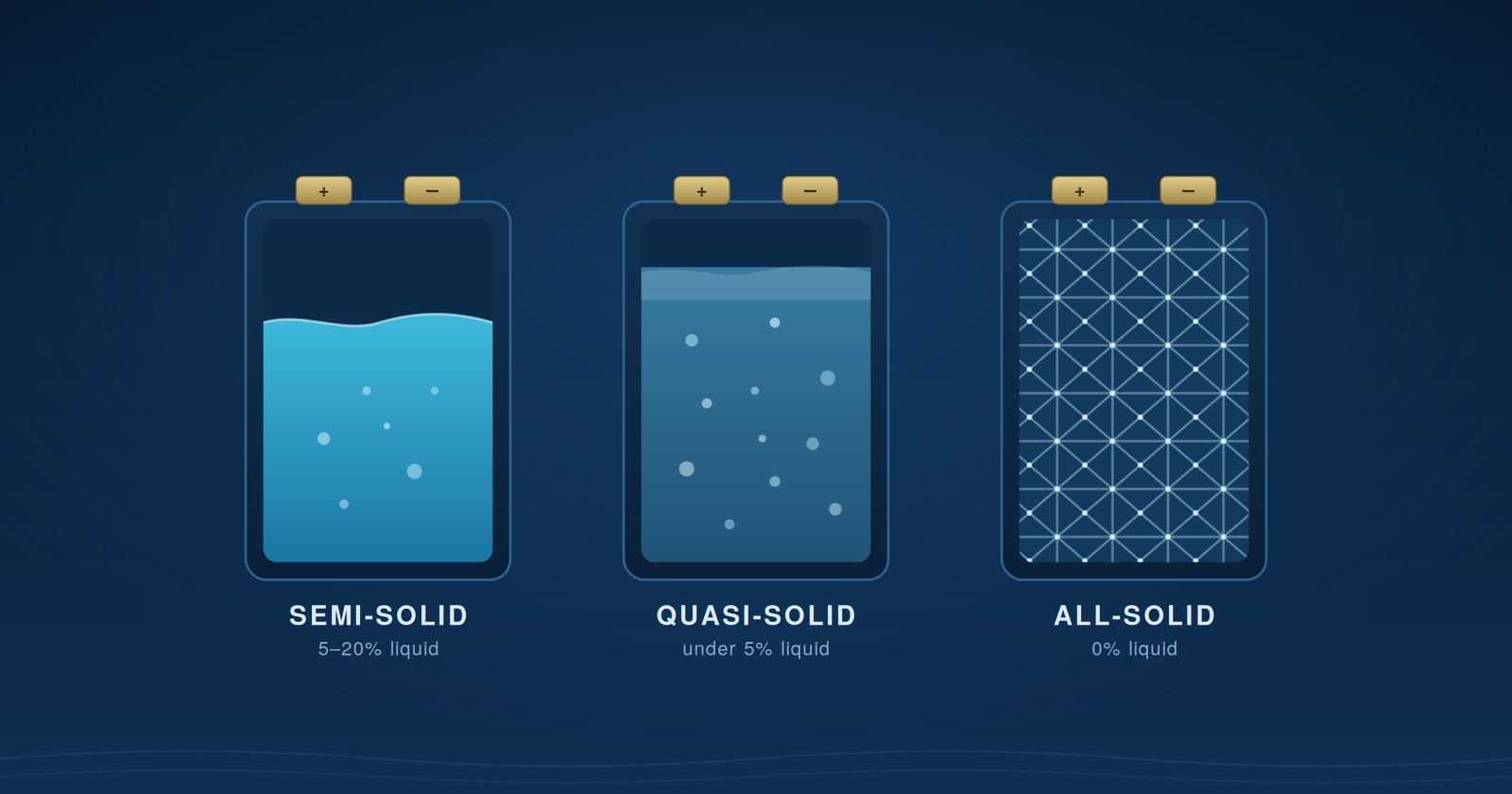
What is it with new battery technology and terminology? First, we had a whole class of batteries described as drop-in, despite the fact they can’t prudently be dropped in. Now, we have batteries marketed as solid state that are, in reality, not fully solid state. In fact, there are three classes of solid state batteries ranging from “kind of solid” to “honest to goodness solid!” They are, in order of least to most solid:
- Semi-solid-state – cells still contain a meaningful amount of liquid. Semi-solid-state cells will contain from 5 up to as much as 20-percent liquid. These cells are essentially conventional cells with much of the liquid replaced with solids and gels and modified separators. The safety and energy density benefits are more modest than true solid-state cells. Semi-solid-state cells are currently available and likely underpin all batteries marketed and sold as solid-state today.
- Quasi-solid-state – the next step in the progression towards truly solid electrolytes. Quasi-solid-state cells range from 95 percent to nearly fully solid. They will deliver more of the promises of density, safety, charging, and cell life. But, quasi will likely continue to leverage traditional manufacturing processes making it the next step in the journey to fully solid state electrolyte.
- All-solid-state – The destination and where everyone is trying to get. All-solid-state cells will fully deliver on the promises we’ve discussed above and achieve 100-percent solid electrolyte.
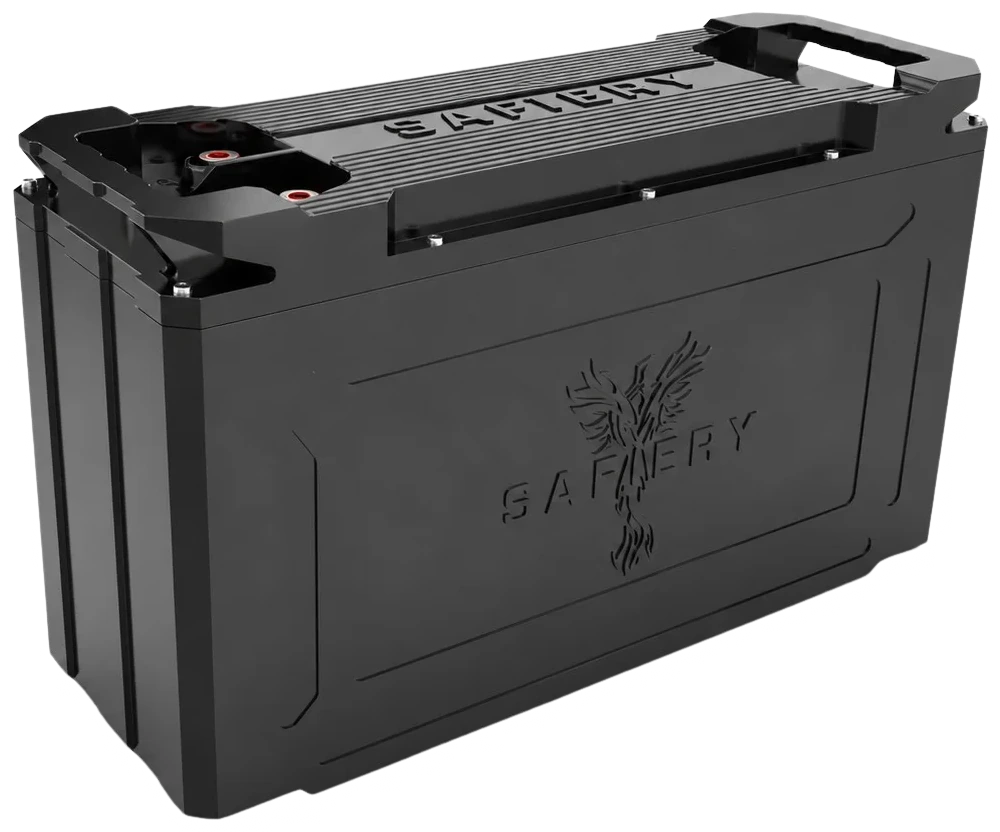
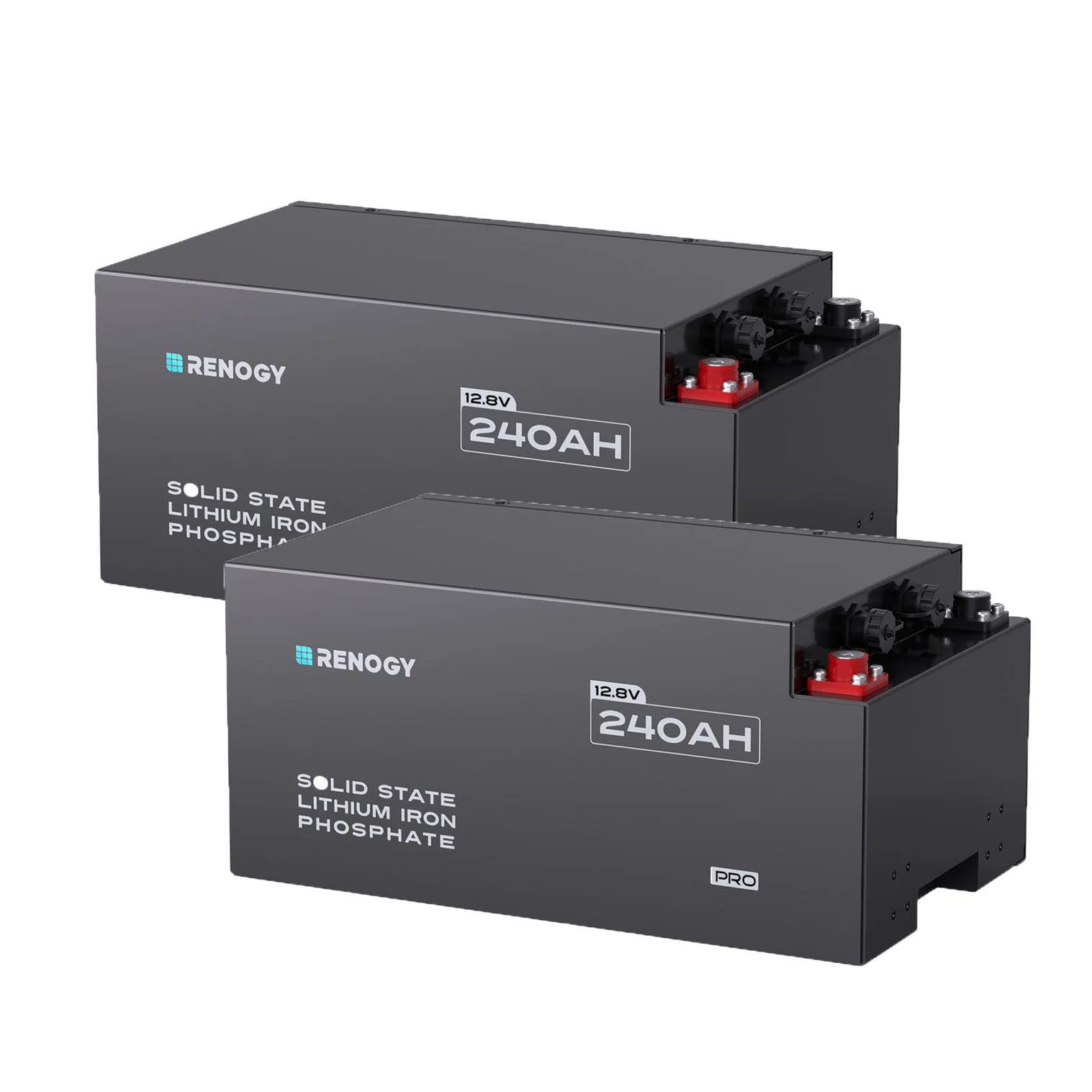
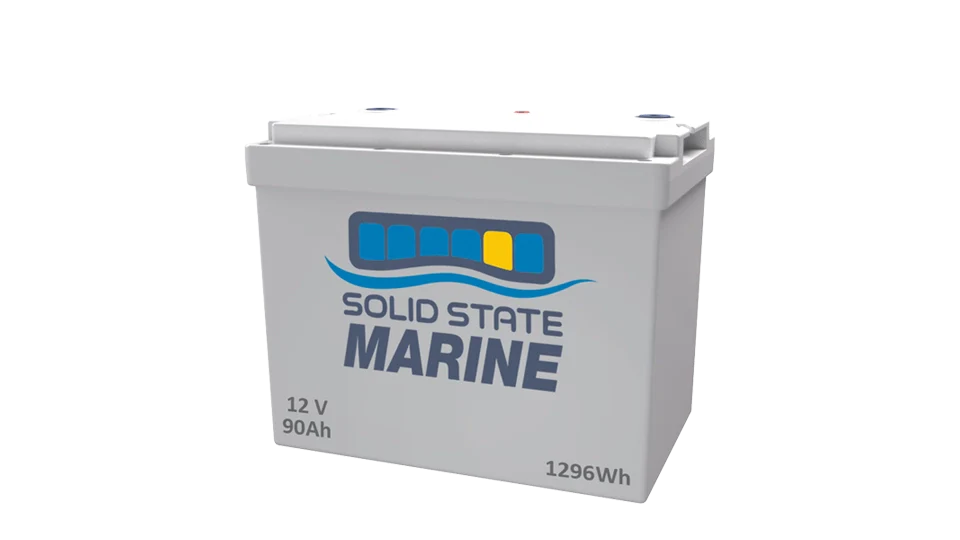
Of the three companies currently marketing solid-state batteries for the marine marketplace, Renogy, Solid State Marine and Safiery, only Renogy explicitly states the percentage of liquid in their cells. Renogy documents that while typical LFP cells contain 25-35 percent liquid electrolyte, their cells contain 10 percent. Despite the lack of clarity from some battery companies, since no all-solid or quasi-solid cells are commercially available in any format relevant to the marine market, any battery a marine company can source and sell today is almost certainly semi-solid. I have heard rumblings about Solid State Marine’s (SSM) batteries using all-solid-state cells, but frankly, I can’t nail down those claims and remain skeptical.
I have reached out to Solid State Marine for clarification on their chemistry, the extent to which the electrolyte is solid and more. So far, I haven’t heard back from them. But, if I do, I’ll update this article.
NMC vs LFP (semi) solid-state batteries
One interesting contrast between Solid State Marine’s batteries and Safiery’s is the underlying chemistry used. Both appear to use conventional manufacturing processes with liquid electrolyte reduced. But, SSM’s are based on nickel manganese cobalt (NMC) cells and Safiery’s batteries use lithium iron phosphate cells.
First, let’s look at the general differences between these chemistries and then drill into how those differences may change with the reduction of liquid electrolyte.
| Attribute | LFP (lithium iron phosphate) | NMC (nickel manganese cobalt) |
|---|---|---|
| Cycle life (to 80% capacity) | 2,000–5,000 typical; premium cells 6,000–10,000 | 1,000–2,000 typical; good cells up to ~3,000 |
| Nominal voltage (per cell) | 3.2 V | 3.6–3.7 V |
| Full charge voltage (per cell) | ~3.65 V | 4.2 V |
| Voltage curve | Flat — hard to read state-of-charge by voltage alone | Sloped — easier to estimate SoC from voltage |
| Energy density (gravimetric) | 90–160 Wh/kg | 150–220 Wh/kg |
| Thermal-runaway onset | Higher (~250–270°C) | Lower (~150–210°C) |
| Failure behavior | Phosphate cathode doesn’t shed oxygen — tends to vent/smolder | Oxide cathode releases oxygen — more energetic, self-feeding fire |
| Cold-weather performance | More sensitive to cold; charging below 0°C risks lithium plating | Somewhat better low-temp capacity and charge acceptance |
| Cost | Lower — abundant iron and phosphate | Higher — nickel and cobalt content |
| Key materials | Iron, phosphate; no cobalt | Nickel, manganese, cobalt |
With greater thermal stability, longer cycle lives, and a voltage range that more closely follows traditional lead acid, LFP has become the chemistry of choice for energy storage on boats. Fortunately, marine storage applications are often less focused on weight, so NMC’s greater energy density is less of an advantage than in some other applications. However, that difference plays larger on high performance boats and when the batteries supply propulsion energy.
| Nominal system | LFP cells | LFP fully charged | LFP mid-capacity | NMC cells | NMC fully charged | NMC mid-capacity |
|---|---|---|---|---|---|---|
| 12 V | 4 | 14.6 V | 12.8 V | 3 / 4 | 12.6 / 16.8 V | 10.8 / 14.4 V |
| 24 V | 8 | 29.2 V | 25.6 V | 7 | 29.4 V | 25.2 V |
| 48 V | 16 | 58.4 V | 51.2 V | 14 | 58.8 V | 50.4 V |
For 12-volt nominal systems, NMC presents a challenge. Fully charged, a 4-cell NMC battery will sit at 16.8 volts and that’s simply too high for many components designed to run at 12 volts. On the other hand, if a 12-volt NMC battery were constructed from three cells, fully charged it would sit at 12.6 volts. But, at mid-capacity, it would be down to about 10.8 volts and hence too low a voltage.
Fortunately, at higher voltages, dropping a cell works out well. For a 24-volt nominal system, 7 cells deliver the voltage we need. Fully charged, the system will sit at 29.4 volts and at mid-capacity at 25.2 volts. The same math scales up. A 48-volt nominal system uses 14 NMC cells, sitting at 58.8 volts fully charged and about 50.4 volts at mid-capacity — right alongside a 16-cell LFP pack’s 58.4 and 51.2 volts. It’s only at 12 volts, where there’s no cell count that lands in the sweet spot, that NMC becomes problematic.
The move to solid state
So we’ve established that the chemistry determines the voltage per cell. Moving towards solid-state electrolyte doesn’t change that voltage. A 3.2-volt LFP cell is a 3.2-volt LFP cell whether its electrolyte is liquid, gel, or solid. Those voltages are determined by the anode and the cathode. The interesting question is what does change as a battery moves along the spectrum from liquid toward solid.
The biggest single change is in safety. The liquid electrolyte contributes flammability to a conventional lithium cell. Replacing or reducing it with a solid or semi-solid material raises the temperature at which a cell will run away and reduces or removes fuel. A failure becomes less energetic and less likely to cascade. For NMC, the oxide cathode remains volatile but the solvent that actually feeds the flames is reduced.
Cycle life improves too. Much of the wear in a lithium cell comes from side reactions at the boundary between the electrode and the liquid electrolyte. Reducing the liquid reduces those reactions, so the cell survives more cycles. Fast-charging should follow, though reports indicate that is among the most difficult promises to harness.
It isn’t all upside, though. Solid and semi-solid electrolytes shuttle lithium ions more sluggishly than liquids do, and that gap widens in the cold. So the move toward solid can actually hurt cold-weather performance rather than help it. Additionally, at least initially, the manufacturing processes are less mature and result in lower yield. That reduced yield will keep the cost of all types of solid-state cells higher than traditional ones for the near future.
Energy density is where it gets interesting, and where true solid state cells excel far beyond semi-solid ones. A semi-solid cell delivers a modest density gain, and that’s about it. The dramatic numbers are delivered when we change the anode material. Only a fully solid electrolyte can safely be combined with a lithium-metal anode to unlock the huge energy density gains. No semi-solid battery you can buy today has made that leap, which is exactly why the weight savings, for now, stay incremental.
Final thoughts
So where does all of this leave us as boaters potentially shopping for batteries today? First, I hope I’ve taught you the value of some skepticism around terminology. Just as “drop-in” never really meant drop-in, “solid state” doesn’t mean fully solid electrolyte. At least not for anything you can actually buy right now.
That’s not a knock. Semi-solid is a real step and brings real benefits. Especially in safety which is arguably the biggest focus on new battery technology. A cell that’s harder to ignite and less volatile once ignited is a huge benefit. Plus, the longer cycle life is a welcome bonus. What semi-solid is not is the drastic weight reduction and energy-density increase that fully solid-state promises. The dramatic energy-density numbers are stuck behind a change of anode material. And that change of material waits on a truly solid electrolyte.
As long as we understand what we’re buying and the benefits that purchase will bring, semi (and eventually quasi) solid state batteries provide extremely important benefits. Now, we just need to work towards clearer explanations from battery manufacturers about what’s in their batteries so we can better understand the degree of improvement.
The future
The progression from semi-solid to quasi-solid to all-solid is real, and the battery industry is pouring billions into closing the gap. Even as the U.S. has stepped back from EVs, the rest of the world continues to embrace them. Solid-state batteries stand to provide huge benefits to EVs and the sale of those EVs will pay back the R&D investment. From my reading, it appears most cell manufacturers are targeting the back half of this decade for commercial viability of all-solid-state batteries and those will surely show up in EVs long before boats.
For now, I’m eager to get hands-on with what’s here today. Safiery’s 48-volt battery is a semi-solid LFP pack, and in the next entry I’ll share how it performs.



Looking forward to some day when I can get a battery (lithium or sodium) shipped to me in off-the-highway system in Alaska. Most companies won’t ship to Alaska/Hawaii at all.. but none (that I would trust) ship where it requires air freight or even barge. Even the barge companies have stated they would only ship 2 electric cars at a time from Washington state to Alaska. (Don’t quote me.. I’m always ready to be corrected..)
I just had a dealer ship 2 12v 100Ah LifPo batteries to me in Fairbanks via the U.S. Postal Service. No issues.
Thanks for that.. mind sharing the dealer name? Would it be Fisheries Supply?
Was a retailer called MyGeneratorPlus, purchased for a solar powered setup to pump water from a creek to a mining camp cookhouse up by Coldfoot, AK. You’ll have to check with the fellow (Josh, nice guy), the first ordered battery was to IL, but it required a warrantee replacement (the BMS was locked open…ugh), but he replaced the battery and shipped to Fairbanks via USPS ground freight.
Thanks for that.. mind sharing the dealer name? Would it be Fisheries Supply?
At the chance of starting a firestorm and as a very early adapter of LFP technology in the recreational industry, the NMC battery technology just is not as “safe” as LFP and are simply not useable in a 12VDC system without the use of multiple DC/DC converters. This is a wait and see situation for me.
That said, I continue to watch with interest the development of this next step in battery technology development and am especially looking forward to your torture testing of the Safiery battery.
Charlie,
I agree about the challenges of NMC’s voltage curve at 12v. I have talked with an installer who has installed SSM’s 12v nominal batteries with success while relying on conversion for some areas. I don’t know that I could recommend it at 12-volts.
As for the safety considerations. With traditional NMC I would be a hard no for retrofit installation. SSM indicates their cells yield drastically different behavior when in distress. I would love to test that but have had a very hard time getting the batteries from them to test.
-Ben S.
Excellent article, Ben. Thanks.
You have missed one crucial and potentially more important item, and that is boat building rcd/Rcr status if you fit Lithium batteries, if the vessel, was built after June 16th 1998 then the change to lithium will according to RSG RFU 199 most likely constitute a Major Craft Conversion and you would need a Post Construction Assessment carried out by an approved/notified body. I looked in to it recently and found the law changed in 2017 regarding fitting lithium on pleasure craft.
I am not as familiar with the UK’s regulatory procedures but this article is not delving into the standards, codes, or regulations. The regulatory and insurance issues considerations when moving to newer technology shouldn’t be overlooked. However, those requirements are also changing.
-Ben S.
Clark’s Adventures on YouTube opened a Solid State Marine battery and looked up the cell manufacturer. It is a 31 Ah semi solid state pouch cell from King Solid Technology. He intentionally overcharged a cell and the result was a spectacular blowtorch.
Spectacularly unfortunate! Very distressing to see that development. Li Ion batteries, regardless of the chemistry, have a shaky reputation, especially among insurance companies. Episodes like this, where a battery is marketed as very safe and testing shows otherwise, set back that reputation significicantly.
-Ben S.