

ABYC Examines the 48-volt boat
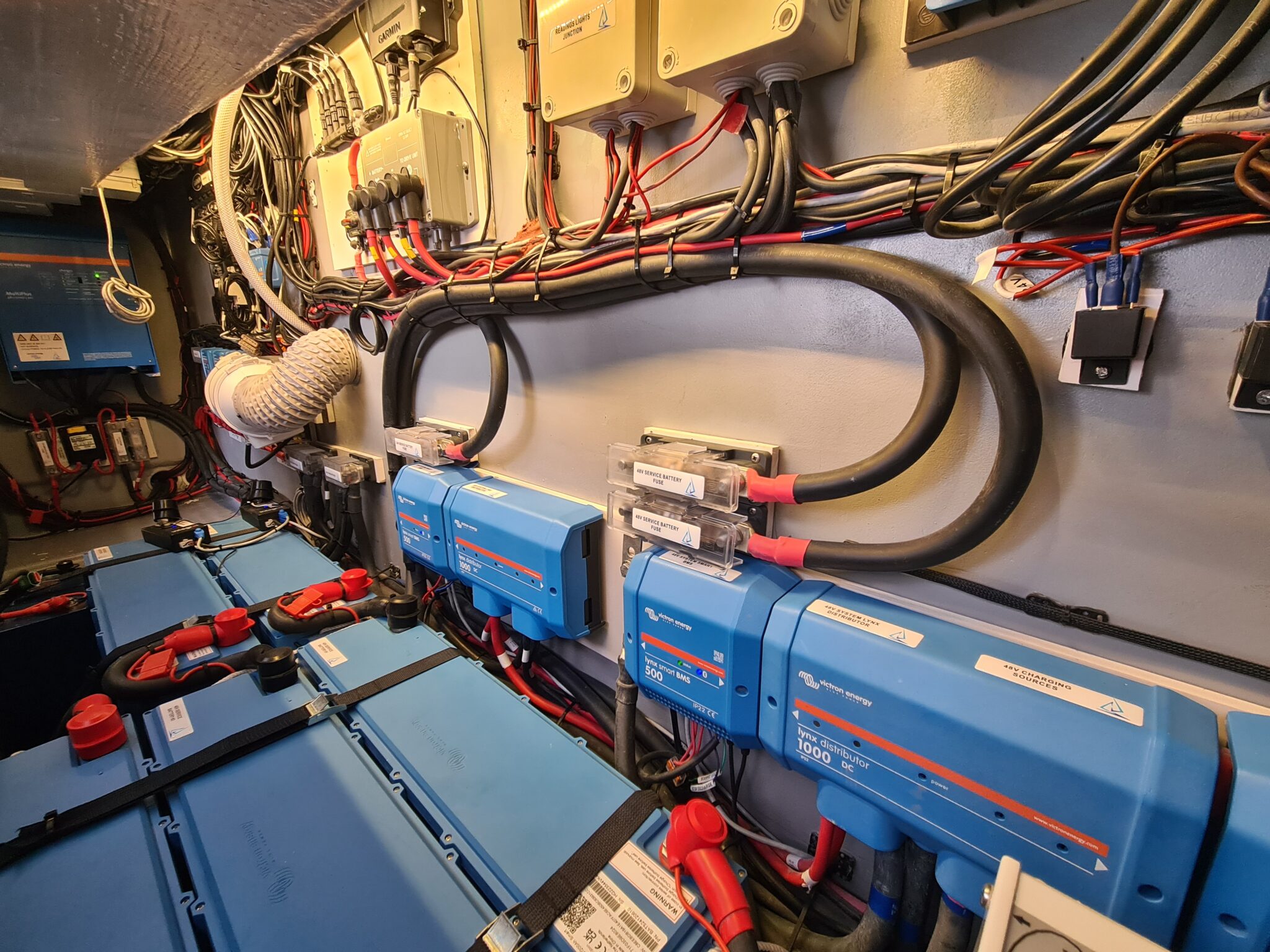
Editor’s note: This piece first ran in Soundings Trade Only. It covers an important topic for our industry as boats move to 48 volt house power systems. This article’s author, Tim Murphy is ABYC’s Education Director. I have the privilige of chairing and co-chairing NMMA’s innovation awards with Tim. He’s an avid sailor, lifelong marine journalist and an absolute pleasure to work alongside.
Manufacturers and technicians may need to take new safety steps when working on these systems
The past several years at IBEX, Metstrade and other trade shows, we’ve seen the introduction of electric devices — grills, bow thrusters, trolling motors, air conditioners and such — powered at 48 volts DC. In 2018, Integrel Solutions won a DAME Design Award for its 48-volt alternator. In 2022, Mercury Marine won a Consumer Electronics Show innovation award for its Verado V-12 outboards incorporating a 48-volt alternator. At the 2024 Annapolis Sailboat Show, six of the 16 new boats entered in Cruising World’s Boat of the Year contest had 48-volt house systems.
Suffice it to say that after years of speculation, the 48-volt boat is here. Compared with 12- or 24-volt systems, these higher-capacity systems have clear advantages: greater power, greater efficiency, less weight, lower fuel costs and, most compellingly, the potential elimination of a genset from the boat. But an emerging controversy raises questions for companies that install these systems and the people who service them: Are 48-volt systems low voltage or high voltage? The difference for safety and liability is crucial.
“Most people consider less than 60 volts low voltage, so therefore, 48-volt systems would be considered low voltage,” Bob Tate said in April at the Sur/Tech Conference hosted by the American Boat & Yacht Council. Tate is director of engineering for Navico Connect, a division of the Brunswick Group. The group’s Fathom e-Power System, which won a 2023 National Marine Manufacturers Association Innovation Award, has been installed in more than 6,000 boats and RVs. A growing number of them are designed to run at 48 volts.
But last year, the National Fire Protection Association changed its NFPA 70e Standard for Electrical Safety in the Workplace threshold for low voltage from 60 to 50 volts. The federal Occupational Safety and Health Administration follows NFPA 70e for its workplace-safety guidelines.
Accordingly, the ABYC added the concept of “safety voltage” to its 2025 supplement of “E-11 AC and DC Electrical Systems on Boats.” While the E-11 scope will remain at 60 volts DC, the supplement adds this language: “Safety voltage — an AC or DC voltage which does not exceed 50 volts DC.” That term appears several times in the new version, as in: “Ungrounded conductors exceeding the safety voltage shall have the means at wiring service points to indicate the voltage or shock potential.”
Maciej Rynkiewicz, the ABYC standards developer who oversees marine electrical standards, says it’s important to note that “48 volts DC refers to the nominal voltage. That’s a convenient, standardized engineering term used for identification and design purposes,” he says. “But the actual measured voltage of a nominal 48-volt system is typically above 50 volts.”
Tate adds: “When you have a 48-volt system, it actually sits at about 56 volts when you’re charging it. I just want to make sure everyone here realizes that OSHA thinks 48-volt nominal systems are not considered low voltage. If you’re working on a 48-volt system, it’s important for you to make a determination about what kind of protection equipment you require and how you are going to treat working with the system.”
The critical determination, Tate says, starts from the short-circuit current of the power source, which could be a charger or a DC-to-DC converter, but is almost always the battery. He highlighted a typical bank of two 24-volt lithium-ion batteries connected in series to make 48 volts. “The batteries I work on may deliver 15,000 amps of short-circuit current,” he says.
He also showed a calculation that comes to 1.91 calories per square centimeter. The NFPA threshold for requiring special PPE, such as arc-rated clothing, is 1.2 calories per square centimeter. “If you have an arc-flash event with a 56-volt system, it can jump across a fuse. The fuse is not protection,” he says.
If a company policy treats a 48-volt system as high voltage, that fundamentally changes the training and procedures for techs who work with those systems. For example, who is qualified to work on a live high-voltage system? NFPA 70e defines five formal training levels: aware, informed, competent, authorized and SR authorized. Not all of them are qualified to determine basics such as whether or not a system is live. Personal protective equipment for live high-voltage systems includes arc-rated clothing, arc-rated face shield, leather or rubber gloves, hard hat, safety glasses, hearing protection, leather footwear and insulated tools.
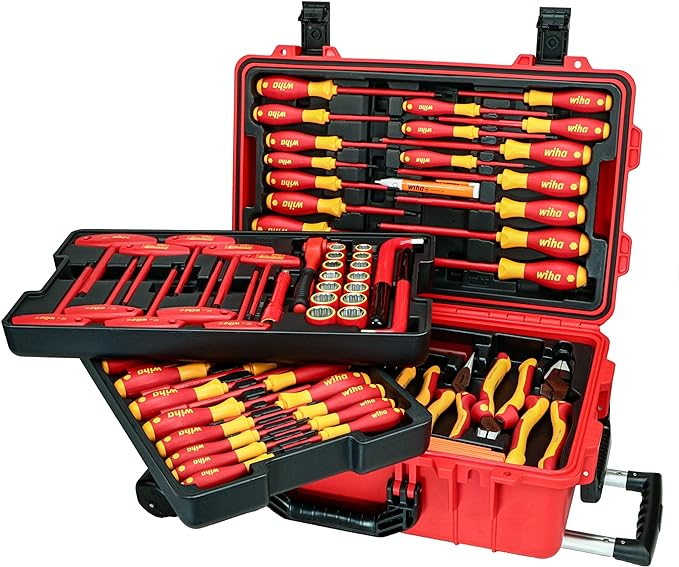
Tate mentioned a simple tool kit of insulated screwdrivers, pliers and socket wrenches. “That’s probably a $1,500 tool set,” he says. “And just putting some heat-shrink tubing over your screwdriver? OSHA isn’t going to accept that.”
Tate adds that another difference with these high-capacity systems is inrush current. “We have seen in 48-volt systems the contacts for battery switches or relays will be welded shut by the inrush current. They were designed in the 12- and 24-volt world, and just are not sufficient. So a device that is supposed to be able to disconnect the battery from the boat now becomes not a disconnect device at all.”
The solution Tate’s team found is to design in a system that precharges the bus before any switches or relays are closed. “Because you can’t trust the boat owner to know the proper procedure for charging the bus before they close the switch, the manual battery switch almost becomes useless,” he said.
The bottom line for manufacturers and service techs who work with 48-volt systems is that they may be different in kind from the 12- or 24-volt systems of the recent past. Before going to work on a 48-volt system, make sure to have a thorough understanding and a clear policy in place. And if 48-volt systems are new to a tech or team, call in a qualified third-party expert.
The 2025 supplement of ABYC’s E-11 standard, published July 31, will include new voltage-drop tables, including those for 48-volt systems.
For Bob Tate’s full presentation or other topics from ABYC’s Sur/Tech Conference, visit abyc.elevate.commpartners.com/products/surtech-conference-2025.


This will definitely be an interesting conversation to watch develop. Having come from the computing world long ago, and large data centers with 48 volts, the protection and regulations around working with that sort of power has always been a challenge.
Now that it’s found its way onto boats, and combined with some of the impressive discharge rates from LiFePO4 batteries, safety while working on these systems is going to be more important than ever.
I already use insulated tools and have for many years, along with a decent amount of personal protective gear, but I see a lot of other folks who are still treating these more modern systems rather casually in my opinion.
We also still have issues with a lot of vendor provided fuse blocks, bus bars, and other equipment which is only rated to 48 volts, when, as you point out, the charging voltage can be as high as 56 volts. I know some vendors have been working to address this.
Any way you cut it, it is still early days for 48 volts in terms of how standards and safety are concerned. I hope those catch up quickly to allow for safe installation and use of a great voltage and energy dense solution!
No doubt there are significant benefits for power distribution in an age where we are moving towards replacing all energy on our boats with DC. A 3kW inverter is now entry-level if cooking with electricity, as we are doing now.
It comes with its challenges though. Protecting connected electronics against voltage transients becomes exponentially harder to do as the system voltage goes up. Texas Instruments has a nice video https://www.ti.com/video/4923175435001 – also a must-watch if you’re struggling with insomnia!
I’m curious to see if a 12V bus will be retained for data and navigation systems. Finding protection components (TVS diodes, capacitors, MOSFETs) to deal with transients in 12v systems (up to 150V pulse) is hard enough. Good luck with protecting your device from a 600V pulse in a 48V system.
Thanks, a thought-provoking article with some interesting viewpoints. As someone who is both HV qualified and having worked extensively on both high voltage DC and AC on commercial and offshore vessels perhaps regulation makers should review rules, regulations and design practices that currently exist in the commercial maritime space. Whilst on the safety aspect you should never work on live systems of any voltage, from 12V to 48V and especially AC systems. It is a fundamental safety rule ashore and equally so afloat. This does not apply when circuit testing however that also requires competence given the frequent incidents that occur.
As an ABYC member and marine electrical professional I am very interested in how the 48V era progresses. I did include coverage in The Marine Electrical and Electronics Bible 4th Edition given it is now entering mainstream boat installations and I have been involved with a several challenging installations already.
I am able to understand the rationale behind the NFPA lowering the threshold to 50 volts as anything workplace is a response no doubt to some incidents. It is however inconsistent with the IEC definitions and what is termed Safety or Separated Extra Low Voltage (SELV) systems. This means that voltages under 60 volts are classified as SELV. To clarify, this is defined as an electrical system where the voltage cannot exceed SELV under normal conditions and under single fault conditions. It also states that if you were to touch the circuit under normal conditions or during a single fault condition you would not sustain an electrical shock. Context is everything and the National Fire Protection Association NFPA 70e Standard for Electrical Safety in the Workplace and the Occupational Safety and Health Administration are not necessarily applicable to general boat installations. The ABYC requirement for safety labelling of service points over 50V (up to 60VDC) is a sensible compromise. I am intrigued by Bob Tates pre-charging ideas and the context on which that is premised.
Steve and Gerhards comments were interesting and I would add that on the installations I have been involved with all the navigation and non 48V equipment were supplied through a separate distribution panel using a DC-DC converter. For navigation electronics these are mostly 12VDC on a separate panel also through a converter. The subject of transient protection is a good point, and there are a number of high quality suppression devices that can be installed. Balmar have alternator protection units that address this issue and quality DC-DC converters have very good protection. The comment about properly rated circuit devices such as common busbars is a very valid one and Blue Seas and others are rated at maximum 48V, usually the dielectric strength of the insulation is the defining factor and most are made from Glass Reinforced Thermoplastics to UL standards.
Very good article, raising important safety issues.
The article states “Compared with 12- or 24-volt systems, these higher-capacity systems have clear advantages: greater power, greater efficiency, less weight, lower fuel costs and, most compellingly, the potential elimination of a genset from the boat.”
A fundamental fact of batteries is they only STORE energy, they do not create energy. A 48V battery brings significant advantages, but does not substantially change capacity (a 1kWh 48V battery is exactly the same size/cost as a 1KWh 12V battery). Efficiency differences exist, but at very small differences. Wire sizing is a huge benefit.
Larger, better batteries can provide more run time, and for boats that spend every night on shore powe, that may suffice. But for off-grid boats, the power has to be generated and the battery type, size, or voltage does not change the energy balance (energy in must equal energy out). Energy comes from solar, wind, towed generators, alternators — and for large energy users, a generator is mandatory.
I sail a 43′ boat with propane cooking and no A/C (and no generator). I have 1kW solar. I have to run my engine for battery charge most days. Reconfiguring my cells to 48V (with associated equipment changes) would not somehow let me cook and cool on battery without needing a generator.
Hi Harry,
48v alternators put out surprisingly high charge power. My 12v boat has a 48v house bank, alternator and inverter/charger. The alternator puts out 7kw for hours. My 5kw generator does 3kw. I’m just guessing that’s what the article is getting at.
The 48v storage and charging means I have the option to utilize AC cooking appliances as needed. If I’m anchorage hopping, all I need is the alternator. If I sit for many days at anchor, I use the generator. Generator is nice for redundancy, but carrying spare alternator, belts and regulator probably may make more sense that installing a genset.
What ridiculous overly risk averse rubbish. This is just an attempt to force boat owners to use ridiculously expensive HV systems and super expensive contractors.
I can personally testify that 48v is perfectly safe to work on live. I’ve been zapped dozens of times without any ill effect.
Over obsession with safety & trying to eliminate all risk kills more people than it saves.
John,
You may feel it’s overly risk averse and that’s fine. But Tim’s information is certainly not rubbish. First, the logic that goes something like, “I’ve been zapped dozens of times and haven’t died so this is crap” is not how any marine professional should operate. I’ve been zapped by 120 volts more times than I’d like to count but don’t advocate the experience. Sorry if reasonable precautions are problematic for you but I’ll stand by the advice of the experts.
-Ben S.
I know this is a little stale now, but to add to Ben’s point.
First, defining “high voltage” is not done by ABYC or marine professionals, and they aren’t driving it for profit reasons. It’s defined by NEC and OSHA, for ALL workers throughout the country. Their goal is to save lives — which to a degree runs counter to the employer’s goal to save money. It’s certainly not driven by profits!
Second, the 50V definition has no say over how YOU do work on YOUR boat. There are no national laws preventing you from working on an 800V electric car with no protection beyond a nice conductive layer of sweat.
Finally, there are few “parts” impacts. There are some, for sure — the classic ATC blade fuse is only rated to 32V. and that by itself creates problems with a “pure” 48V system (but most 48V boats run a 12V bus for all those little loads anyway).
The bulk of the cost impact of a 48V system is keeping the people you pay alive to work again tomorrow.