

Category: Safety & SAR

Spot news: DeLorme Communicator & HUG 3
Spot news: DeLorme Communicator & HUG

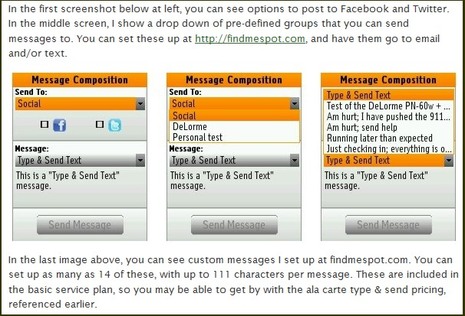
Spot_DeLorme_review_snippet_courtesy_GPSTrackLog.JPG

As best I can tell, Rich Owings at GPStracklog is the first to write up a field test of the interesting wireless pairing of a specially designed DeLorme handheld mapping GPS with a specially mated Spot Satellite Communicator, and he’s pretty excited about what he found.  Yes, you can type a 41 character message from anywhere with Spot coverage and post it to Facebook or Twitter, or send it to one of several pre-defined e-mail/text groups.  And that includes quite a lot of ocean and coast, as we saw even with the first generation Spot Messenger.  And even though DeLorme’s core clientele are terrestrial types, I notice that the PN60w/Spot system (and its PN-Series siblings) now support Navionics Gold SD chart cards (and HotMaps lakes), as well as NOAA raster downloads…
Gizmo’s halo, hello Lightning Electrotechnologies 33

Gizmo’s halo, hello Lightning Electrotechnologies

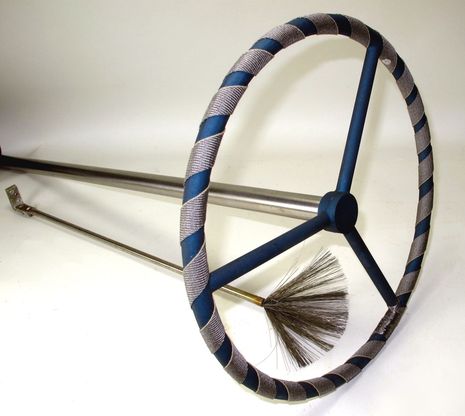
Lightning Electrotechnologies Streamer Inhibitor cPanbo.JPG

We’ve had a run of interesting new products this week, but this may be the topper.  That cast-aluminum “wheel” — wrapped with I’m not sure what and threaded for a stainless steel masthead mount that’s grounded to a Dynaplate — is a new lightning protection technology called a Streamer Inhibitor from a new company called Lightning Electrotechnologies.  I’ve posed it with the Lightning Master Static Dissipater which generated a fair bit of skeptical commentary when I took it off Gizmo’s masthead last summer.  The Inhibitor seems to be related to the Dissipater, but different.  Understanding lightning and how you might avoid it is very challenging, and I have yet to form strong opinions one way or another…

ACR Aqualink View & 406Link, hand’s on 12

ACR Aqualink View & 406Link, hand’s on

ACR_AquaLink_View_testing_cPanbo.JPG

The first time was the best. I was tootling down the Bay in May when I tested the ACR AquaLink View PLB. I’d already appreciated its high build quality, and how neatly instructions about how to activate its two self test modes and primary distress function are explained right on the casing. Then when I pressed the GPS Test button for five seconds, it was very nice to have the small LCD screen show the procedure step-by-step and advise me to give the antennas a good sky view.  And it was impressive that the GPS — perhaps never used before, or at most tested in Florida — got (and displayed) a position in well less than a minute.  (In fact, the whole test procedure is so quick that I’ve had a hard getting a good photo with the scrolling screen in action.)  But the kicker was how my cell phone buzzed a moment later with a text message confirmation that the beacon’s test signal had made it through the COSPAS-SARSAT satellite system, along with a link to its accurately mapped position…

Jotron AIS SART, & the L-3 Protec 19

Jotron AIS SART, & the L-3 Protec

Jotron-AIS-SART.jpg

I once heard a gentleman who probably knew what he was talking about complain fairly bitterly about the electronic radar reflectors called SARTs.  He said they’d been pushed on the GMDSS by a member nation where they were made and that they’d never proven themselves effective in search and rescue operations.  Which is just one reason why the new Jotron AIS SART is an interesting development…

ACR, two BIG Miami safety debuts 7

ACR, two BIG Miami safety debuts

AquaLink_view crop.JPG

The new ACR AquaLink View sure looks like the most sophisticated and best performing Personal Locator Beacon (PLB) ever designed.  Built-in buoyancy, 6.3 Watts of 406 MHz distress output, a 66 channel GPS receiver, 30 hours of battery life…the specs go on and on.  But that’s not all.  This PLB is also designed to take maximum advantage of ACR’s new 406Link through-satellite testing service, including its ability to deliver SPOT-like “I’m OK” messages via email and cell phone.  406Link also offers some level of service, even free testing, to the owners of many EPIRBs and PLBs, including lots of models not made by ACR…

New from FLIR, more choices 1

New from FLIR, more choices

FLIR_M636_thermal_in_rain_cPanbo.JPG

Among the new products to be shown at the Miami Boat Show next week, FLIR just announced both a lower cost fixed M-Series and two new higher-end hand held First Mate models.  The new M (no model # yet) packages a single 320×240 thermal cam with the same excellent bullet casing and Ethernet controller(s) that I tested as the M-626L last fall, with dual payload 640×480 thermal and low light cams. The purported retail of the new cam will be $12,000, which will likely mean an under 10g street price judging from some outlets for the existing models.  It’s great to get the price down on this valuable safety tool, but it reminds me of the occasional value I saw in also having the low light camera.  The shot above was taken in daylight, but the thermal camera would have seen out the harbor as well as it does at night if it weren’t for the downpour.  After the break, you’ll see what it missed…

Gloria A Dios, & to ACR, SARSAT, USCG, USN, etc. 15

Gloria A Dios, & to ACR, SARSAT, USCG, USN, etc.

Gloria_a_Dios_thermal_image_USCG.JPG

One of the great technological and human triumphs of our time has to be the offshore rescue system.  Some details remain unclear — like what sort of sailboat Gloria A Dios was, and what route owner/operator Dennis Clements attempted to single hand from Virginia to the Virgin Islands — but we do know this:  90 minutes after the USCG got the distress signal from his ACR Satellite 2 EPIRB at 5 pm last Saturday night, a C-130 was standing by over the boat 250 miles off Cape Hatteras in nasty full gale conditions.  It was that crew who thermal imaged Glory To God (a sobbering film you can find at the bottom of this USCG page), and who dropped two life rafts when an extra big wave dismasted and then holed her…