
Digital Yacht iAIS, hello apps developers
I don’t have a good image yet, and some really interesting new products have revealed themselves in Newport, but I’ll bet a lot of readers will want to know about Digital Yacht’s iAIS, announced...

The Marine Technology Hub

I don’t have a good image yet, and some really interesting new products have revealed themselves in Newport, but I’ll bet a lot of readers will want to know about Digital Yacht’s iAIS, announced...
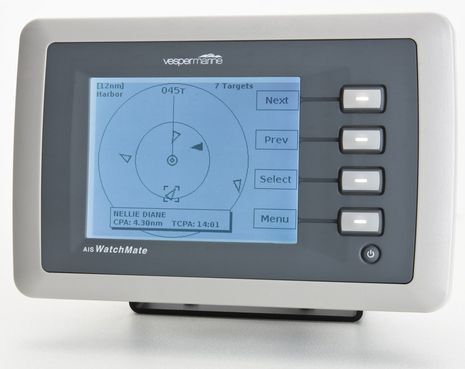
At first blush Vesper Marine’s just announced Class B AIS transponder seems similar to the Simrad AI50 and the Icom MT-500R, which is to say a transponder with a handy target plotting and info screen built in. But I think the WatchMate 850 will be significantly different, because Vesper has been focused on AIS collision avoidance for years and has gotten quite good at it. I finally got some hand’s on time with a WatchMateRX early this summer, and was even more impressed with the company when I met co-founder Jeff Robbins a few weeks ago. I had not realized, for instance, that Vesper designed and built the AIS receiver that’s in the RX model, and they’re doing the same with the transponder as well as an interesting antenna splitter also announced…
Oops: “Between July 27 and August 19, 2010, while conducting development testing of its Nationwide Automatic Identification System (NAIS), the Coast Guard inadvertently tele-commanded most AIS users transiting the Eastern United States between lower...
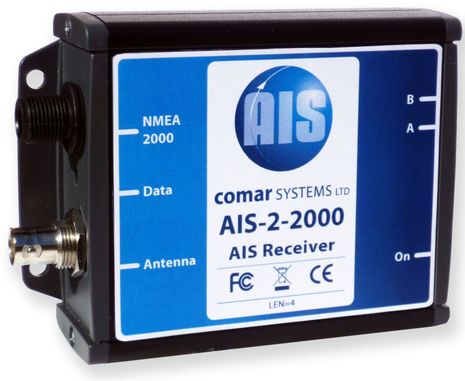
Sweet. Comar’s new little dual band AIS receiver not only outputs NMEA 2000 but is powered off it. Could there be a simpler install? In fact, the AIS-2-2000 doesn’t even have NMEA 0183 plotter or PC ports. But the way things are going, especially given all the charting programs slated to support the Actisense gateway, who needs no stink’n’ 0183? Actually a lot of boats do, which is why the Digital Yacht AIS200N2K is a nice product to have in the pipeline. And actually you may recall that NMEA was none too quick about writing N2K PGNS to match all the 0183 AIS messages, but the Comar unit is designed to deal with that tardiness…
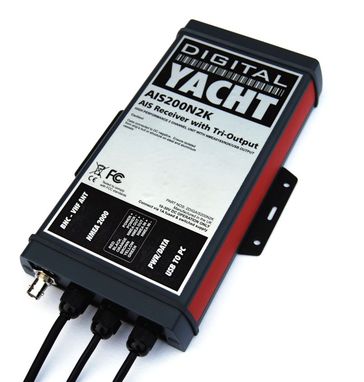
The picture tells a lot: Digital Yacht’s new AIS200N2K is the first AIS receiver I know of with NMEA 0183, NMEA 2000, and USB outputs. But get this: it can also multiplex 0183 input and gateway it to N2K, “so that traditional data such as depth,
position, speed and wind, which is available in NMEA 0183 format, can be converted
to N2K within the unit.” All for $519! The press release doesn’t say what’s coming out of the USB port, but I suspect it’s 0183 with a mix of AIS target data and 0183 inputs. Maybe someone from Digital Yacht or its US and EU retail arm Cactus Marine can elaborate in comments, because I may lose my Internet connection any moment now…
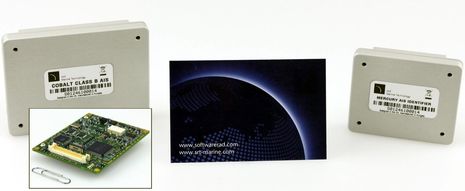
I mentioned SRT’s amazingly miniaturized Class B and SART AIS modules back in May, but seeing is believing. In that aluminum EMI enclosure at left is a Cobalt Class B transponder complete with precision GPS engine and power supply (the board itself is inset)! What we’re looking at is smart phone technology applied to a very specific marine use, and it shouldn’t be too long before these modules make AIS less expensive, more powerful, and much easier to integrate with other devices. But I’m also hearing about a dark cloud looming as the marine world rapidly adopts AIS…
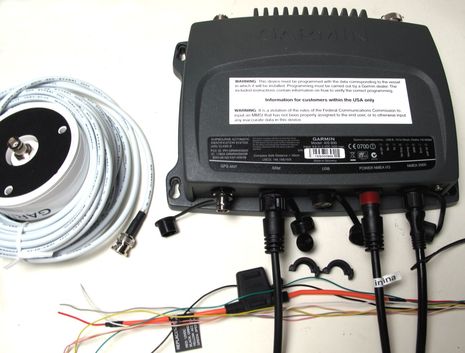
Today I checked out some just-received Garmin gear prior to installation on Gizmo, and I noticed some nice little changes. For instance, this AIS 600 has an automotive blade fuse instead of a glass cartridge and its relatively flimsy holder (which should all vanish from boats, I think). And Garmin’s included NMEA 2000 cable is thicker than it used to be, indicating, I’d guess, some added EMI protection (needed to get NMEA certification, pdf on that subject here). Garmin has also started using separate split screw collars — seen on and off in the photo — on lots of connectors besides Ethernet, which means easier to run cables (in some situations). Note, too, the most LED indicators I’ve ever seen on a Class B transponder. Tentatively speaking, the thing seemed to work pretty well too…
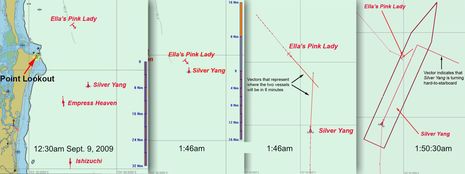
DBE! is my new shorthand for “Don’t Blame Electronics!” And the collision of Ella’s Pink Lady with the Silver Yang off Queensland, Australia, last September is a terrific example (especially as no one got hurt). I first heard about it in a Panbo comment focused on the “limits in detectability of Class B AIS” that the Australian Safety Board uncovered, which I’ll discuss after the break. But I sure hope that the Class B naysayers who may jump on this news actually download and read the full report first. Then they’ll know that the AIS data collected by a shore station and shown on the above chartlets (click for full size) was available on both vessels, and could have easily been used to prevent the accident…
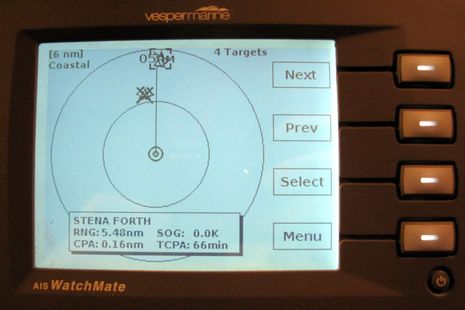
It’s good to get some solid hand’s on time with the Vesper WatchMate AIS plotter, which I admired when it first appeared, then as it got a built-in receiver option, and finally as seen live in Miami. And, yes, that is the 750 foot deep water drill ship Stena Forth now anchored in Penobscot Bay for an amazing warranty repair, mentioned in comments this week and to be explored further. But for a really vivid example of why Vesper’s sophisticated AIS alarming is valuable, consider the Bermuda Race fleet crossing the shipping lanes last night…
One of the very first Class B AIS transponder prototypes — the Shine Micro RadarPlus — was a standalone design, and it seemed to make a lot of sense (though for some reason it never came to market). It’s a little surprising then that EMA’s new BlueAIS is the first truly available standalone Class B, to my knowledge. Everything is in that 8-inch square waterproof box, and its single cable — which carries power, RS232 and 422 data feeds, and even “silent mode” switching to a little breakout box (with LED indicators) below — can be had in lengths up to 300 feet. The configuration purportedly performs very well and because EMI already has a lot of experience with similar standalone marine communications designs, there are numerous mounting options now and some interesting possibilities to come…




Recent Panbo Comments