

Don’t murder your batteries, tips for winter storage of LFP batteries
Editor’s note: Please join me in welcoming Allen Jones to Panbo. Allen has been an active participant on numerous electrical forums and Facebook groups. Allen also runs the YouTube channel MV Intrigue – Trawler DIY. Additionally, Allen worked in technical support for Epoch Batteries and moderated their facebook user support groups.
In recent years LiFePO4 (LFP) batteries in boats have morphed from a slightly mysterious luxury to commonplace. The perception has gone from an expensive and risky modification to a widely accepted, game-changing, and comfort enhancing upgrade. As such there is great excitement when it’s “your turn” to upgrade your boat. Marinas and boating forums are full of stories from the recently converted about their newly installed LFP system and the resulting improved and simplified boating. Those still using legacy lead for house power may be feeling left behind. At the same time the prices of converting to LFP have dropped significantly.
I have been able to share these revolutionary experiences with hundreds of people while working with the tech support department of a popular battery manufacturer. I have had a front row seat to witness the joys of making the change and improving their boating experience. LFP truly is a game changer and in this case the cliche is apt.
However, there is a rarely discussed potential dark cloud hanging over LFP batteries. Once you understand the cause it is as obvious as it is devastating. Over discharging cuts short the lives of many LFP batteries. Most boaters know that overly discharged batteries are bad. While many boaters are careful not to allow over-discharge of their new LFP bank, many lose track of their batteries during storage periods, and some may fail to track them at all. The great majority of us have killed a car or boat battery at some point. But most of our experience is with cheaper and potentially more forgiving batteries
Excitement over the new technology and shared stories about the amazing performance of LFP adds to the mystique. All the promise and performance aside, you can murder an LFP battery just as quickly as a lead acid battery. In some cases, maybe even faster.
There are many misunderstandings about LFP conversions. Many of these misunderstandings stem from the differences between LFP and lead acid battery chemistry and physics. An LFP graph of the voltage vs SOC contains most of the clues to these mysteries. It’s important to untangle and understand what kills an LFP battery. With this understanding, users can manage their batteries, so they live a long life and provide reliable service year after year.
As many know, nearly all LFP batteries contain a battery management system or BMS. The BMS serves to keep the battery within a “safe operating envelope” or “SOE”. It does so by monitoring parameters such as voltage, current and temperatures. When one of those parameters reaches an unsafe threshold, the BMS intercedes and isolates the battery. For MOSFET based BMS’s the charge and discharge MOSFETS are individually controlled. For batteries that use contactors to control the flow of power, the battery is entirely isolated from the DC system.
MOSFETs are essentially electronic switches that manage the flow of electricity in or out of the battery as needed. If the voltage gets too high the charge MOSFET will shut off to keep the cell/pack voltage within the SOE. When the voltage gets too low it shuts off the discharge MOSFET preventing cell damage. With these fancy features it is understandable you may assume a quality LFP battery can safely manage itself. If the BMS is protecting the cells, how can you end up with an overly discharged battery to the point of damage?

Unfortunately, when boats come out of storage, many are finding completely dead batteries or banks. The majority are battery banks that won’t power up, won’t take a charge and are essentially non-functional. How could this possibly happen to these miracle batteries?
To understand the details, we need some battery basics. All batteries have some amount of self-discharge. LFP cell specifications typically quote 1-3% per month. This number is generally accurate for the mid-range state of charge between 5% and 99% SOC. But the 1-3% range doesn’t apply when the cells reach what is known as “the lower knee”.
As seen in the voltage vs SOC chart below, once an LFP battery nears depletion, the drop in voltage is precipitous. The bottom row of the chart represents amp hours (Ah). Ah is a unit of capacity; however, it is a unit made up of two components, time and current flow. Taken another way, the precipitous drop in voltage is graphed over a time component on the bottom row. Self-discharge of LFP cells must be factored into this precipitous drop when cell voltage is in the lower knee ranges.
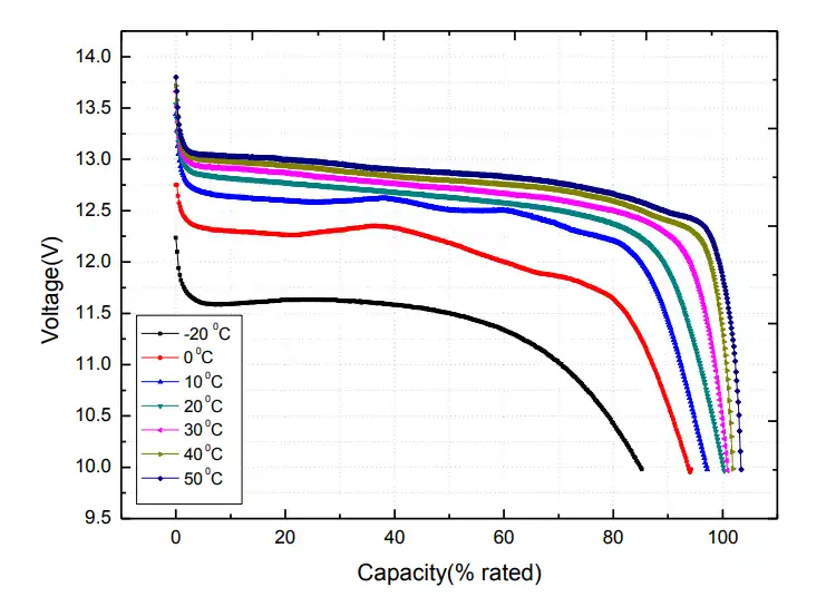
As a result, you can see that a self-discharge in the mid-range of SOC over the course of what might be a month will hardly be noticed regarding voltage. But a month or even a few weeks with cell voltage in the lower knee is a recipe for disaster. Cold temperatures often encountered during winter storage hasten this trajectory towards the lower knee voltages.
The final factor is battery electronics energy consumption. Things like Bluetooth modules, the BMS itself, indicator lights, and displays all use some power. Even small internal draws will add up when calculated over months. In addition, I have noted significant variation in self-consumption between battery brands and even models of a single brand. BMS selection and additional features such as plug in monitors seem to explain much of the spread. Some batteries can have an astounding amount of self-consumption while others have nearly none.
The BMS may or may not properly register cell self-discharge and parasitic consumption. As a result, SOC calculation in the battery app or monitor may become significantly inaccurate over long idle periods. It’s not uncommon to see a battery registering a full or nearly full SOC with a voltage reading indicating near complete discharge.
The battery BMS calculates SOC using an internal shunt to measure power in and out of the battery and then calculates power usage. Most self-contained batteries shunts lack sufficient resolution to capture the very small currents being used in self-consumption and have no means to capture actual self-discharge. In addition, some BMSs will shut off when the battery is powered down or when the battery “goes to sleep” and stops capturing this SOC loss over time.
As a result, you may shut down the battery at 13.3 volts and 75% SOC. After several months turned off, it still reads 75%. But, in our hypothetical scenario, voltage has dropped to 12.7 volts, indicating a large loss in capacity not captured by the SOC meter. Not all batteries behave this way but be sure to keep a close eye out for this occurrence. These challenges are not deal breakers but do need to be known by the boat owner so they can keep a keen eye on things. A good rule of thumb is to get used to looking at state of charge percentages and voltages at each check. Always cross check.
The actual cause of battery homicide generally fits into just 2 categories:
- Batteries that did not have sufficient capacity to be stored for the length of time they were stored. Especially in very cold temperatures.
- Batteries and DC systems that were not prepared for the anticipated inactive period properly prior to winter storage.
Capacity sufficient to avoid cause number one above is determined by the rates of cell self-discharge and battery self-consumption. Typically, self-consumption is the larger culprit. I have seen batteries with self-consumption as high as 0.25 amps/hour. That doesn’t sound like much but consider a 300ah battery. That calculates to around 50 days of storage before the battery exhausts 300ah of energy just to support itself. And having 2 or 4 of these very same 300ah batteries does not increase that 50-day mark since each battery is consuming its own power. At the 50 day point the battery voltage is squarely in the lower knee and the BMS will shut off the discharge MOSFETs to save itself. This usually happens around 2.5 volts per cell or 10.0 to 10.5 volts of the pack. But shutting off the discharge MOSFETs may or may not help to slow the death spiral.
Each passing hour with voltage in the lower knee drops capacity and voltage at an increasing rate. Eventually, it falls so low that the BMS cannot be powered any longer. At this point the battery is already in danger of being unrecoverable. If it is on the cusp of BMS voltage, applying a charge at this time may or may not power up the BMS and allow charging to commence. Past this stage, internal intervention is required to directly charge the cells which requires opening the battery (if possible) and charging the cells directly at contact points prior to the BMS. In this state, if the battery is not discovered and rescued quickly, the voltage will continue to fall until the cells themselves are damaged. The battery is in a precarious state. You have days or a few weeks at most to discover it and take immediate action to charge and rescue your LFP batteries.
It is unfortunate, but many times that rescue never comes. When a boat owner returns to a dead boat with an unresponsive DC system, the natural assumption is a failure of their newly installed LFP batteries. All 2,3,4 or more of them, at once! Although LFP batteries do fail from time to time, I assure you they don’t fail 4 at a time without help. This cascade of events typically culminates in a call to tech support. What happens next varies based on many factors. Are the batteries serviceable so that the top may be removed and cells probed? Is the customer honest with the description of events? The battery manufacturers policy and even the sophistication of support in troubleshooting the event will affect the outcome.
I can tell you that many times batteries may get replaced under warranty for damage that probably shouldn’t have been covered. In other circumstances the warranty is denied completely based on details and information gathered. Several times I led the customer, via troubleshooting, to the realization that he/she essentially killed their batteries, and that it is not a warrantable condition. It is these conversations that led me to write this article. It’s a tough conversation to have and it is far too common.
To avoid being caught in such a situation I have refined my opinion on LFP-battery winter storage to just a few cardinal rules. In my opinion there are only three acceptable practices for LFP winter storage.
- If shore power is available leave the battery pack on charge throughout the winter. Set a storage voltage of 13-13.2 volts and leave the charger on. If you want an increased time cushion in case of power loss, use the standard float voltage of 13.5 volts or the manufacturer’s recommended float. Check on the system often to ensure power remains on and the batteries are being maintained. Bluetooth or the Victron VRM remote monitoring is very useful here. Even a 120-volt AC outlet with a small charger will be sufficient. If the battery has self-heating features, you must check on the battery during the initial cold snaps in which the self-heating and charging should have engaged to ensure proper heating and charging. If you anticipate temperatures low enough to initiate internal heaters, ensure there is sufficient amperage available from the charger to power all heaters in the system simultaneously as some heaters in large batteries require 1 to 10 amps to bring the temperature up before a charge will be allowed. In some scenarios that could be a significant amount of power, and more than a small charger can handle.
- Remove the batteries. Take them home and put them in a warm place and on charge using a quality charger such as the Victron IP65 or IP22 with storage mode engaged or charge to a mid-level SOC and shut them down. Even in this scenario, you should still check them often.
- The least desirable option in my opinion is to charge the batteries to nearly full and secure all possible loads, preferably with battery disconnect switches. Making a checklist for this scenario is particularly useful. It would be wise to check on the batteries weekly for the first month to evaluate power losses and adjust the interval of the visits as needed. Check after prolonged periods of cold weather and charge as required. Routine monitoring is still a must. Sometimes this is not possible with boats that are wrapped and fully winterized. In that case another option is mandatory.
Regardless of what you choose, walking away from the boat for 3-6 months is a bad option. Protect your investment!


Allen,
Thanks for the article. Its great seeing your addition to Panbo. For those who don’t know Allen, I “met” him a couple years ago as I was moving to LiPo on my boat. We were both early to the Epoch scene, but Allen’s testing, Youtube videos, and countless chat conversations were awesome.
I look forward to many more insights from all his hard work that the rest of us can benefit. And, eventually, meeting him in person.
Thanks Ray. Much appreciated.
Thanks for this very interesting article.
Could leaving the the solar panel charging during the winter do the job?
Definitely. But even then checking on things, especially in the early stages of your storage, is a good idea. Atleast until you have a good understanding of how your system responds in a storage situation. Each boat is different.
Remember that the efficiency and output voltage of a solar panel is strongly temperature dependent. When a panel is cold it is more efficient and its output voltage increases. Take this into account when selecting your solar panel controller, either MPPT or PWM, to ensure that the controller can accommodate the increased voltage from a cold solar panel.
what about storing in heated storage with batteries fully charged and disconeected.
Perfectly fine. But the main gist is to check them regularly to ensure there is no high self consumption or other anomalies that might give you a surprise
One correction. If you are storing in heated storage I would probably fully charge them and then take a bit off the top. You hear 50% quite often but I think that stems mainly from the requirements for manufactures prior to shipping. IMO anything slightly less than resting voltage would be fine. 50 to 90% soc or so.
This has always been a bit confusing, what SOC to put an LFP battery into warm-ish winter storage for 6 months in Alaska where I work. Owners never understand, and I’ve never had a solid explanation to give, as to why we need to “take a little bit off the top” after a full charge. As long as the battery is fully disconnected after being properly fully charged, what is the explanation for needing to take it down to 90% SOC or so before storing it?
Welcome Allen. It’s great to have you onboard.
Great advice, nicely delivered. Which should also heeded by captains who leave their boats in Mexico, the Caribbean, etc. for months during the summer.
Amps/hr is a commonly misused term, and as an engineer it makes me cringe. Unlike some misuse of units, it’s hard to really know what was meant (knots per hour, for instance, clearly means knots). Is he talking about a rate of increase (the literal meaning of .25 Amps/hour, where it is .25 Amps now, .5 Amps in an hour, and .75 Amps in two hours)? Or does he mean a consumption rate of .25 Amps? Or does he mean .25 Ah, without any time period (is it .25Ah/day, or .25Ah/hour — meaning really .25A)?
I expect this exceptionally sloppy terminology from the unwashed masses. I can even tolerate it as a typo in a first draft. But for an industry professional to misuse basic terminology in a published document is absolutely cringe-worthy.
Doing my best to put aside the loss of all credibility from the glaring misuse of terminology, the rest of the article is quite informative.
Harry, don’t get wrapped around the axle on that. This article wasn’t meant for engineers it was geared towards new users going into their first storage period. The first draft actually had the basic terminology of .25 amps. It was intentionally changed to be a bit more descriptive and demonstrate the time component to someone who otherwise might otherwise miss the correlation.
You’re kidding right? Exceptionally sloppy… Loss of all credibility… Come on!
-Ben S.
Yes, strong words. But we see it over and over and over again. In this case, with a steady state draw, it’s actually easy to know what he meant (he meant Amps). But it’s an expert perpetuating and encouraging a very frustrating language.
Consider a common statement on various online forums. Something like “My fridge draws 5 A/hr.” You tell me what is meant by that? It’s the EXACT SAME mistake, and completely useless. Does he mean “My fridge draws 5A when running” (mine does)? Or does he mean it draws 5Ah/h (mine draws about 3Ah/h, since it runs a little over half time)? Or since this is usually done in the context of a daily power budget, does he use 5Ah/day?
It’s frustrating. And not just for engineers (I am one, so “he has the knack” as Dilbert’s mom learned…LOL). Talk with a friend, try to decide what he needs for a battery, and when he uses Amps/hour, try and understand what he means (no fair if you ask him what he means, just understand from his words!). It is close to the number one problem in simple battery discussions.
Experts in the field simply don’t make this basic mistake. Does Allen actually use the words “Amps/hour”, and is that how they talked in the Tech Support department? Does he size fuses in “Amps/hour,” or look up wire sizes for given “Amps/hour?”
Harry, for tech support I use the language I think the customer might understand based on what they are showing me at the time. We use whatever language we need to help the customer understand various concepts. My goal is not to enforce technical jargon so that they might one day be able to talk to an engineer without being scolded…it is simply to help people get their project past the goal line. Keep in mind that the actual majority of people that will get their RV or boat online and in use will rarely think about such technical things again. Anyways, thanks for the opinions and point taken.
Professor Gralla? Is that you? Still teaching University Physics I after all these years?
i rarely put it in front, but this time i feel it belongs to the topic. I am an electrical engineer since 45 years.
To structure the issue to an engineers common work process:
a) Allen did a great job in explaining to the public a complex system like a Lithium battery. If it would have been as simple as an lead acid battery invented 120years ago, the same description would have been used.
b) The ampere-hour (Ah) is an SI-derived unit (by the IEC Technical Committee 25) of electric charge, it is based on two out of the seven base units forming the core of the SI, current and time.
c) Ah is a reasonable perfect unit of measurement for batteries. The content of the battery discharged in one hour and measured with an Amp-meter (A per hour (hour=1)) calculate with an integral of the the voltage equals W (unit of power)
d) Hence, if your fridge consumes 3A and nothing more within 1hr it consumed 3A per hour (3Ah) or in capital lettpose on knowledge about fphrasers (but wrong in terms of IEC) 3AH
To use in an public environment amps in place of A and hrs in place of h is IMHO legitimate as the aim is to have people understand the topic. It seems Harry Keith has not grabed the context and derive the content of the message. Pretty worrying, he would not be my electrical engineer of choice.
Great job done, Allan Jones
Thank you Vinzens. Much appreciated. I thought the intent was obvious too. But despite that, hopefully the article on balance was helpful to save a few expensive battery packs this coming winter 🙂
As fellow a “recovering” electrical engineer of, ahem, 45 years, and a fan of those who quote IEC standards, I found Vinzens comments oddly entertaining.
Nice article! I look forward to the day when LFP batteries include a “park” setting to maintain a 50% state of charge for storage.
One clarification – I think the horizontal axis of the voltage vs capacity chart should be “Depth of Discharge” rather than Capacity.
This was an excellent, timely, well thought out article and, as the leaves north of the Artic Circle (considered by Floridians to be the FL/GA border) are starting to turn (+/-), boats with LFP batteries are going to be laid up soon. Your recommendations are spot on.
LFP batteries with internal BMS’s and no method for measuring and displaying individual cell voltages are especially susceptible.
The Victron chargers that you cited are an excellent choice for recovering a neglected battery. We have used one to recover a LFP bank that had been neglected by being on the hard with a disconnected shore cord for months. Self discharge and other parasitic loads had brought bank voltage to <6 volts as I recall. The Victron charger slowly and gently recovered the bank one battery at a time.
Thanks Charlie. Some of the conversations with those who killed their battery bank were really tough.
Good info here. I am trying to come up to speed on these things. I recently bought a pair of Epoch C12460As. One is being replaced under warranty for a bad network port. The other is installed in our system as stand-alone, but i can’t get it to provide power to the system. We are currently running on 2 100Ah AGMs with no issues. When I switch to the Epoch, all the lights go out. No power. If I turn on one of the IP43 chargers, there is power, but not from the battery. I put a 5A pump across the terminals and it ran. The current showed up on the app as a 4A draw like it should. We are hauled out now, and I have a ton of work to do before we launch on monday, so I haven’t had time to do much with this.
I would really appreciate some help here. I have been in contact with Geoffrey, and he gave me a list of things to check, but i can’t get to it now, and I think most of them will prove to not be the issue. Thanks.
Rich, I sent you an email.
Very interesting article. I have one question that hopefully you can help with. I have the Epoch 460ah, V1. I use a Magnum MS2012 inverter/charger to maintain.the battery employing a CC/CV charge cycle. It all works well until the cold weather hits. Last year the internal heaters never came on when the Magnum attempted a charge cycle. I ended up using a hair dryer to warm the compartment so that charging could be done. Do the heaters start with the attempted charge using charger current or does the attempted charge use battery internal current to warm the battery? Is there a charger behavior that wouldn’t trigger the heaters? When this occurs the Magnum indicates it’s applying high current but of course the battery isn’t accepting it. This isn’t explained very well in the battery documentation.
Bob, The V1, like most drop in batteries with internal heating, would use the chargers applied power to power the heaters and would NOT use power from the cells. All incoming current is diverted to the heating pad until the required temperature is met (41 degrees in your case) and then the cells are connected to the charger. In your description you say the charger indicates it is applying high current? The V1 heater is about 10 amps. If there are no other loads and the charger is outputting a high current (I assume much greater than 10 amps) then it would presumably be going to the cells. One other tidbit for the V1. If you download the Roypow Fish app and connect it to the V1, you can toggle the “wifi” switch in the app and you will hear the heater relay click inside the battery and it will power the heater from the cells manually. At least you wont have to use a heat gun. But you should be present to monitor the situation IMO. Also, if you go to the LFPexperts.com come website and click on “resources” you will find a video covering the Epoch app that describes some of those details along with other potentially useful items.
Allen, thanks for the detailed response. I have the RoyPow app but didn’t know that the heaters could be manually activated. I will investigate that when the temperature starts going down later in the fall.
For clarification, my Magnum indicated it was providing around 80 amps, my SmrtShunt showed zero as did the battery. The charging MOSFET also was off.
Allen, just wanted to do a follow-up post. I did use the RoyPow app to turn on the heaters when the cell temperature were in the mid 30’s. I could see they turned on but then would turn off. I’m guessing that since heat wasn’t really necessary because they were still in the charge temperature range the heaters turned off. Fast forward a couple of weeks and the temperature dropped significantly. Each time the cell temperature dropped below 32 degrees, the heaters turned on and my Magnum 2012 powered the heaters until they reached 41 degrees and then a charge cycle would be completed using the CC/Cv settings. The heaters have worked flawlessly since I turned them on with the RoyPow app. I have been able to keep track of my cold weather charge cycle with my Cerbo GX setup.
Thanks for the the help with this, it’s made the cold weather much easier to handle.
There is so much that can go wrong on an inactive boat that I installed a boat monitoring system on my last boat. We lived in Atlanta and the boat was in Tacoma. I had an alert. I called the harbor master and learned it was a soon to be fixed shore power problem and that the boat was fine. This provided a lot of peace oh mind over the years.
I agree, some kind of monitoring is really the way to go.
One of the advantages of LiFePO4 vs. FLA is the much lower self-discharge rate. If you are sure that your battery doesn’t waste energy on its own (.25A – wow!), which it really shouldn’t, and your boat is in a non-freezing environment, I think you have a winterizing option 4: With SOC around 50-60%, disconnect and secure one of the battery terminals. That’s it. I have done this twice now for 6 and 8 months respectively and the voltage was at ~13.2 V when I returned. I then fully charged the battery, which calibrates the battery monitor again, and off I go sailing.