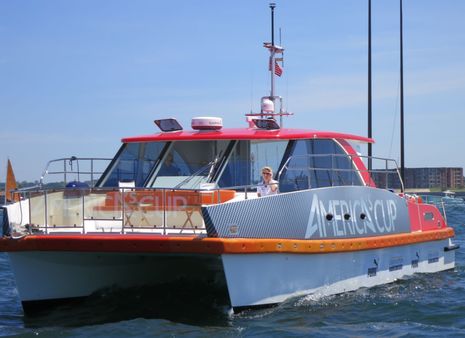
A visit to the America’s Cup World Series in Newport, RI in June 2012 provided an opportunity to tour the engineering spaces and helm of this second-generation mark/VIP boat as a follow-up to Ben’s visit to hull number one. Before the engineering tour I spent the day on the race course in the vessel’s predecessor, observing the racing and learning what drove the design improvements to this latest generation.
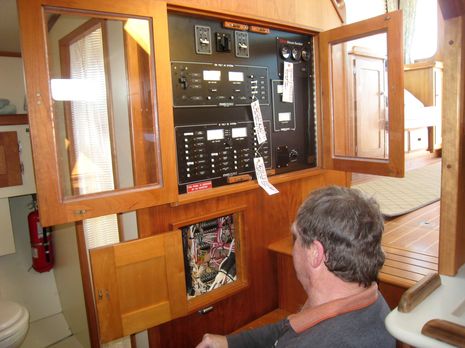
In retrospect, it’s almost funny that the very first picture of GizmoI published on Panbo (repeated above) highlighted that mess of wiring tucked under the circuit breaker panel. In the four years since, I’ve at least figured out, and in many cases changed or removed, nearly every electrical component on the boat. Just before I went to the Miami show it seemed like the time had come to attack what lay behind that nice little access door, but things did not go well…
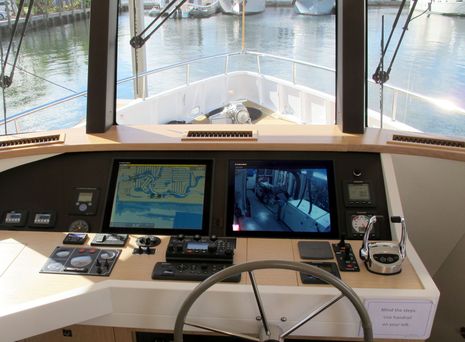
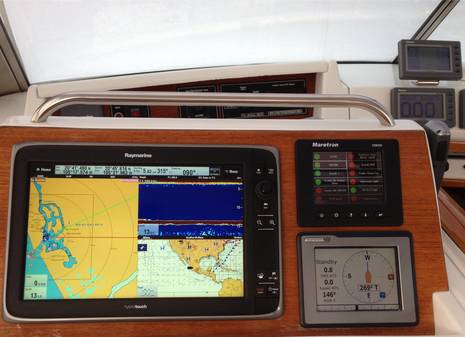
I did get to tour a couple of yachts during my Trawler Fest engagement and the one that got my attention was the Garcia GT54 hull #1, which was built in France and motored to the U.S. on her own bottom…during hurricane season! “Le Trawler” is both stylish and practical in numerous ways, and it’s also a good example of a full-on Furuno NavNet 3D system…
Regular Panbo readers may recall that Jeremy Anwyl wrote a 2011 guest entry about his efforts to bring some stability to his admittedly complex NMEA 2000 network. Back then he was focused on the backbone, minimizing voltage drops, managing reflections and so forth. Anwyl continues to enjoy using his lovely Beneteau 57 Tranquilidad as an electronics lab, but he’s also finding bugs in new places…
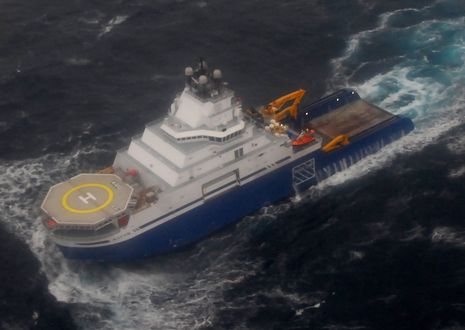
When most of us were enjoying the holiday quite the sea drama was playing out off Kodiak, Alaska. Last Friday the mighty 360-foot icebreaking anchor-handling tug supply vessel Aiviq (above) “experienced multiple engine failures” while towing the unusual conical drill ship Kulluk in 20-foot seas. Assisted by several large tugs and especially U.S. Coast Guard cutters and helicopters, the Aiviq eventually got her fuel issues solved and by Monday the Kulluk was back under tow, though without a crew and in even worse weather. And then the story turned again: The Aiviq’s tow line parted, the CG ordered the tug Alertto drop hers for the crew’s safety, and by New Year champagne time the Kulluk was hard aground being pounded by 30-foot waves…
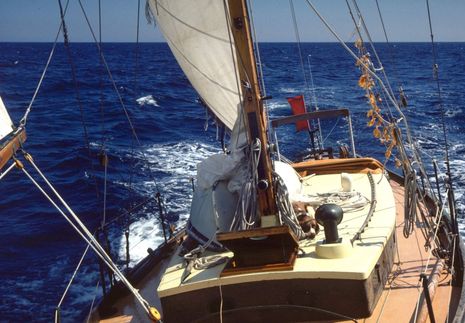
2013 is going to be a bang up year for Panbo, I think. News about that tomorrow, and soon we’ll be back to actual electronics news and reviews, I promise. But first I have one more bit of boating nostalgia to cap off 2012. I took the photo above in April, 1978, as the good sloop Alice reached along well offshore about half way to Maine from Man-O-War Cay in the Abacos (hence the conch jerky hung to dry in the rigging). We’d already endured some fairly heavy weather without problems and this was a glorious morning when Alice was taking care of herself nicely and I was further enjoying the fruits of our long relationship…
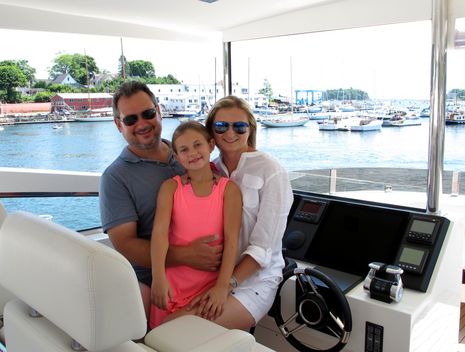
This picture of the Levey family is very similar to one which was published years ago in an article called Early Adopter that I’m still proud of. It was an unusual story because at first I didn’t want to write it. When I met Mark and Natalia in 2007 they were very early adopters of a snazzy nav system that was behaving quite badly, and frankly I was reluctant to cover what seemed like a possible accident about to happen (and, besides, writing about gear that doesn’t work very well is not what enthusiast magazines are about). But when they motored Alexis — an Azimut 55 named for their daughter — into Camden a year later, the Simrad Glass Bridge 60 was working better and, more important, I realized that this couple epitomized an early adaptor attitude that works. They like new technology for sure, but they know it doesn’t always perform as advertised and they don’t let that get in the way of their boating safety and enjoyment. I hope you’ll check out the article before taking a peek at the Levey’s new boat…
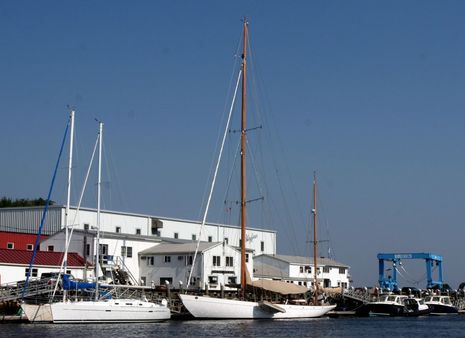
A Camden Harbor 2012 spring bonus has been getting to know that classy 85-foot wooden yawl as she prepared for an attempt at the Northwest Passage. Her name is Nordwind though her mainsail cover and life rings are marked Nordwind 1939, presumably in memory of both her launch year and the Fastnet Race in which she set a record that held for twenty-four years. Some of this history can be found on Nordwind’s 2011 Transatlantic Race page along with mention of her recent rounding of Cape Horn. This old boat still gets around! I suspect that her greatest asset for the adventure north is the fact that her professional skipper, Alex Veccia, has already sailed her so many hard miles. But if you look closely in her rigging, you’ll see that he will have some new electronic helpers…
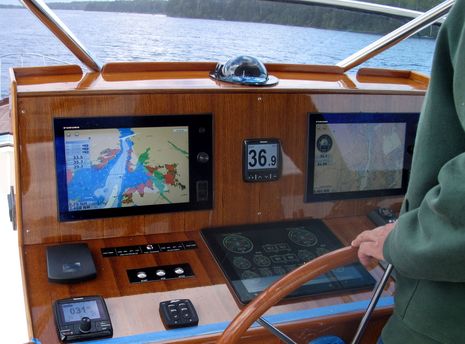
A wry line that applies to this and numerous other cutting-edge installs is: “Many things work!” (Though maybe not everything just yet.) This is the 58-foot yacht I mentioned in February when I met the owner at the Miami Show as he planned a nearly complete electronics update. Obviously he decided on the Furuno TZtouch displays that debuted that very day. In fact, while the four TZT14’s on this boat may be some of first installed anywhere and they’re mixed with lots of non-Furuno gear to boot, they seemed to be working quite well. So nicely done, Furuno! But I emphasize “seemed” because it takes a while to wring out a system as complex as this, especially when so much is happening preparatory to delivery day. Heck, guys were varnishing below even as we blasted up the St. George river at nearly 36 knots to check that yet another prop change had fixed vibration issues. And though the techs are joining the owner for the two-day delivery home, it’s still unlikely that they’ll get all the way through the “issues list.” That’s life on the cutting edge. Nonetheless, I think the owner is going to be very pleased with how close the system comes to his vision, and how well it will customize and expand to his future wishes…
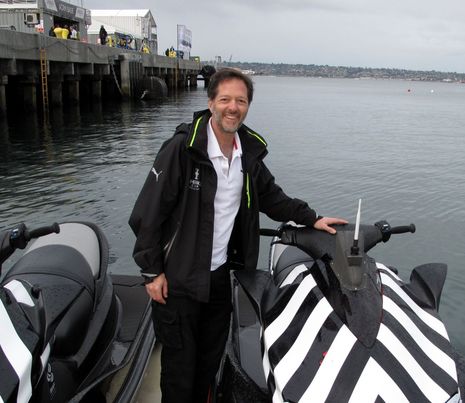
I’ve corresponded with Eric Steinberg for years — and wrote about some of his offshore racing electronics ideas in 2010 — but what a pleasure it was to meet him in San Diego. Aside from overseeing Farallon Electronics and IstarGPS, he is now Director of Electronics Systems for the Americas Cup Race Management and hence responsible for all the high tech gear on some 29 support vessels. Yet it was Eric who took the time to patiently explain the many-layered systems that I tried to lay outexplain in Yachting. He was especially proud of what they managed to squeeze into the “personal watercraft” (PWC) that some of the umpires use to chase the AC45 catamarans (pictured here)…




Recent Panbo Comments