Category: What’s on board…
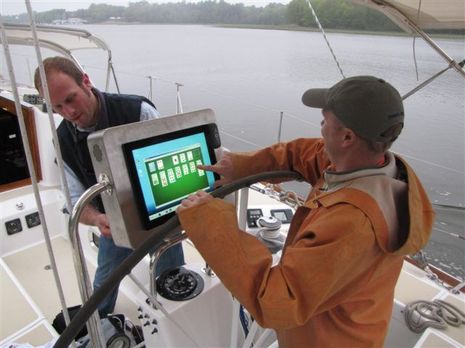
Here’s one way to test a newly installed KEP Marine Glass Bridge Monitor, the first with dual touch technology, which happens to work well with Windows 7. The owner of this J160 racer/cruiser was purportedly very happy with it last season, but there was, in fact, a problem getting the touchscreen signals to consistently make the 25 foot trip from the helm to the nav station PC below. Adam White (left) — former electronics guy and now service manager at Yankee Marina & Boatyard — worked with KEP to solve the issue…
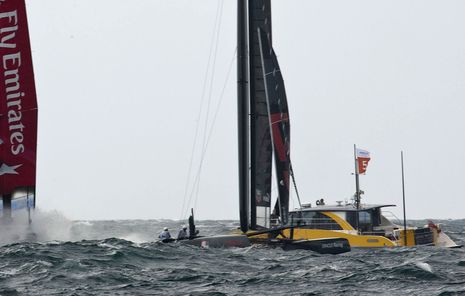
The first day of AC 45 racing in Naples yesterday made for must-see YouTube video, and must have been quite an initiation for the six new Mark/VIP boats. For instance, did the Volvo Penta IPS dynamic positioning I saw being tested in San Diego on hull #1 actually work in these very rough conditions? I’m also curious why there seem to be so few “VIP” spectators on board as the mark boats seem to the perfect spot to watch the racing. Yesterday I thought it might be for safety reasons, but today the conditions I saw on the live feed were much more mellow…
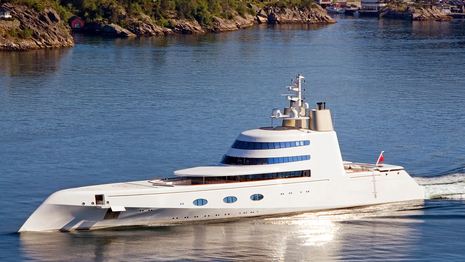
It’s hard to beat this chap’s description of what it must be like to arrive somewhere aboard the 390-foot motor yacht A:
You could hear the sound of penises shrinking from as far away as San Remo when “A” dropped anchor in the bay of Cannes recently. You could hear the sound of Billionaire’s accountants calculating the cost of building a more spectacular boat about thirty seconds later.
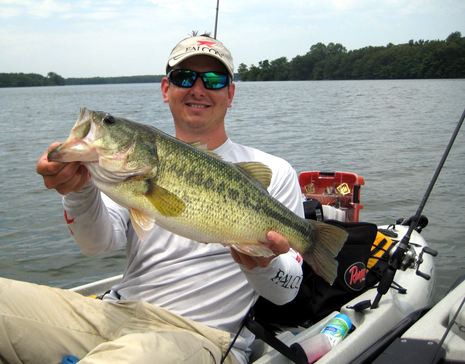
Navico product manager Lucas Stewart may look like he’s having fun, but he really is putting a lot of Lowrance gear through its paces. Really. When I got chatting with him during an early morning Miami demo (more on that soon) and he mentioned that he does some testing aboard his Hobie Mirage Pro Angler, I pictured perhaps an Elite-5 DSI fishfinder/plotter mounted on its deck. But it turned out that Stewart had a much grander vision for his 14-foot pedal boat…
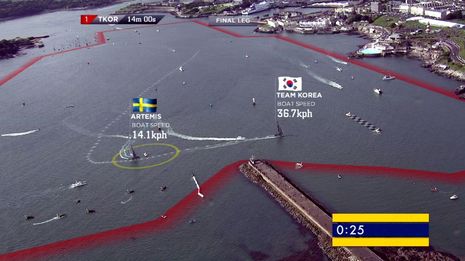
Never mind the final Super Bowl score (and the unfortunate headlines), did you appreciate those slick digital field overlays like the yellow 1st & ten line? Frankly I’m still impressed with this technology even though it’s not magic. HowStuffWorks explains pretty well the sensors, geometry, and video processing required to make that virtual line look like it’s painted on the field. All it takes is precise knowledge of where the camera and line markers are in a 3D model of the stadium, plus the use of the turf color as a reverse mask so that the players — who must never wear the same shade of green — don’t get overlaid. But once you understand that, the new LiveLine info inserted into America’s Cup video seems practically impossible…
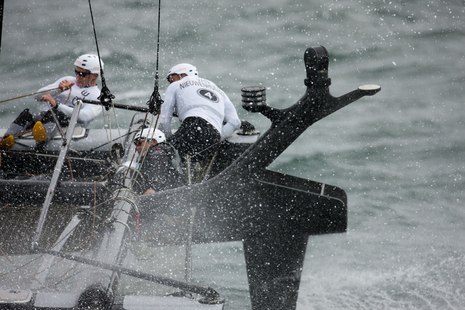
I spent some time recently looking through the wonderful photography AC34 is making available to the media (the public can browse large thumbnails). Most of the images were taken by the superb shooter Gilles Martin-Raget, and I thank him for taking some that illustrate my story obessions with the underlying technology and the support fleet. Like the one above which frames the intense racing with the AC45’s space-age boomkin. As described in November that gray disk most aft is a NovAtel high-precision GPS which works along with inertial motion sensors and a high speed wireless data network so that the entire AC system knows exactly where this boat is…
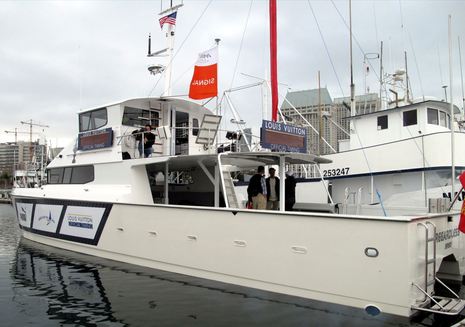
Almost two months later and I’m still excited about what I saw of America’s Cup 34 in San Diego. If I had a megayacht I might well dispatch it to Naples or Venice for the spring World Series events, and I’ll certainly be tuning in to AC’s YouTube channel. But I’m convinced that understanding the incredible technology behind the scenes helps you appreciate how pure the racing is, and I’ve got several more entries to write on the subject, as well as an April Yachting feature in the works. Today we’re going to peek at what goes on aboard the AC 34 committee boat, a sturdy power cat named Regardless…
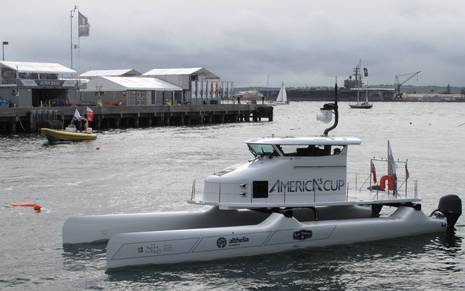
Given that the Golden Gate Yacht Club — home club of Larry Ellison and his team BMW Oracle Racing — couldn’t confidently start on America’s Cup 34 until they won the much-litigated AC33 in February, 2010, it’s pretty amazing that they got the new World Series program running last August. Besides the raft of new behind-the-scenes technology discussed here recently, the organizers put together a large fleet of support vessels and a core shore infrastructure that could all travel around the world packed into a cargo ship. And the AC34 folks do not seem to do anything halfway. For instance, click on the photo and see how the ACRM (Race Management) containers were stacked and accessorized on the San Diego Navy Pier to make a two-story Base with decks and awnings (and even wheelchair access). Consider too the sleek camera-toting power catamaran Cambria…
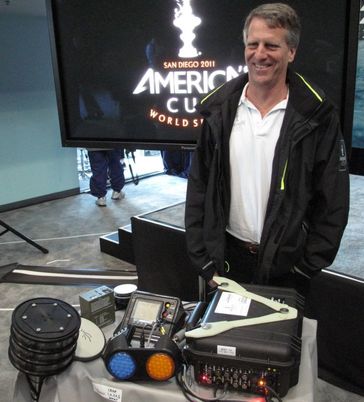
Stan Honey has not always been grinning during the San Diego session of the AC World Series, but it’s staggering what he and the many tech teams behind the scenes have already accomplished. As I had hoped. In fact, while I came mostly to see the technology, I’ve become enthralled by the racing itself, which — almost ironically, and a far cry from previous AC’s — is all about sailing skills rather than competing design and gear technologies. The fleet of AC45 catamarans is nearly pure one design (they have some latitude over the “soft” sail designs) and I understand that the only racing electronics the crews are using are GPS speedos. What all the gadgetry and software supports are remarkably agile race management, fast and fair umpiring, and phenomenal audio video broadcast coverage…
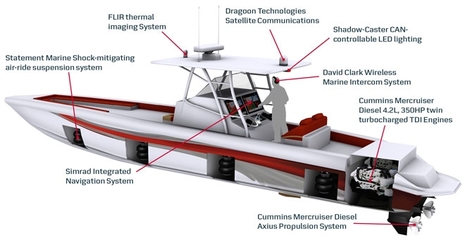
Rats. I got excited that an accomplished-sounding guy named Chris Fertig had departed New York Harbor yesterday morning in an attempt at the Bermuda Challenge. He hoped to beat the current speed champ “while using less fuel and producing less engine emissions.” But the Spot tracking page for TDI Clean Diesel indicates that he hung a hard right for home at around eight last night. The boat is still moving right along, so there’s no sign of gear failure, but my calculations show an average speed of only 28 knots for the first 290 miles, and he’d been hoping for 35. Plus his track had started zig-zagging a bit suggesting a contentious sea state despite the Statement Marine’s “shock mitigating suspension system.” Giving up on a sure-to-lose attempt might have been my decision too! But let’s discuss the Challenge and some of Fertig’s gear anyway…




Recent Panbo Comments