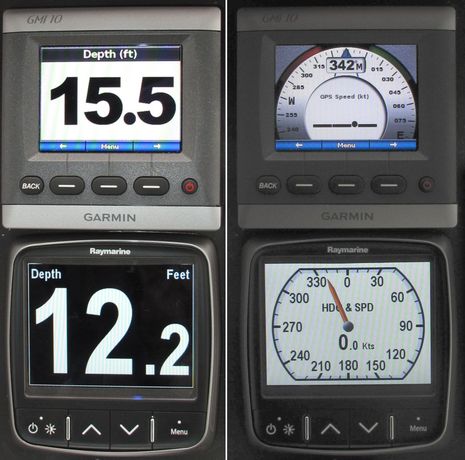
A bigger and at least as bright a display? Check! Able to show vaguely as many NMEA 2000 data fields in vaguely as many ways? Check! Also manageable with a clean and intuitive interface? Check! Don’t take me too seriously as I’ve only tested the new Raymarine i70 for maybe an hour now, but it’s no doubt an impressive parry at the venerable Garmin GMI 10…
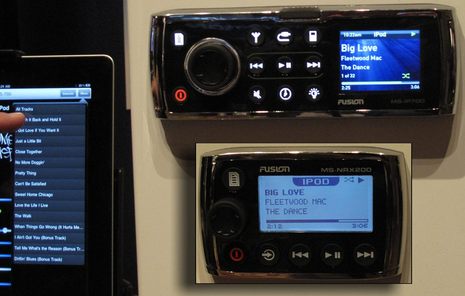
Pardon the lousy show booth photography, but you’ve got to see what Fusion Audio debuted at NMEA, and it’s not fully online yet. The new MS-IP700 at upper right obviously has a color screen, but it also has both NMEA 2000 and Ethernet ports on its backside. Which means that it will be easy to install that new MS-NRX200 wired remote and it will even be able to display instrument info on its 2.7-inch monochrome screen (which is the same size as the 700 screen, because the collaged images are not to scale). And, yes, the Ethernet port is connected to a WiFi router which is being used by a Fusion app on that iPad at left to choose tunes, adjust volume levels on four possible zones, etc. But that is not all!…
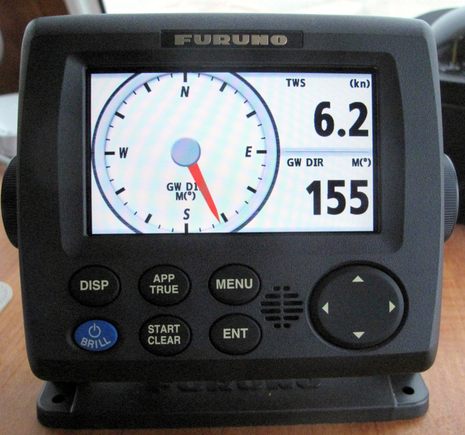
Please trust me that the Furuno RD33 — first discussed here in March, 2010 — looks better than I’ve managed to photograph yet. And, somewhat oddly, it seems that you’ll find more screen shots and a better brochure on Furuno.com’s RD-33 page as opposed to FurunoUSA’s RD33 page. In fact, you’ll have to look elsewhere for images of the many handsome data pages that an RD33 can flip through because today I’m going to focus on a few behind-the-scenes screens…
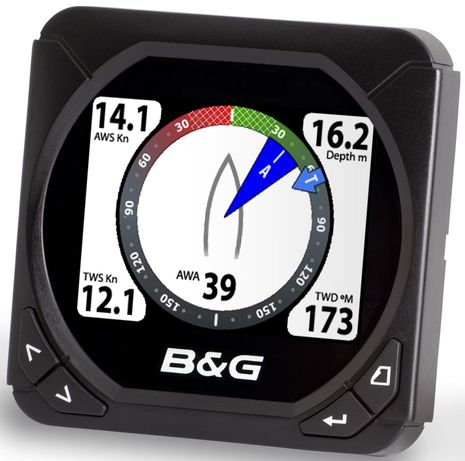
When I hinted last week that the new Raymarine i70 all-in-one NMEA 2000 instrument would soon have a new competitor, I honestly didn’t realize that the B&G Triton would be announced today (with at least the Australian release online already). The Triton T41 sports a 4.1-inch color display under a 4.6-inch square bezel while the i70 has a 4-inch screen in a 4.53-inch high by 4.3-inch wide case. And I’ll bet the Triton is also LED backlit as it too claims wide viewing angles along with a power range of just 50-150 milliamps, which seems similar to Ray’s claimed 135ma “typical” usage. You’d almost think that Navico and Raymarine were looking over each other’s shoulders!…
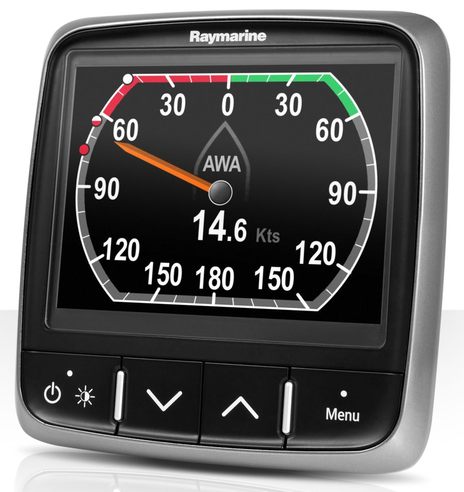
With all the fuss about Raymarine’s new e7 MFD, the similarly styled i70 all-in-one instrument may not have gotten the attention it deserves. That 4-inch LED-backlit screen is a nice half inch bigger than the ST70, not to mention the very successful Garmin GMI 10, and it looks like the software designers made maximum use of the display space. If you’re going to mimic an analog dial on a rectangular screen, that flattened style above makes sense. (And note the dots showing minimum, maximum, and average wind angles, a graphic nicity that I liked on the original ST70 but still haven’t seen elsewhere.) You can find out more about the i70, and the new p70 autopilot heads, at this Raymarine page, but I came across a dealer presentation that has some extra details…
It’s great that the NMEA’s magazine Marine Electronics Journal is available online these days, but I screen captured that two page spread above for reasons that may not please the organization. The “NMEA 2000, Doing it...
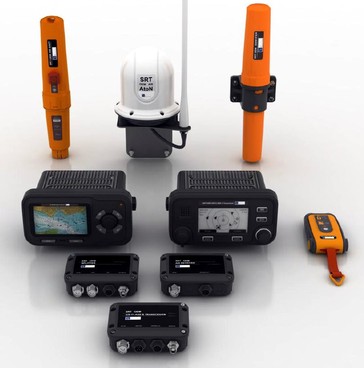
The AIS Summit began today in Hamburg, Germany, and SRT took the occasion to announce a boat load of newly available OEM AIS modules. Of course that means that other companies have to brand and sell the gear above — or build their own devices based the same internal technology — but I have reason to believe that in at least one interesting case that will happen soon, and, in fact, several of the items above seem like they will be interesting products eventually…
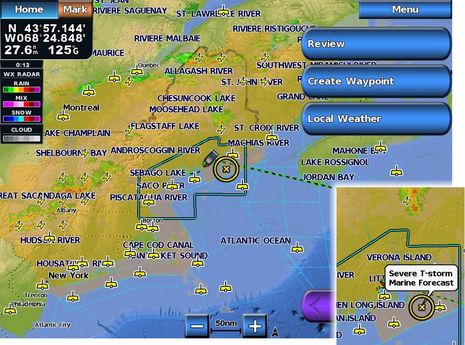
An energetic but somewhat chaotic frontal system passed over Maine last Thursday afternoon but I was able to keep on boating largely thanks to Garmin’s new GDL 40 cellular weather system, which I’m getting to test somewhat ahead of the shipping date. The severe thunderstorm warning that headlined most of the NOAA coastal forecasts might have kept some people off the water. (The forecast areas greyed out on the screen above all have some sort of warning, as shown in the inset, as well as the full text, which can be called up.) But the animated Nexrad precipitation radar, along with lightning strike data, indicated that that my bit of Bay was going to enjoy a frontal hole…
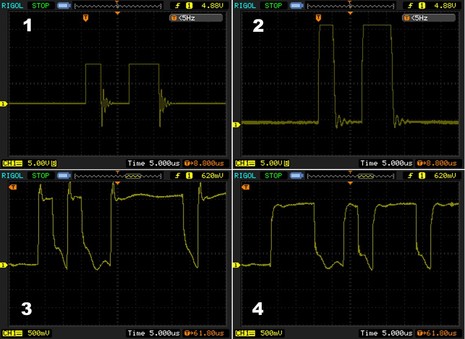
Maretron’s Rich Gauer has repeatedly tried to explain to me how NMEA 2000 is an impedance-driven networking technique and that’s why it’s so important that the cabling have the right electrical characteristics with the proper termination. He can get quite passionate about the subject, almost poetically describing clean waves of N2K data bits getting distorted by reflections to the point that microprocessors along the backbone can’t recognize them anymore. But then again Rich is an electrical engineer and Maretron may well have more troubleshooting experience than any other company with the large N2K networks where impedance problems tend to show up. Installs or other manufacturer’s gear that cause trouble because the impedance rules aren’t abided to gets him upset! However, a guy like me is way better at visualizing the dynamics of a hull passing through ocean waves, and I couldn’t begin to fathom the “Transmission Lines, Reflections, and Termination” PDF Rich once linked me to. Which is why I am especially taken with the graphic N2K analysis (above) that our friend Kees Verruijt posted on his Yacht Electronics blog…
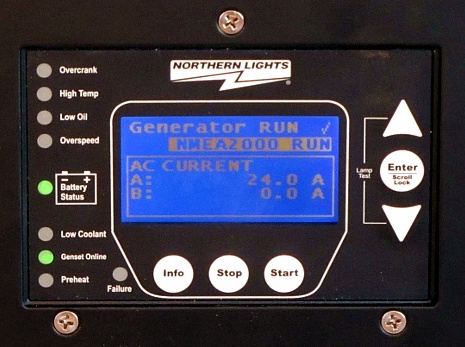
When Westerbeke developed a NMEA 2000 monitoring and control head for its generators way back in 2006, I thought the other generator manufacturers would follow right along. The approach seemed to simplify cabling and make it possible to at least monitor a generator from other displays if not actually go to the next level where, say, a NMEA 2000 inverter could turn the generator on and off as AC loads changed. To my knowledge that sort of advanced control has not happened yet, though in fact a check of NMEA’s database of standard PGNs suggests that it is possible (look in the “power” category). One problem is that so far only Northern Lights seems to have followed Westerbeke’s lead, with the WaveNet panel seen above…




Recent Panbo Comments