Category: Network & control
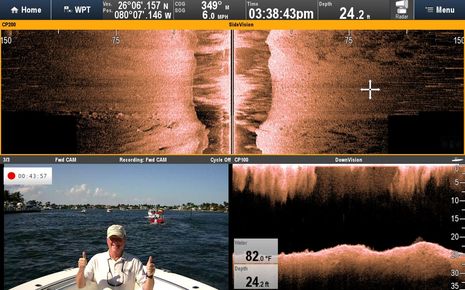 While I was just goofing around during the Raymarine demo cruise seen via screenshot above, in retrospect my thumbs are seriously up about both the new CP200 CHIRP SideVision sonar and the new CAM200IP marine camera. I’ve been on the water twice now with SideVision and it seems to have noticeably greater side looking range than the Navico, Garmin, and Humminbird side imaging I’ve previously experienced; there are numerous factors at work here, though, and they’ll have to wait for a future discussion. Today I’m writing about advanced boat cameras, particularly the CAM200, which could be an excellent addition to most any boat running Raymarine LightHouse II software…
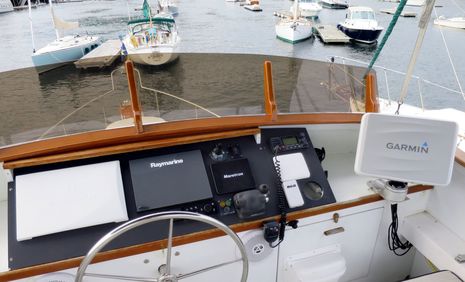 Redoing almost all of Gizmo’s electronics has taken longer than I would have guessed last fall, when it seemed like a good idea to rip everything off the boat. And sadly I’m not done yet. But the hoped-for glass bridge theme is revealing itself and I like it a lot. But then again new equipment and even just re-installed old gear also means fresh opportunities for things not to work together correctly. In this entry I’ll go over much of Gizmo’s test setup for the next year and a half — though by design there’s room for more — and also note a couple of features that have worked well and not so well during recent shakedown cruises…
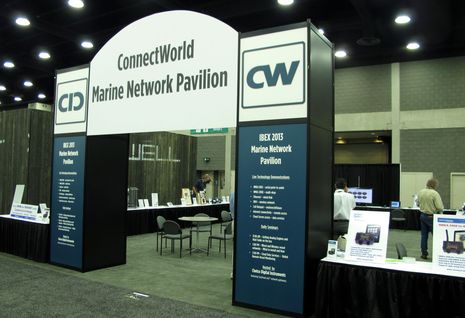 A surprise high point of last year’s International Boatbuilders Exhibition (IBEX) was ConnectWorld. For several years the National Marine Electronics Association (NMEA) had staged a substantial ConnectFest NMEA 2000 networking demonstration on the show floor — remember the Fish Gate 100? — but for some reason they dropped out in 2013. I was skeptical about a hurried effort to keep the idea alive managed by a manufacturer instead of NMEA. What I found, however, was that Chetco Digital Instruments had put together a nice demonstration of multiple brand devices sharing data across multiple networks. While NMEA 2000 made a lot of it possible, there’s some great development going on beyond the N2K backbones and I’m excited about what we’ll see in Tampa at IBEX 2014…
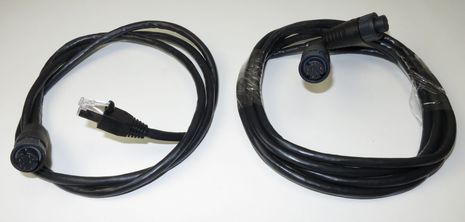 It’s not an exciting photograph, I know, but cables are a fairly big deal when you or your installer get down to the real nitty-gritty of putting a marine electronics system together. While it’s great that the NMEA 2000 cable and connector standard is pretty much taking care of lower speed sensor networks regardless of equipment brands, the sore spot now is the Ethernet cables used for high speed data like radar, sonar, IP cameras, and chart sharing. Though standard Ethernet cables easily connect many different devices in our homes and offices, in the marine world the connectors are not standardized. In fact, some Raymarine customers are dealing with two proprietary Ethernet connector designs as the company transitions to the Raynet plugs seen above. But Raynet makes sense to me and shouldn’t cause undue pain once all the available options are understood…
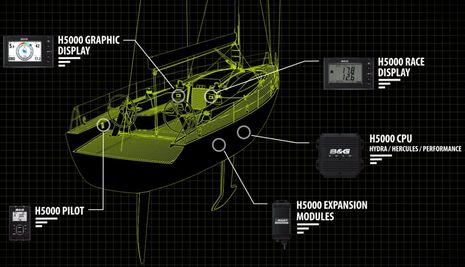 At the METS 2013 show in Amsterdam last month B&G unveiled their new H5000 range of sailing instruments and auto pilots. Unlike the Triton range which is meant for recreational and club racers the H5000 series is designed for high end cruisers and all levels of racers (from club to round-the-world), and replaces the H3000 series. B&G’s racing reputation stems from the capability of their systems to make corrections to the raw sensor values and deduce derived values at high rates. Cruising systems do basic smoothing of raw sensor values (wind, boat speed) and some computations (remember the Panbo discussion on calculating true wind?) but nothing else. The H5000 range can do much, much more. For instance all systems compensate the wind speed for heel and trim angle, there are advanced MOB features and the autopilots have special gust and high-wind response modes.
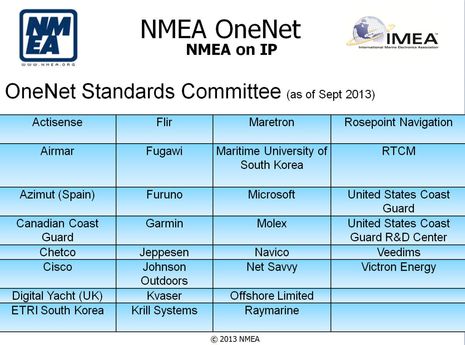 OneNet is the NMEA’s ongoing effort to create a subset of Ethernet and Internet Protocol (IP) standards for marine electronics. It won’t be fully released for two more years, but I liked what I heard (and could understand) in a September seminar delivered by NMEA Technical Director Steve Spitzer. When I first wrote about OneNet, for instance, some skeptical commenters could only envision it as a way for the major manufacturers to keep small developers out and profits up. But that seems paranoid when you consider the wide variety of organizations who are volunteering time and expertise to create OneNet…
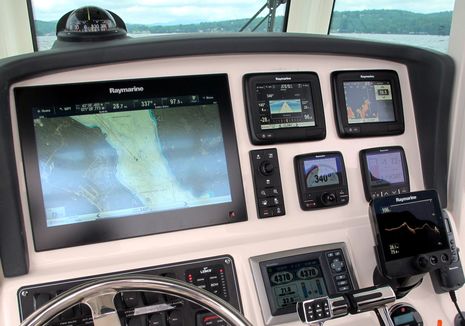 Yesterday I enjoyed a few hours on Lake Winnipesaukee, New Hampshire, aboard a Boston Whaler 280 Outrage recently fitted out as a Raymarine demo boat. Much of what I first saw introduced in Miami last February is now shipping and working in impressive ways. Note, for instance, how the “low end” Dragonfly sonar/plotter is holding bottom in DownVision mode at more than 75 feet and 28 knots. And if it weren’t for the camera-exaggerated glare you could also see how bright and sharp the “high end” gS125 Glass Bridge display was looking. I became particularly enamored of the new RMK-9 keypad that gave us hybrid-style control of not just the gS but also the two a6x MFDs…
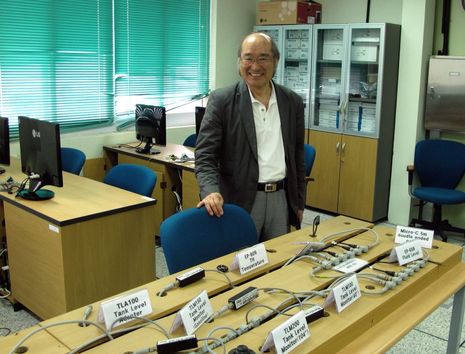
I so appreciated getting to know Dr. Yung Ho Yu — known around the world simply as Dr. Yung — at the Korea Maritime University in Busan, and I think you will too once you realize how much he and his programs are doing to advance marine electronics and improve the standards that make them inter-operable. For starters, take a close look at the NMEA 2000 teaching lab surrounding the good Doctor. The twenty work stations are all gatewayed to an extensive N2K sensor network so that students can experience and even interact with the protocol right down to the bit level as the instructor demonstrates from his work station. I’d like to be wrong, but I doubt that there’s a similarly powerful teaching and research tool anywhere else on the planet…
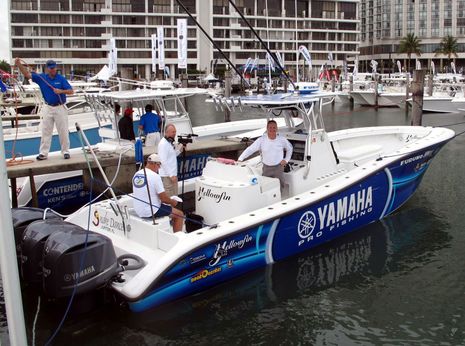
When I was at the in-water powerboat portion of the Miami show before it opened one morning, I discovered Furuno marketing manager Jeff Kauzlaric and product manager Eric Kunz making video. Of course I interrupted them for a photo but I was also hoping to see their long-rumored CHIRP fishfinder in action. But while it turned out that the big sonar screen behind Eric was not showing CHIRP, Furuno did announce the new DFF1-UHD during the show and Eric showed me the nifty NavPilot Safe Helm and Power Assist modes just about ready for release…
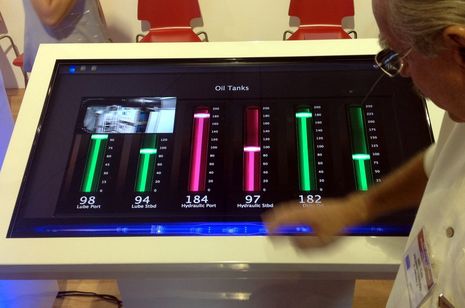
A Panbo search on Palladium Technologies will show you some very jazzy big yacht technology, much of it with a distinctly Apple style, like the SiMON2 iPad-based system installed on a futuristic Cheoy Lee Alpha 76 at the Fort Lauderdale show in 2011. This year, Palladium’s Lauderdale introduction was much more a prototype but it was also quite sensational. The idea behind SiMON Gold is to evolve ‘traditional’ SiMON monitoring and control along with video feeds, switching, and much else into a finger-gesture-managed megayacht multiple multi-touch monitor helm extravaganza. That’s Palladium founder Mike Blake pulling a data source off Gold’s sliding menu bar, which he could then drag and size easily to further build a particular monitoring screen, but actually that’s the most obvious feature…




Recent Panbo Comments